Crypto Customer Support: Meet Angry Users
Crypto support turns confused users, weak incentives, outsourcing, and young products into a direct test of trust.

Every technology matures through its first angry user. Not the type who falls in love with the beta release and enthusiastically shares her thoughts about the upcoming master branch - the kind that has a stake in the product’s performance. The one who clicked “buy” on the interface that was presented to her, read the terms of use in the manner they were offered, and now finds her funds stuck, transferred incorrectly, or waiting for a third-party confirmation that is taking forever to appear.
At this point, the chart of development milestones stops being relevant to the user. She does not care about the roadmap, the founder’s tweets about industry disruption, or the product’s ability to provide financial sovereignty. All she wants is for someone to tell her what happened to her money in a manner that does not involve talking to a chatbot.
Finance figured this out a long time ago, and while its institutions still suffer from the same issues, big banks, brokerages, payment processors, credit card companies, and insurers have evolved a set of rituals to placate the user and help her get her money where it is supposed to be. A customer service rep, a ticketing system, a call center, a branch manager, a regulatory-compliance desk, or a 24-hour helpline await the user’s phone call or an online form with her inquiry. In her most desperate hour, she might have the option to speak directly to someone in the regional office. The customer is never delighted, but she is reassured that an appropriate authority is always available to help.
Crypto was not built on this philosophy. Its early adopters reveled in the dismissiveness of the technology: if you lose your keys, too bad, you are welcome to use this free-to-mint memorial coin on our blockchain so your loved ones can send you ETH from the beyond. If you sent your tokens to the wrong address - the blockchain does what you told it to do. The user is responsible for making sure she did not make any mistakes, because there is no one to whom she can appeal once the transaction is confirmed. Code is law, and the law does not answer customer support requests.
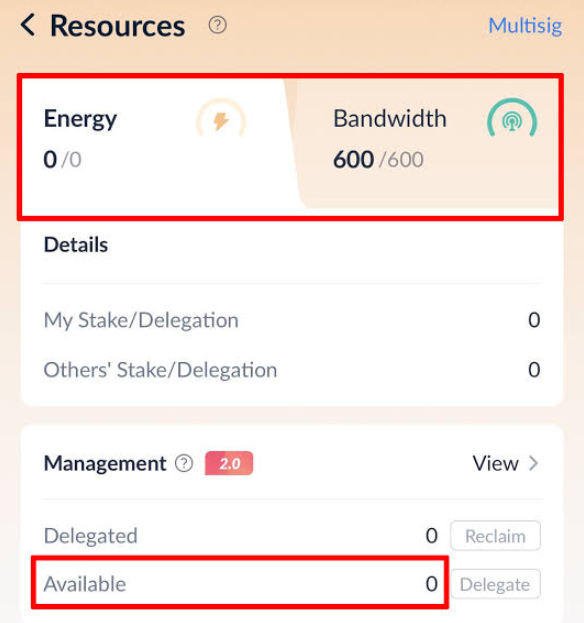
This approach may have resonated with the technically sophisticated early user base. But as crypto products began targeting a more mainstream audience, the same philosophy started to produce friction. The newcomer did not want to think of a crypto wallet as a beautiful ceremony around her life savings. She wanted something intuitive, reliable, trustworthy - like a mobile banking app. And so, while USDT remains a great idea, a TRON user has no reason to understand why she cannot simply send her tokens to her friend’s address, or why she should not spend her remaining Bandwidth on a small top-up when her Energy is already at 0%. She does not want to be a blockchain expert - and more importantly, she does not want to be a blockchain expert when she just sent 3 ETH to a smart contract that promised to let her claim her NFT, only to realize it has a “claim” function and a “withdraw” function, and they do very different things.
First Angry User: She is Not an Edge Case
Large exchanges are already employing customer care professionals in a manner similar to traditional finance, because they had no choice. Coinbase, Binance, and Kraken are losing users to competitors in an extremely competitive environment where each transaction fee represents a hard-earned dollar. These companies have dedicated help centers with ticketing systems, phone trees, and escalation procedures, and even those are not sufficient to prevent users from complaining that their accounts are frozen, their withdrawals are stuck, the customer support is not human, and their lives are already miserable enough without the cryptocurrency industry choosing this moment to extract another $50 in fees.
The newcomer crypto project typically does not have such luxury. Its initial support is likely to be provided by the founder him/herself via Telegram or a similar medium, who is happy to spend time on each user’s request and solve their problems, because she is the only one available and her time is better spent growing the product. The early users feel like they are part of something special - and they are right to feel this way, because the founder probably spends her evenings debugging the contract for a critical bug that could have occurred.
The project grows, more questions arrive, and the founder is no longer able to spend hours on end trying to parse wallet addresses and explain how the chain reorganization worked in the last upgrade. The company hires its first customer support specialist - and this is the point where crypto starts to really hurt. The support desk is a critical stage in the user’s journey, where the company determines whether it will earn and retain customers for life or drive them away in frustration. And the first customer support rep has just been hired.
The new support agent reads the onboarding documentation, reviews the frequently asked questions, and spends a few days observing how the more experienced (and busy) colleagues treat the users’ inquiries. She is confident that she knows more than the user, because she spends her time studying the product, while the user has only her Telegram messages and the web interface to rely on. And yet, the new agent has little idea what to do when the user asks if she can get a refund for a large transaction that was sent to the wrong address, or why her recent transactions have started to take significantly longer to confirm, or if she has any chance to recover her tokens after her wallet was robbed in a phishing attack.
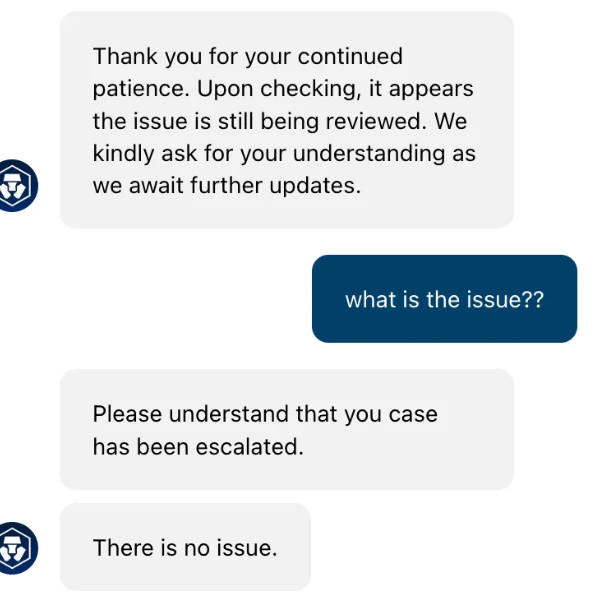
This is the agent’s fault - and it is not. She was not expected to know everything. The product is young, the user base is small but growing, and the documentation is still being written. The support team barely has enough time to reply to the users’ questions, let alone improve the product based on the knowledge it gains from them. The agent feels her responses are good enough - after all, she has the knowledge the user does not have, and she uses friendly language to keep the user calm. But the user notices the uncertainty in the support agent’s tone and realizes that nobody really knows what is going on. If a simple question about transaction fees or account freezes can lead to a multi-day long conversation with no resolution, what will happen if she asks a truly difficult question?
Emerging technologies in general, and crypto in particular, tend to suffer from this growing pains phase disproportionately affecting the customer support team. Software companies of all kinds realize that the customer success team is frequently the weakest link, where inexperienced staff is thrown into a competitive environment with little training, documentation, or resources. The first wave of users gets exceptional support from the founder him/herself, which creates high expectations for the next users, who are then served by an overwhelmed and underprepared team. Even more challenging, the company frequently fails to incentivize support representatives to truly care about the user’s problems, because the cost of support can appear prohibitively high, especially for a young company.
Outsourcing the Confusion
The economics of support are challenging, because good support is expensive to provide. Language proficiency, product knowledge, emotional intelligence, and patience are not cheap skills to acquire - and crypto adds years of technical expertise on top of them, including knowledge of wallets, chains, bridges, block explorers, smart contracts, phishing techniques, and other unique challenges. Many young companies are forced to outsource their support operations in order to survive the high costs and unpredictable demand patterns.
This is where crypto’s challenge with customer support tends to peak - because not only is the product difficult to understand at the best of times, but many users will find themselves talking to someone whose fluency in English (or any other language, for that matter) is limited. Support agents typically receive very little training beyond product specifics, and the quality of their English proficiency varies widely. When a user sends a message that expects a carefully-worded response, the agent has to reply in good English while attempting to explain very technical concepts in simple terms. If his English is not perfect, it is very easy to make mistakes and turn potentially reassuring statements into accusations of irresponsibility.
It is also hard for the agent to admit that he does not know the answer, because users frequently assume that they are speaking to the company directly. If the user feels misled by bad English, she is likely to take it out on the agent and even accuse the company of dishonest practices, such as stealing her funds or intentionally keeping her balance inaccessible. The separation between the agent and the company he represents is not real to the user - and it should not be, because the user has no reason to believe in this separation.

This is not to blame the support agent for the shortcomings of the system he is a part of - his job is to handle the users’ requests, not to fix the product’s problems or rewrite the company’s documentation. But the agent has little incentive to do what is best for the user in many situations. He can be fired for spending too much time with one user, or penalized for escalating a complicated issue that is best handled by senior engineers or the product team. He is paid to be helpful and polite, but his compensation is unlikely to be tied to actual retention or growth outcomes. If he can get away with providing shallow, generic answers in order to move on to the next user, he will do so, because his motivation is to get paid. He does not have any reason to believe that a user will return to the product he is asked to support.
This dynamic is dysfunctional to both parties. The user deserves a competent and straight answer to her question. The agent deserves an opportunity to do his job right without threatening his livelihood.
Incentive Problem
The issue is rooted in incentives. Customer support is frequently staffed on a shoestring budget, with agents operating on metrics such as tickets closed, first response time, talk time, and escalation rate - with very few companies tying financial rewards to customer retention and lifetime value. And the fault is not the support agents’: they work for a living, just as anyone else. Company executives do not expect the support team to behave as if they possess some magical customer-centric mindset at all times, because the belief in the “customer obsession” is typically reserved for the product team.
Most customer support agents would love an opportunity to do a better job without having to sacrifice their own financial stability and career prospects. An agent whose work directly impacts the company’s ability to retain paying users will behave very differently than one who is simply told to resolve each ticket in the shortest possible time. She will spend more time educating the user, guiding him/her toward product features that will reduce future support requests, and advocating for deeper product improvements based on the recurring issues she observes. If she is rewarded for reducing churn and increasing upsells, her actions will have a far-reaching impact, compared to the agent who only gets a bonus for closing tickets.
The problem with this approach is that no company wishes to allocate significant resources to customer support, let alone tie the support team’s compensation to broader business goals.
Customer support operations always feel like a cost center, even when they are technically not. The support agent’s work is indispensable but difficult to recognize, because she mostly handles the tasks that nobody else wishes to do - namely, deal with unhappy users. This is why we see so many support agents at the lowest tier of the company hierarchy, with no opportunity for career advancement beyond their current role.
The customers should not be blamed either. They are rational people who behave as one would expect from any dissatisfied user. The customer will seek an easy, expedited solution to her problem, and she will not hesitate to take advantage of any weaknesses in the support infrastructure. If the company offers poor support, she will punish it by not returning after her issue is resolved. If the product is complicated to use and her mistake is costly, she will blame the company, not herself - and she will share her criticism freely on social media.
The CEO typically behaves much the same way. He wants to maximize retention and drive growth, but in practice, few executives think of customer support as an enabler of these lofty aspirations. He is more likely to believe that sales drives growth, engineering delivers value, and marketing spends money to attract the users the product will retain. Customer support is a necessary evil, because it handles the aftermath of these functions’ mistakes. If the CEO really wants to help the support team, he only has to recognize its role in the business, align the compensation strategy, and ensure the support team has the resources it needs to actually help the product and the company.
No Small Roles
Trust is a cornerstone of crypto, but users tend to be demanding when it comes to trusting the companies they use. Even the blockchain’s most enthusiastic proponents frequently forget that they are using a financial product - one that requires users to place trust in an interface to understand reality and accurately convey their intentions to the underlying cryptographic mechanism. Users trust that their wallets will keep them honest, that bridges will explain their limitations, that exchanges will not confuse phishing attempts for legitimate operations, and that customer support will always tell the truth, even when the truth is inconvenient.
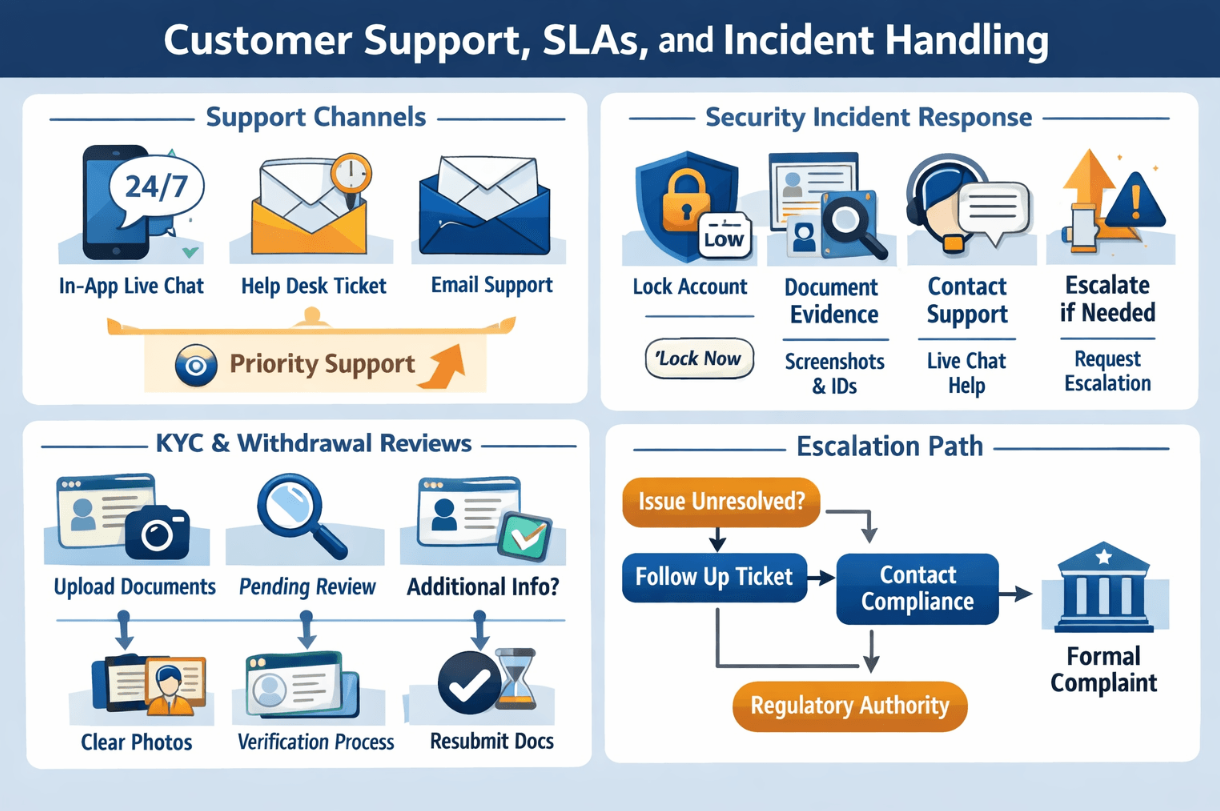
Crypto support teams occupy the front line of this battlefield, shielding the rest of the business from the users’ understandable skepticism. Some of the most competent crypto support agents are actually excellent translators: they render block explorers into plain language, engineering uncertainty into concrete next steps, user panic into a reliable set of actions, and regulatory restrictions into something the user feels heard. The same support agents serve as company advocates, protecting the organization from its own missteps and frequently uncovering product or infrastructure issues long before they appear in the operational dashboard.
Support agents’ roles should not be underestimated in any of these capacities. The product roadmap needs to evolve alongside the users’ needs, and the support team frequently observes the most pressing challenges first. A pattern of tickets asking about the same issue, however “simple” it may seem, is a roadmap item in disguise. If users consistently ask why their funds are inaccessible while their tokens appear to be on the correct chain, this is an indication that the status screen should be reworked. If the support desk receives frequent inquiries about the same type of scam, it is an opportunity to educate the users and reduce exposure. If the user keeps asking the support team to refund the fees associated with a single transaction because she sent her tokens to the wrong address, this is an opportunity to rethink the design of the transaction flow.
Management plays a vital role in making sure the support team has an impact proportional to its efforts. An agent who feels empowered, adequately compensated, and rewarded for advocating on behalf of the users is likely to go above and beyond their regular duties and responsibilities. They will do more than point the user to the relevant documentation or remind him/her that the company is not responsible for the transaction costs - they will actively work to help the product reduce these costs. Agents who are encouraged to engage with product stakeholders are more likely to provide meaningful feedback based on their frontline insights. And agents who are not stressed about keeping their talk time down are more likely to listen to what the user needs, not just what the user asks for.
Essentially, no role in a company is truly small - only underserved, typically by default.
Receptionists at law firms, nurses at hospitals, tellers at banks, and customer support agents at crypto companies all play an integral part in their respective organizations. They represent the company to the outside world and, critically, serve as the first line of defense against users who are confused, scared, and angry. Most of them would like to believe, as the CEO does, that they serve the users by helping them get the support they need in their time of need. But the users are not likely to have this conversation with the support agents: they are likely to think that the company made them angry in the first place. One bad interaction is all it takes for a user to abandon a product for good - and the company will be left to waste precious resources trying to convince the user that they were wrong to blame the company.
Crypto wants to achieve mainstream adoption, but it must realize that adoption will require tolerating large-scale user frustration before it can graduate to the next stage and earn the loyalty of the mass market. Newcomers to crypto will not enjoy learning the fundamentals of self-custody, blockchains, wallets, transactions, Energy, Bandwidth, bridges, and so on. They will expect this burden to fall squarely on the shoulders of the companies they trust to provide an appropriate explanation. The businesses that will thrive in this environment are the ones that recognize their responsibility to educate their users, because they understand the alternative: to ship a superior product and still lose the users due to poor support.
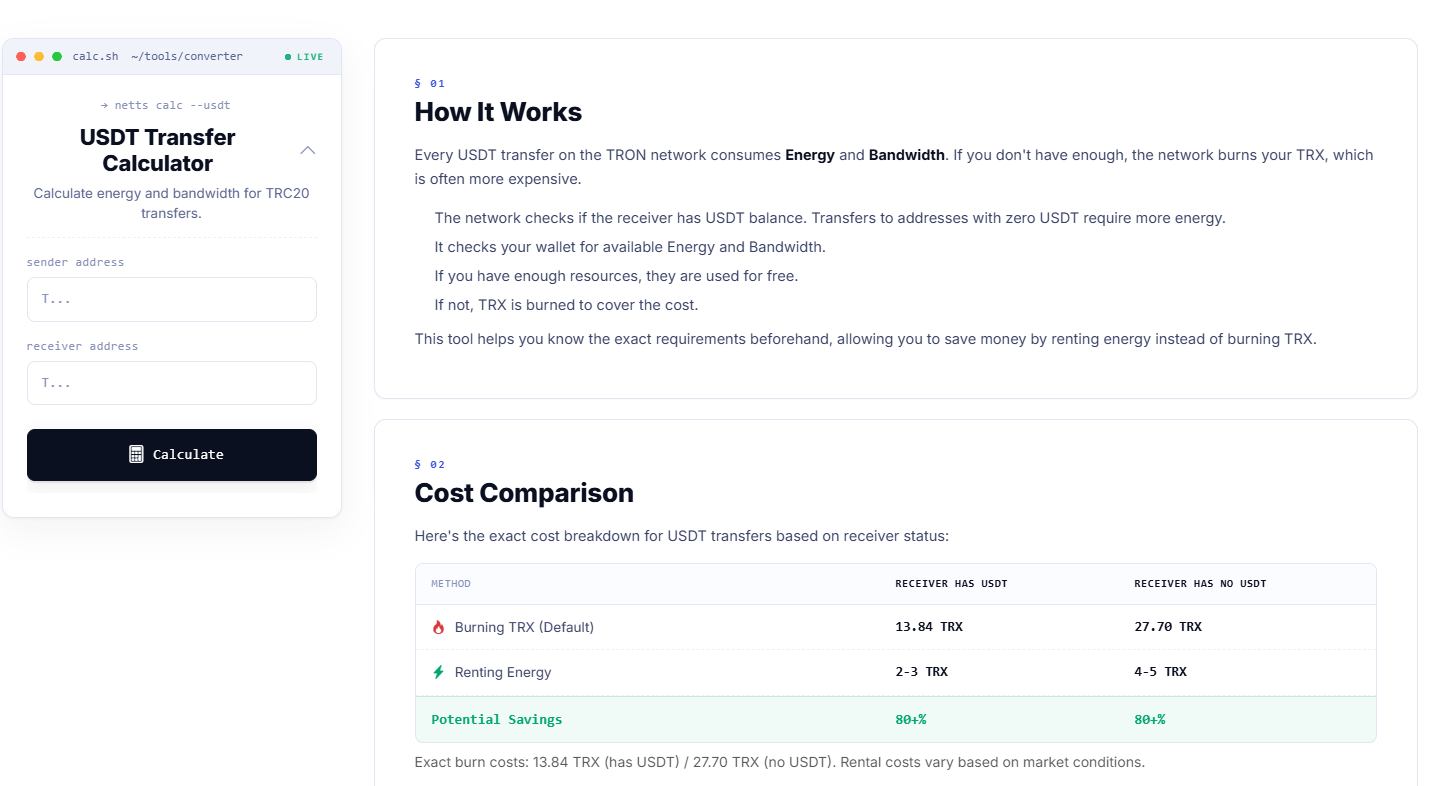
Netts.io’s USDT Transfer Calculator allows TRON users to estimate how much Energy and Bandwidth will be spent on transferring TRC-20 USDT.