The Vitalik Doctrine: Buterin's 2025–2026 Essays as Political Theory
Buterin's 2025 essays as political theory — the worldview behind Ethereum, where it holds up, and what it reveals about power and society.

First things first, let us clarify that Vitalik Buterin is a literally strange fellow. Not unusual in the way that tech executives have learned to do unusualness — a little noticed eccentricity of planning, or perhaps a fashion cue, or maybe an iconoclastic assessment uttered as if by instinct. Really weird, in that somewhat unique way that occurs when someone's brain is basically on a different firmware cycle than most of the people in their vicinity.
He helped to launch Bitcoin Magazine at seventeen. At nineteen, he left the University of Waterloo after winning a Thiel Fellowship and released a paper that was essentially an argument for a cryptographically-fuelled world computer. In January 2014, he introduced Ethereum in Miami where his twenty-five-minute address was delivered without notes and included improvisational discussion of crop insurance, decentralized autonomous organizations, and the nature of trust. He was only twenty years old. At twenty-one he was running a multibillion-dollar global open-source project with thousands of developers. His bronze medal at the 2012 International Olympiad in Informatics almost seems like a side note.
Real, too, are the personality quirks. As a child, he cites a nerf to the Sorcerer's fireball spell in World of Warcraft as an early example of what centralized control could do for human suffering. According to him, he has wept over that experience. In 2021, he donated 1.14 billion dollars in SHIBA Inu tokens for the COVID relief fund of India which led to fifty percent fall in the token price. He then presented 336 million dollars of Dogelon Mars tokens to the Methuselah Foundation's care on a multi-year anniversary, causing that coin to collapse seventy percent too. He made a 760,000-dollar donation in 2025 to privacy-focused messaging apps SimpleX Chat and Session. He has honorary doctorates and goes to academic cryptography conferences. On the first day of Russia's invasion of Ukraine, he tweeted that while Ethereum was neutral, he was not.
What goes through the head of a person like that? The truth is we can never know for sure — but unlike most figures with such influence, Buterin writes a lot about what he thinks. His homepage is a blog that spans dozens of essays, stretching from cryptography to the details of governance, economics theory, AI risk, privacy practices and open source licensing as well as political philosophy. The essays from 2025 onward especially stand as an entire worldview in and of themselves, suitable to read — not simply as a technical commentary by a blockchain developer but as political theory from one who has both thought deep about how power works and is qualified to reflect what it is like firsthand to sit at the center of a decentralized system that quite literally much of the world wants very much to influence.
The Worldview
This immediately runs into trouble, though; this itself is revealing. He is far from a libertarian in the usual sense, although certainly individual freedom and decentralization matter a lot to him. He is not a believer in technocracy; however, he does believe that good systems (well-designed) can lead to better results than bad ones (ill-designed). He is not a traditional liberal and he is not a traditional conservative. As forced into a box, I suppose he is something like a pluralist institutionalist committed to — if one can call it that — individual privacy, and with an almost ironic skepticism of concentrated power in any form and unusual willingness to think about really long time horizons.
The directness of the essay "Let a Thousand Societies Bloom," from December 2025, draws it closest to us. Buterin reviews the phenomenon of new communities, cities and governance trends (network states, charter cities, seasteading experiments, Freetown Christiania and Balaji Srinivasan's coordi-nations). It's a cataloguing tone: he plots the terrain along several vectors, observes that these projects either want radical legal autonomy or take a gradualist approach, and compares the current moment in the movement to crypto five-to-ten years ago — early, fragmented, at the edge of institutionally possible but something material. This framing exposes a fundamental attitude: Buterin does not necessarily view existing nation-states as ideal, but he also does not regard them as something that can or should be swiftly replaced. He wants the experiments that will demonstrate what the up-next layer of governance infrastructure might be.
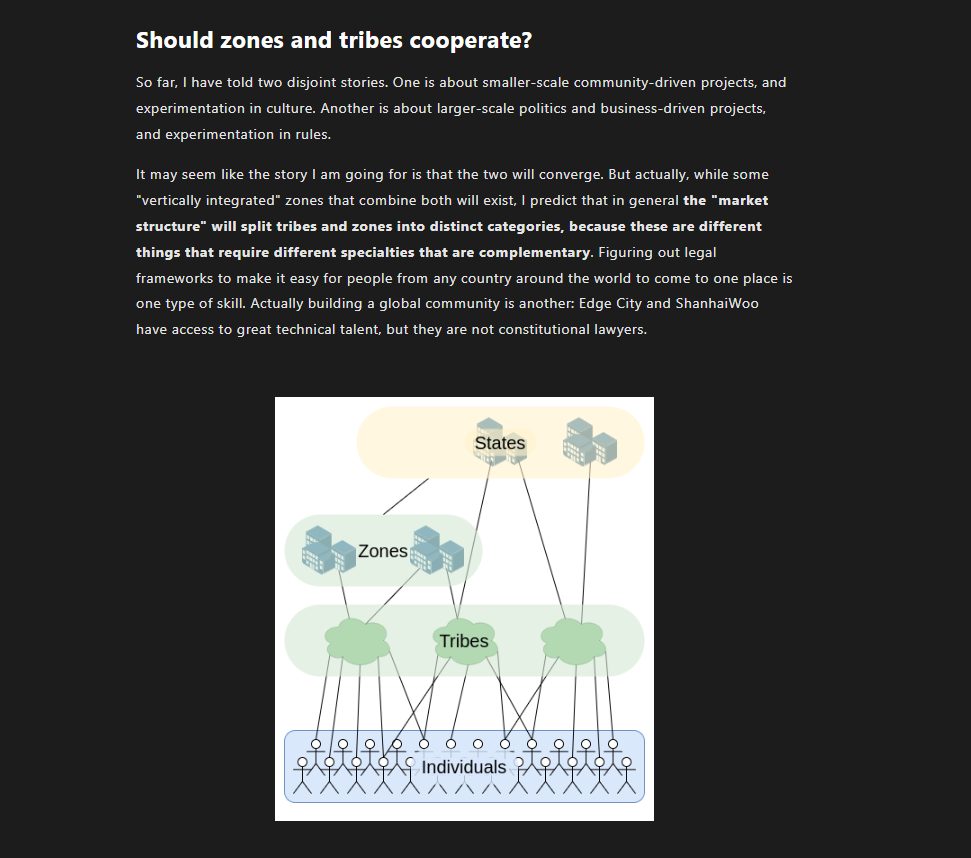
This has historical parallels. The Federalist Papers were written by people who, similarly skeptical of received political forms, are trying to design alternatives from first principles while in the midst of an active political project. Logical positivists in the Vienna Circle systematically subjected matters which had previously been treated by intuition to empirical investigations. The early twentieth-century institutional economists — Veblen, Commons, Mitchell — evolved path dependency frameworks that Buterin's tree ring model mirrors. In his essay "The Tree Ring Model of Culture and Politics," March 2025, he contended that political discourse and institutional reality function at different timescales: the dominant ideology of one era is structurally embedded in laws and institutions while later ideological faces layer themselves on top but do not erase earlier selves. The argument in the outer circle — what is being debated by the press at this moment — reveals an astonishingly small amount about what governs behavior. This is the application of Gramsci's notion of cultural hegemony through institutional economics, served without footnotes and with an ongoing explanation for why neoliberal rhetoric never did actually roll back the state: because the underlying elements were still load-bearing.
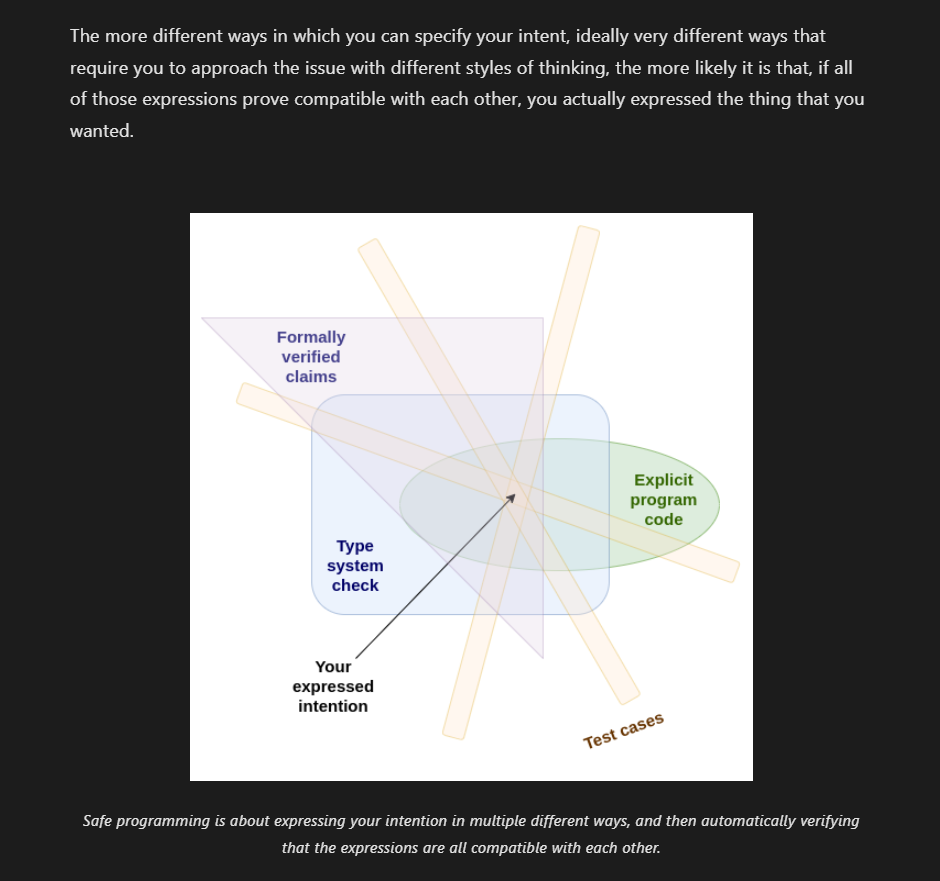
Galaxy Brain Resistance, from November 2025, is one of his most practically interesting. It contends that reasoning systems should not be judged by their ability to reveal the right conclusions, but whether they can be easily subverted into asserting wrong ones. Consequentialist reasoning, he claims, has low galaxy-brain resistance: since it asks what produces the best outcome, a sufficiently clever reasoner can be led into almost any conclusion through a series of plausible-sounding connected steps. Rule-based thinking — deontological frameworks, hard commitments, bright lines — is less manipulable exactly because it does not yield to cunning calculations of outcomes. It reads like something that quotes itself, his pithy summation: "If your arguments could justify anything, then your arguments imply nothing." Taking this to AI safety, he argues that a result-optimizing AI can be incrementally pushed into dangerous territory, because strong constraints are valuable precisely because they are difficult to reason about. This is not solely an abstract argument. It extends to smart contract design, protocol governance, and really any system — where adversarial actors will be looking for logical weaknesses in the code base that can be exploited.
April 2025 essay on privacy: Privacy is at least not a secondary consideration, but the very foundation of decentralization itself: whoever controls the information wields power — centralized data collection is not just a present dystopia, but an existential threat to crypto itself. He admits candidly that crypto prioritized P2P exchange in days gone by because the technical tools to implement it in a decentralized way simply didn’t exist. Today the omission feels like a choice, with zero-knowledge proofs well mature and homomorphic encryption coming of age. Specifically, his framing directly connects this AI moment to: because centralization of data analysis is enhanced by and thus the potential for an AI-dominated world totally corresponds with how rapidly privacy tooling becomes a necessary component – as urgent must-have capabilities available just when all the technical means necessary to implement them become possible.
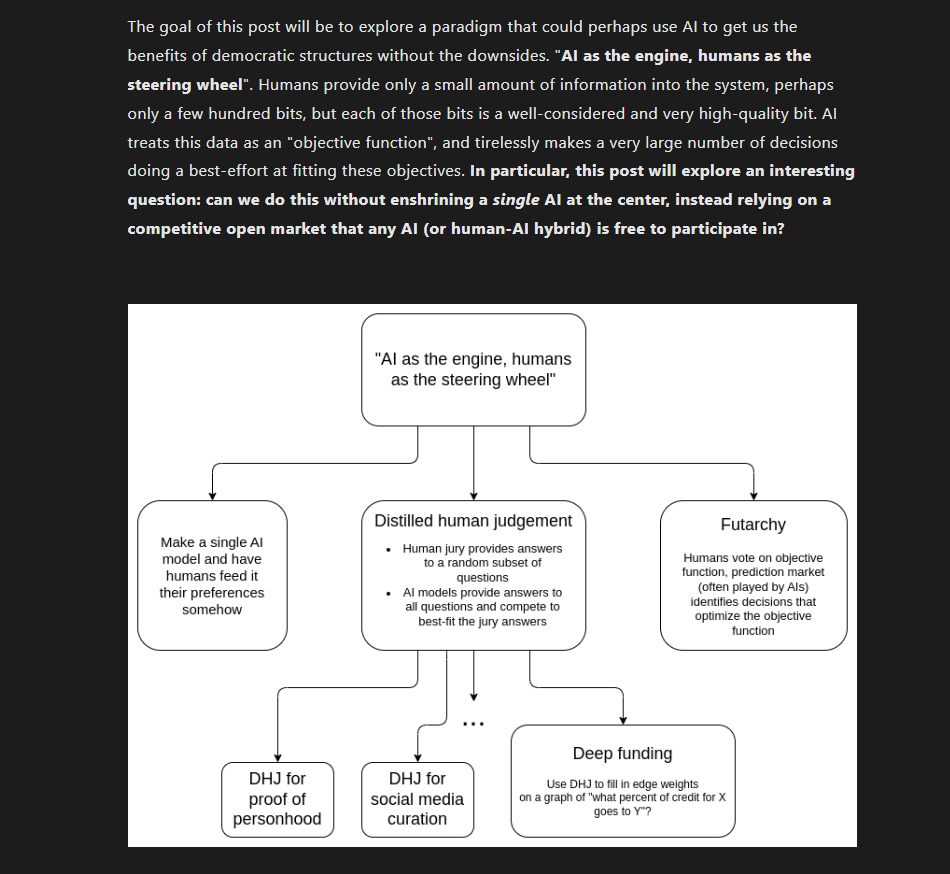
The essay "AI as the Engine, Humans as the Steering Wheel" from February 2025 is probably the one worth scrutinising most by anyone interested in political theory. Buterin argues that while democratic structures have real formal virtues — they stop power from coalescing and bring in multiple human value classes, but practical failures: stupidity at the vote, rational ignorance, and people's tendencies to imitate influencers instead of forming their political views. His proposed framework maintains humans as the ultimate source of values supplying what he calls "a few hundred bits" worth of very high quality input, and considers AI a mechanism for consistently enforcing returned value from this data on an industrial scale — but explicitly states that this must occur through an open market of competing models rather than a single centralized system. This is the politics of a person who has been reflecting for decades on structures to create systems wherein no single actor can poison the entire pond.
What He Gets Right And Where It Gets Complicated
But this part of Buterin's broader track record — empirically, at least — is really mixed (not very surprising considering how tough the questions and timeframes are), considering surrounding issues like NFTs.
He has been correct, and crucially early, about a constellation of things. At a time when most people thought of blockchain in terms of payment rails, he was right back in 2013 to frame Ethereum as more general computation platform. This price action, combined with his relentless focus on scalability issues — L2 development, the Merge, the technical roadmap — have bestowed piles of validation by virtue of Ethereum's actual path. Before the FTX collapse cataclysmically demonstrated those risks, his warning in 2022 about single points of failures in crypto infrastructure came. His claim that privacy was a base first-principle concern the crypto community had been engineering away looks prescient now, after we've seen AI systems turn people into their surveillant features. The d/acc framework — defence/accelerationism, approaching technologies in terms of whether they concentrate or decentralise power, for example — predates the safer AI discourse as we know it and has shaped it.
He's also been wrong, or at the very least not-right-enough on some things. Yet, the governance models he has espoused for Ethereum have not always panned out — on-chain governance possesses an inherently structural flaw in that token concentration hands large holders outsized sway, something Buterin himself has highlighted in writing, which often reads as a notably frustrated essay. A fair amount of his optimism over various uses for crypto in funding public goods financing and decentralized coordination did not scale to even remotely the levels he expected. This was satire, but some readers interpreted his April 2024 essay "degen communism" — which he characterized as "the only correct political ideology" — as a sign that his politics might be more sincerely radical than they seem in his serious essays; and the reaction to both revealed how much projection people apply to the dominant public image of him.
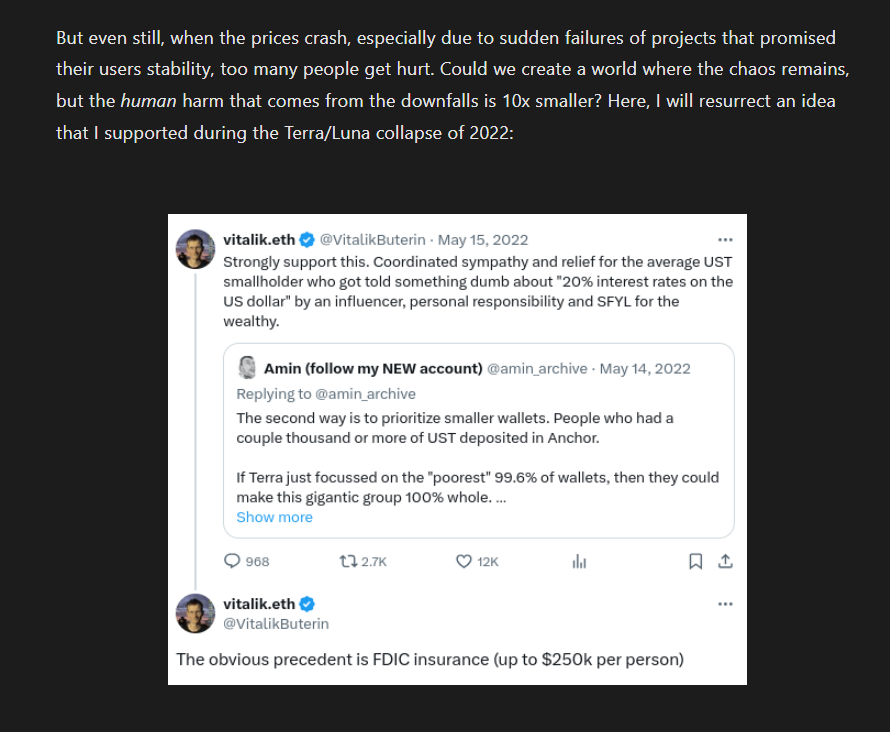
The targets are valid. His sway over Ethereum is massive, and the language of decentralization can disguise how much he still determines as an individual what path this protocol takes. Many of his more technical essays are written at an abstract level that read almost as gospel, and yet lends itself to being empirically unverifiable. The framing of AI and crypto governance he uses as a sort of "balance of power" is interesting, though perhaps underspecified — it's not entirely clear how distinct AI systems would compete rather than consolidate.
Why People Read Him Whether They Like It or Not
The reception of Buterin's essays in various communities is predictably revealing. In the Ethereum ecosystem they serve almost as official doctrine — he is often cited by developers and researchers, and when he takes a position, it tends to move the discourse even if those in disagreement with details. The response in the wider crypto community is more split: Bitcoin maximalists have long had doubts about Buterin, his complexity, and willingness to answer governance questions that the Bitcoin ethos regards as already solved; The DeFi and trading communities only interact as needed, absorbing aspects of protocol mechanics while sticking their eyes to the political philosophy.
In respect of crypto, the response is muted to patronizing. Most mainstream political theorists find his arguments engaging but undercooked — he is doing this without the scaffolding that academic political philosophy provides, and his empirical claims are sometimes made with too much confidence for the evidence. His writing is taken more seriously by AI safety researchers, especially the galaxy brain essay and the AI governance framework. Journalists write narratives about his personality and donations instead of arguments, he has said, somewhat frustrated.
His critics, of which there are many and all noisily, sometimes uncharitably distill his essays into simply naive techno-utopianism or a cunning defence for why the guy running Ethereum should continue to run Ethereum. Neither reading is entirely fair. The techno-utopianism charge misses how frequently Buterin explicitly tackles failure modes and limitations. The power preservation objection writing overlooks that his real actions — donating billions (see self-interest objection), publicly blogging about his own doubts, and pushing for governance structures which reduce his influence — are not the behavior of a person whose primary motive is just to remain on top of the pile forever.
What is true is that his essays occupy an uncomfortable space: they are the private musings of a person in possession of some serious public power brought to light, and they entail an authority based partly on that power rather than the quality of the arguments per se. Therefore, one paragraph on Vitalik's blog is functionally more powerful in the governance of Ethereum than another identical paragraph from an anonymous blogger, irrespective of relative merits. That is neither uncommon nor inherently bad — this is how influence operates — but it does mean that the essays cannot be understood in an academic vacuum.
The last observation to make is a structural one. Regardless of one's views on particular issues, the essays together illustrate something important, and too often in short supply: an ambitious man with actual power thoughtfully making public a consideration of the nature of that power and the systems it inhabits. The moral that one draws from a careful reading is not that Buterin is in the right — he isn't, and most of the time the interesting question is not whether he is right but where the limits of his framework are. To conclude, that even the exercise of trying to put together a coherent view of the world and letting it out into the public domain is worthwhile. The point is that on the surface that statement is disputable: the act of thinking about how to think in public keeps the argument going and going. The battle over what is right and wrong never ceases. It is just getting more interesting when the event by willing participants puts it on paper.

Operational efficiency at the blockchain layer is the underwhelming groundwork that enables higher-level work; for developers building on top of this infrastructure — whether TRON-based payment systems, stablecoin pipelines, or any application needing automated transfers at scale — that groundwork is what makes everything above it possible. Netts Workspace is the professional platform for that layer: Automated TRON app infrastructure management with smart energy delegation, purchase Energy API access secured by IP whitelist with multi-layer authentication, host mode for 24/7 continued Energy provision and complete financial management suite (CSV transaction export & referral commission tracking). The people thinking about governance and philosophy are operating on top of a stack built on transaction infrastructure that needs something to maintain it. If you are a developer, and you see all that data flowing through your workspace and getting indexed, now is the time to make it useful.