Renting Energy in TRON Network — the Airbnb of Cryptocurrency
In the following article, we take a closer look at the TRON Energy Market and Airbnb models and why it matters to both users and providers.
The sharing economy has revolutionized resource usage and monetization in the past ten years. Arguably one of the most recognized names in entrepreneurship today, Airbnb has shortened the distance between the stranger trying to rent out his spare room one weekend and the tourist right on the other side of the globe — from a phone call or an ad in the paper to an “instant booking” in a matter of clicks. Alternatively, digitally, the TRON network has managed to bring forth a similar revolution, albeit this one is primarily targeted towards leasing computing resources — namely, Energy. In the following article, we take a closer look at the TRON Energy Market and Airbnb models, the driving forces behind the nuances and why it matters to both users and providers.
Airbnb is a worldwide marketplace between property owners and travelers looking for temporary housing. Hosts can earn extra income by listing a home, apartment or a spare room in their home, and guests can look for a diversified possibility of accommodations typically at a lower price than traditional hotel lodging. The key to Airbnb is providing global access to an abundance of untapped assets — unoccupied rooms and entire homes.
The TRON network, however, is a blockchain-based decentralized platform aimed towards digital content, smart contracts and decentralized applications (DApps). Energy — a fundamental resource that TRON users need to call smart contracts and conduct transactions. Energy can be gained by freezing TRX tokens, or more simply by renting from others in the TRON Energy Market. It thus enables the sharing economy on the blockchain, analogous to how Airbnb allows for the efficient use of physical space.
TRON Energy vs Renting Real Estate
Whether it is Airbnb or the energy market at TRON, at its simplest core is the leverage of optimization of underutilized resources. In the real world, this means leasing out an extra room or an apartment. This translates to renting out excess Energy on TRON in the digital world. The parallels are striking:
Asset utilization. Airbnb enables property owners to generate revenue from idle space. Users can also rent out any excess Energy they may have on TRON, and receive TRX in exchange.
Availability. The Airbnb method introduces a completely different avenue of lodging options for travelers. TRON Energy Market makes it easier and cheaper on users who do not wish to freeze their own TRX to make transactions on the blockchain.
Flexibility. Both models provide flexible terms. An Airbnb host can rent out an entire space for a night or a month; while a TRON Energy provider can delegate Energy for hours or days based on demand.
Marketplaces. Airbnb connects hosts and guests on its platform. On TRON, platforms like Netts.io aggregate Energy providers to ensure renters receive the best rates with instant access.
Nevertheless, while similar in many respects, they are also different. Airbnb deals with physical properties. The TRON Energy Market is completely digital, and all transactions are completed through smart contracts and blockchain protocols. No cleaning service required, no exchange of keys, just a few taps and Energy is delivered.
For instance a couple who transformed their dormant guesthouse into a profitable Airbnb listing might welcome travelers from all over the world, manage to save enough to travel themselves and even complete some home improvements along the way. This is a story many cities can relate to over the world, where the rise of Airbnb has transformed normal citizens into micro-entrepreneurs.
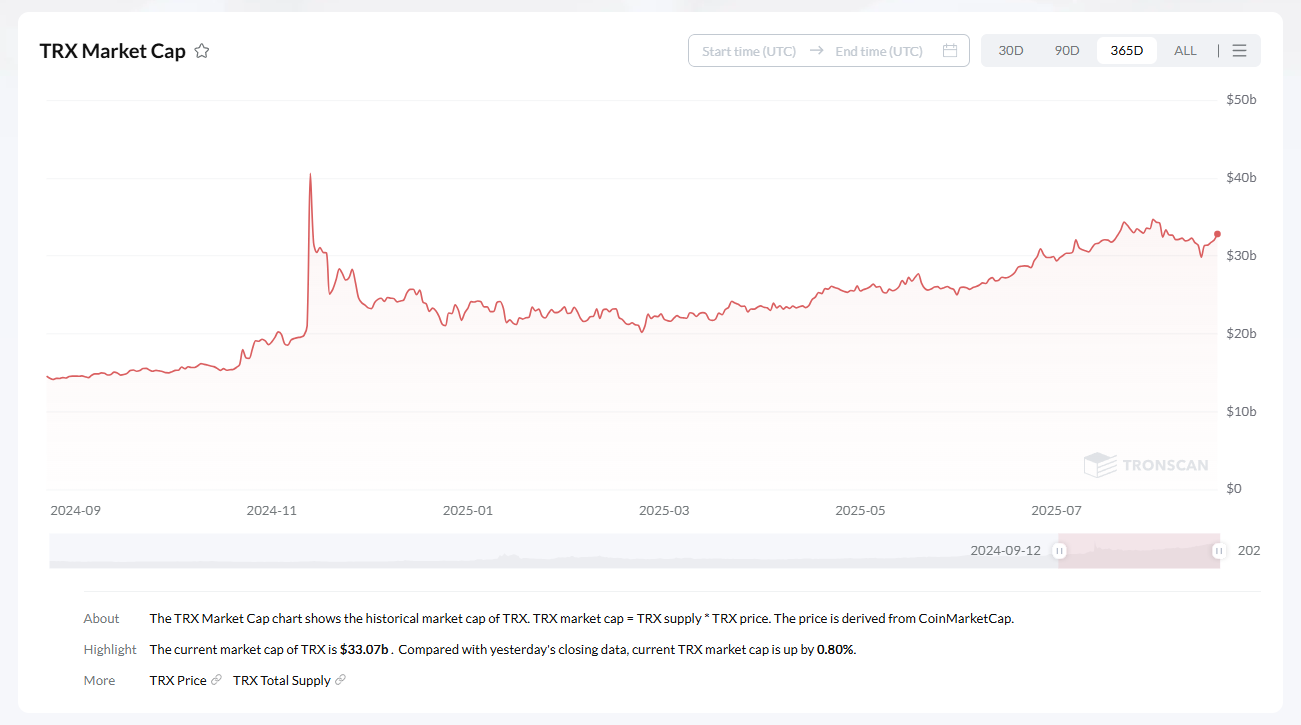
Ok, now how about the digital side? Let's say a TRON user has gathered plenty of TRX over time. Rather than letting them sit idle, they freeze their tokens to produce Energy to rent it out in the TRON Energy Market. By delegating their spare Energy on platforms like Netts.io, they earn passive income — sometimes enough to cover their own transaction fees or even turn a profit. Similar to how an Airbnb host maximizes their property value, TRON users maximize their digital assets, which is evident from TRX market capitalization as of now:
On the renter's side, the parallels continue. For hotels, these may be travelers who opt for Airbnb due to price and/or differentiated offerings. For example, a developer (or a crypto enthusiast) who wants to run several smart contracts might choose to rent Energy on TRON to save cost without the tedious work of freezing their own TRX. Platforms like Netts.io facilitate this without any challenges, aggregating from more than 20 providers and ensuring that users always get the lowest price available.
Differences: Physical Assets, Regulation and Market Forces
Although the core idea of renting underutilized assets is shared between Airbnb and the TRON Energy Market, the distinctions are also equally fundamental:
1. Tangible things: Airbnb properties are physical and require maintenance and cleaning. TRON Energy rentals are indisputably digital; they require no tangible maintenance.
2. Regulatory environment: the real estate rental market is fragmented, in that local laws, taxes, and regulations differ greatly from region to region. The TRON Energy Market is based on the decentralized world of blockchain, where everything is decided by code and global consensus, although digital assets regulations are going through a phase of evolution.
3. Market dynamics: demand for Airbnb is tied to tourism trends, seasons, and local events. More activity on the blockchain including smart contract deployments, token transfers, and DApp usage creates the demand for TRON Energy. During busy periods the Energy prices increase, during quiet times they fall.
4. Trust and security: Airbnb depends on its reviews, deposits, and customer service to gain trust. Powered by the transparency of blockchain and the robustness of smart contracts, the TRON Energy Market guarantees instantaneous, irrevocable Energy delivery with zero ability for a host to ghost a guest.
Now imagine the usual experience for Airbnb & TRON Energy Market user:
The homeowner then lists their home on Airbnb and sets the price and the availability. For instance, a TRON user with excess Energy puts his Energy up for sale on a platform like Netts.io — with rates and periods.
Search. While travelers are looking for accommodations on Airbnb, TRON (TRX) users are actively seeking out the best Energy rates, sometimes even aggregating providers and matching or updating rates in real-time.
Booking. The traveler reserves a stay, pays for the stay, and receives a confirmation. After selecting the provider, the Energy renter pays the amount in TRX and gets Energy in seconds.
Process. The guest completes their stay; the Energy renter conducts transactions or smart contracts on TRON.
Feedback/Reviews. Both Airbnb guests and hosts leave reviews. Reliability, speed, and a clear pricing strategy drive reputation on TRON.
Emerging TRON Energy Market
Since launching, the TRON Energy Market has expanded to process more than 1 million delegations per day, exchanging hundreds of billions of Energy units every 24 hours. Users are able to reduce their TRC20 token transfer, DEX, DeFi and smart contract transaction costs by up to 90%, competing over 20 providers in real-time. The average Energy price is around 72 SUN/energy (one unit), but on platforms like Netts.io, rates can be as low as 17 SUN.
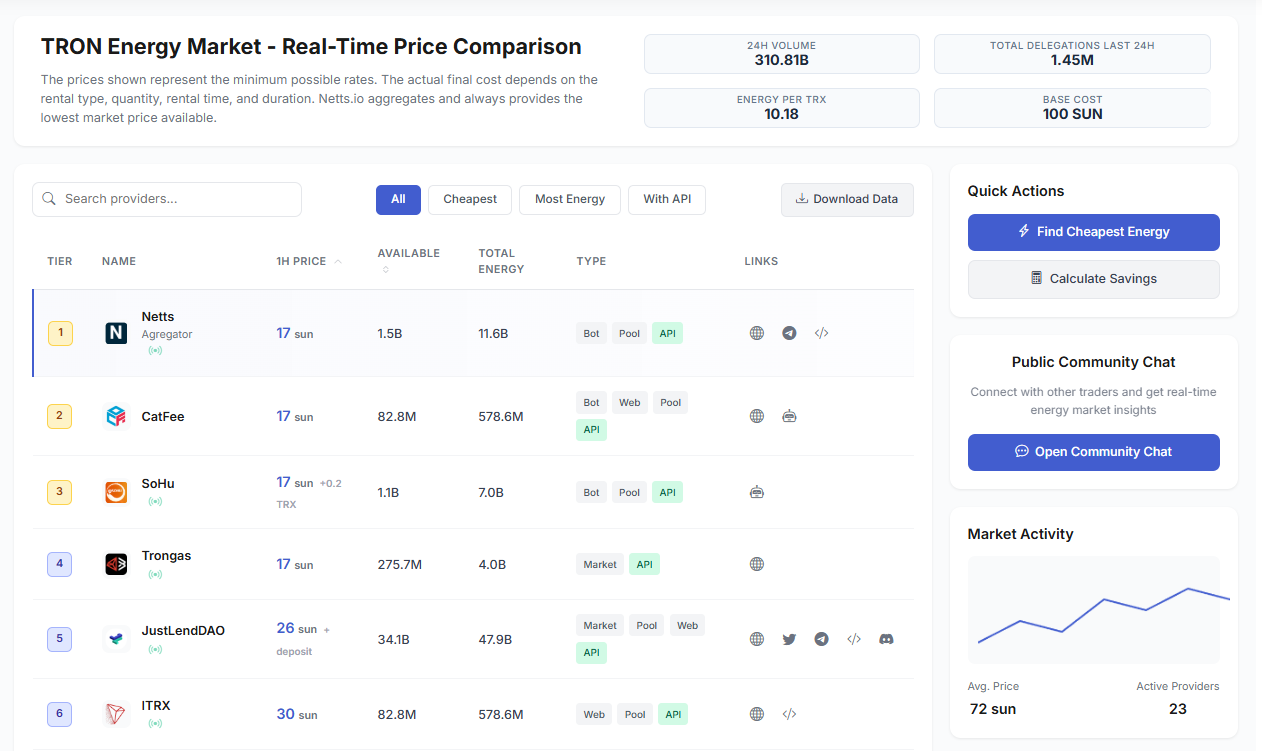
Providers hold TRX in a frozen state for a long time, and they generate Energy which can be assigned to clients for limited times. They all provide instant delivery, flexible rental periods, and quantity discounts. And for developers, quite a number of providers, including Netts.io, offer powerful APIs for automating energy management, facilitating the integration of energy rental into DApps and trading bots.
It is thus straightforward to see the merits of using TRON to rent Energy. It allows users to rent only as much Energy as they need at the time they need it instead of burning TRX for every transaction. This is especially valuable for:
- High-volume traders on TRON DEXs requiring stable Energy supply
- Smart contracts deployment and testing for developers
- Companies that process many USDT or other TRC20 token transfers
- Those who want to save on transaction fees without staking TRX
Utilizing the TRON Energy Market, users can save money, gain more flexibility and engage more with TRON.
From Keys to Code: the Evolution of the Sharing Economy
Not only what travelers buy or where they work, but how we conceptualize ownership and access has been changed by the sharing economy. Its sharing/distribution was primarily focused around physical capital — cars, bikes, homes, etc. — in the early days. From Airbnb and its peers making sharing of space a thing with people you never met before to ride-sharing apps that redefine how we move in cities, the impetus for change was technology, trust systems, and the potential for dormant assets to be monetized. With the rise of digital technology, the notion of sharing expanded outside the physical realm. The same principles that applied to physical resources are now being applied to digital ones, creating supply and demand for fundamental digital resources like computing power, storage, and, in the case of TRON, Energy. Enabling users to lease out their unused digital assets and enabling access to these resources without having to own them on-demand, and for limited time frames, the TRON Energy Market is a natural progression of that trend.
To understand why the TRON Energy Market is such an effective mechanism, it makes sense to take a look at the underlying mechanics. Energy on the TRON blockchain is the resource consumed by every transaction and smart contract execution, and it can be generated by freezing TRX tokens. The frozen TRX gets converted into the proportional amount of Energy, which can be delegated to another user or used by the user itself for their own transactions. The rental market is built on this delegation. TRX holders who also have a sizeable TRX on the network freeze their tokens to produce Energy and then rent it out.
Renters, by contrast, have only to use the total amount of Energy they require, for so long as they require them and at a fraction of what the cost of burning TRX directly might be. The benefits are twofold: providers earn a yield on their staked assets, and renters see up to 90% savings on their transaction costs. The entire process is automated and secured with smart contracts, which guarantees instant generation of Energy and transparent payment processes. This system has established a thriving economic landscape, where cost varies according to availability, requirement, and network-wide usage.
Different users from all backgrounds with different needs and motivations use the TRON Energy Market. For DApp developers, they can rent Energy in order to standardize their costs during the development and deployment stage. Rather than locking capital with massive TRX freezes, developers can rent Energy on an as-needed basis, scaling up and down with the demands of the project. NFT project owners, which often require bulk mints or token transfers, enjoy reliable, affordable transactions. TRON DEX high-frequency traders depend on a stable Energy supply to make fast and highly efficient trades, whereas a small business dealing with USDT payroll or USDT customer rewards may not want to burn TRX to deal with TRX volatility; they could rent Energy to pay for each transaction. The flexibility and savings the rental market provides are useful even to casual users — people sending a few TRC20 tokens here and there or interacting with other DeFi protocols. At the provider end, large TRX holders, staking pools, and also some exchanges are Energy suppliers that receive a passive income and also add to the market liquidity.
Netts Energy Market: User Experience, Automation and Transparency
Netts.io, based on its advanced technology architecture, has become one of the key players in the TRON Energy Market with an emphasis on automation, transparency, and user experience. In contrast to traditional peer-to-peer rentals, where users have to negotiate rates or wait for manual approval, Netts uses Energy from more than 23 verified providers and routes Energy instantaneously at the best available price. One of the essential features of the platform is its automation tools — you can set up rent for recurring use, see your Energy balance in real time, and receive reminders to top up.
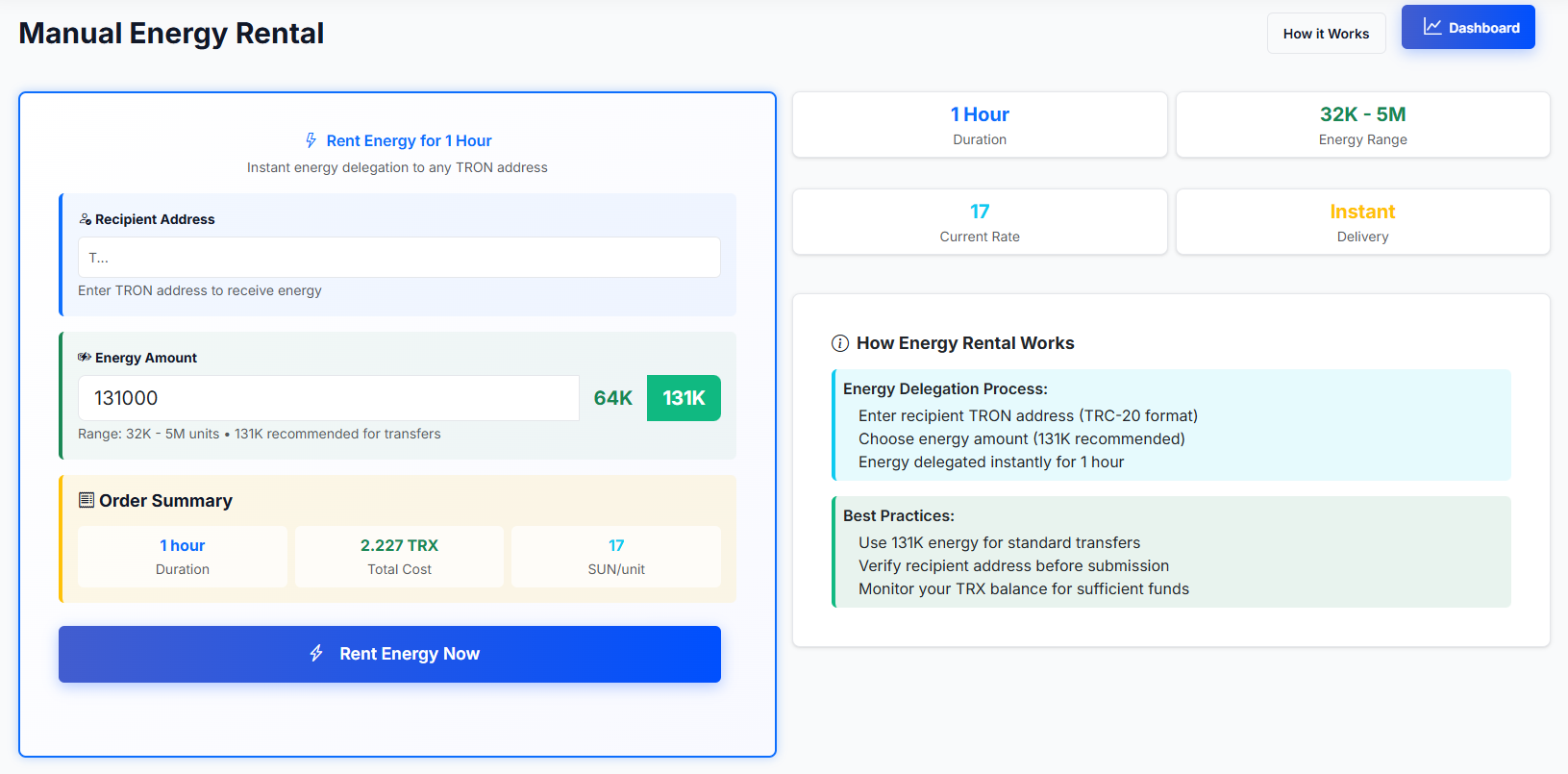
Netts provides a full-fledged API for developers & businesses to integrate energy procurement into DApps, trading bots, and business workflows. The professional workspace also includes transaction analysis, cost tracking, and other financial management features, enabling easy optimization of resource usage and expense control. Netts also excels over other providers when it comes to reliability (99.9% uptime), transparency on pricing, and customer service. Customer reviews mention the peace of mind associated with never needing to think about Energy again, that Energy is available at a well-defined cost, without needing any monitoring or manual action.
The Future of Digital Resource Markets: What Lies ahead
As more use cases come into play, we should be excited for the new waves of tokenizing digital assets on the blockchain and a more effective dynamic pricing market for those resources like Energy. The deployment of smart routing, where the platform chooses the cheapest or the most dependable provider for every single booking, has already started taking place. Users could hedge against price volatility with energy futures and options, and cross-chain solutions might be used to rent resources between blockchains. We will also see the influence of regulatory trends as emerging guidelines and frameworks around digital asset markets take shape by various governments and industry bodies.
The dynamic nature of platforms such as Netts, particularly in terms of transparency and automation, is what positions Netts.io for these changes, so long as they continue to comply whilst upholding their efficiency and availability. Ultimately, the same key ideas underpinning the success of both Airbnb and the TRON Energy Market — resource optimization, trust, and flexibility — will continue to influence transformation in the digital economy and create new opportunities in the long term for providers and users alike.