DAOs: The Experiment in Owning Everything Together
From The DAO hack to MakerDAO's billion-dollar treasury — a decade of decentralized governance experiments, failures, and survivors.
The concept of decentralizing money plays well at cryptocurrency conferences. There’s a neat logic to it — cut out the middlemen, spread around the ledger, have the network perform what banks have been doing for centuries but without all those fees, that gatekeeping and the odd bit of fraud. Fine. People can get behind that. But then someone at the back of the room raises their hand and follows up with a question: What about the organizations that build and govern over the decentralized money? Should those be decentralized too?
And this is where the philosophically interesting and the practically messy become one.
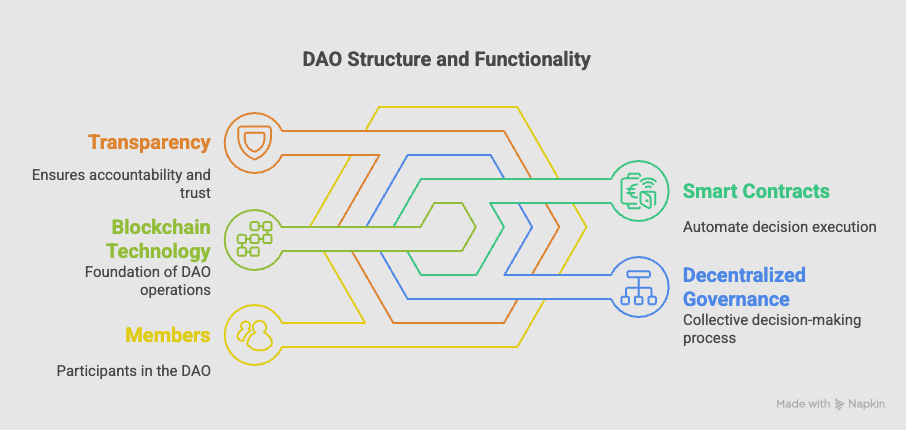
The DAO — not to be confused with the titular entity — is the blockchain world’s attempt at an affirmative answer. No CEO. No board of directors. No shareholders engineering quarterly results. Instead: a community, a shared treasury, smart contracts that enforce a set of rules and governance tokens that provide holders with voting rights over how the whole operation functions. The idea has a clear allure: transparent, participatory, theoretically incorruptible. It’s the sort of thing a political philosophy professor might sketch out on a whiteboard and then never expect to see put into action. And yet here we are.
Whether the experiment has worked is entirely a matter of which part of the past decade you consider.
Lovely Idea and Its First Funeral
The thing that hits you when you read about the original DAO is how confident everyone was. It was April 2016, and a project simply named “The DAO” had just wrapped up what was then the largest crowdfunding campaign ever — $150 million worth of Ethereum raised from thousands of contributors who thought they were purchasing into a new model for decentralized venture funding. There would be no gatekeeping committee to decide which projects were investments. Token holders would vote. The community would decide. The results would be run automatically by the code.
Nobody spotted a vulnerability in the code during audit, either. On 13 June, 2016, an attacker found a re-entrant bug in The DAO’s smart contract — a vulnerability that made it possible for them to repeatedly call the withdraw request before updating the contracted balance, draining funds in a loop.
By the time anyone could answer, 3.6 million ETH — about $60 million at the time — had been drained into a child contract. The attacker worked methodically and unhurriedly, which may have made it worse.
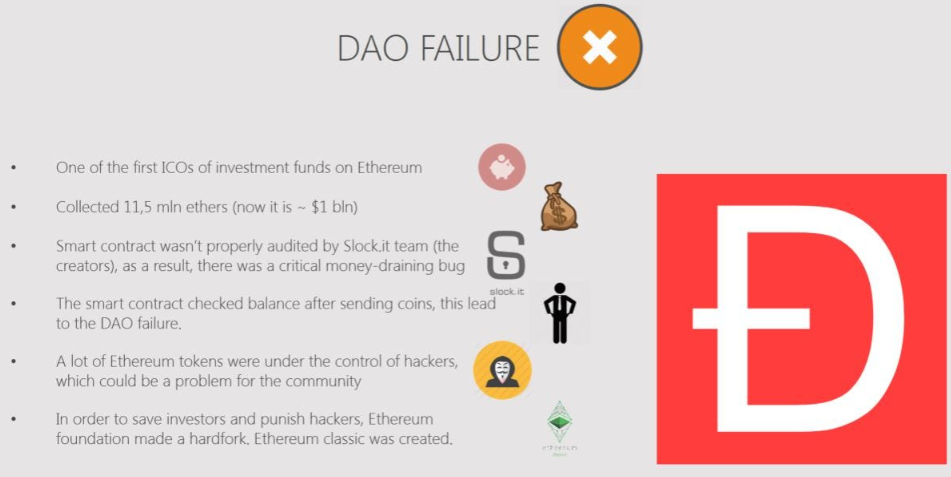
The response drew a division in the Ethereum community. One group said the blockchain was meant to be immutable — code is law, and the attacker had discovered a legal edge case, reversing it would establish a precedent that outcomes could always be called into question if enough people found them inconvenient. The other faction, fronted by Vitalik Buterin, contended that practical ethics trumped philosophical nicety and that $60 million of hijacked investor resources was not a test case anyone wanted to lose.
The actual hard fork occurred on July 20, 2016. The stolen funds were in fact returned. The original chain was then continued by those who opposed the fork, and was eventually dubbed Ethereum Classic. One project, two chains and a wound in the industry’s confidence that took years to heal. The DAO was dead. Its legacy was converting smart contract security from an afterthought into a real discipline.
A Catalog of Spectacular Mistakes
If The DAO’s collapse was a tragedy in the classical sense — hubris, catastrophe, a moral lesson written in fire — what happened over the next several years could be described as something closer to a darkly comic anthology. The same basic errors kept surfacing in different garb.
In November 2021, a crowd of internet strangers decided to team together to crowdfund and buy an original copy of the United States Constitution at a Sotheby’s auction. ConstitutionDAO raised $47 million in under a week from 17,437 contributors — the largest crowdfund ever put together for a physical object. The energy was extraordinary. The project trended everywhere. It felt like a proof of concept: a DAO could organize a community, raise massive capital and act with a speed that no traditional institution could match.
They later lost at auction to Ken Griffin, the billionaire CEO of Citadel hedge fund, who bid $43.2 million. ConstitutionDAO peaked at $40 million once storage, insurance and transport were factored in. The community that two days before had seemed to be making history now needed to find a use for $47 million it had raised in service of a mission that was no longer facing a threat.
Its own disaster was the refund process. Ethereum gas costs meant that contributors who had given $50 or $100 paid more in transaction cost to get their money back than they actually received. The PEOPLE token, offered as a certificate of participation, paradoxically shot up in value after the shutdown — the memetic residue of what had once existed as a more or less coherent community, however briefly and intensely. The episode itself was both hilariously farcical and inspiring, which may be the most honest summary of DAO culture.
Wonderland DAO went belly up a few months afterwards with far more human cost. Operated by its namesake brand Time along with a TIME token, the project formed part of DeFi 2.0 wave that promised outsized returns via algorithmic staking mechanics. Its treasury manager used the pseudonym “Sifu” — as it was unremarkable at the time to handle funds in DeFi anonymously. And then a researcher discovered that Sifu was, in fact, Michael Patryn, co-founder of QuadrigaCX, the Canadian cryptocurrency exchange whose C.E.O. died in circumstances still contested — leaving behind $190 million of investors’ money unsalvageable. Patryn had previous convictions himself, for identity theft and credit card fraud.
The founder of the project, Daniele Sestagalli, later acknowledged that he had known about Sifu’s true identity for weeks and continued collaborating with him. The TIME token fell 36 percent in mere hours. The project's assets under management plummeted from more than a billion dollars to $146 million. Sestagalli said he would close down the project — then reversed course fourteen hours later after a community vote against that. The entire episode highlighted that “decentralized” governance can be rendered moot on a whim by the architect of that very governance, and that anonymous treasury management does not serve as an adequate proxy for basic due diligence.
Olympus DAO taught a different lesson: what happens when the math can’t possibly work. The protocol, which launched in March 2021, offered an extraordinarily seductive pitch — stake OHM tokens and receive yields measured in the hundreds of thousands of percent per year. The (3,3) meme proliferated, a game-theory shorthand intuiting that we all win if we all cooperate by staking. The issue was that paying those yields demanded an endless issuance of new tokens, which diluted the value of existing ones, which in turn made it necessary for the token’s price to rise in order for the illusion to hold up, which in turn required new buyers constantly entering. When the broader market soured in early 2022, the whole edifice fell apart with remarkable speed. Those who had come in late believing in the (3,3) magic were exiting badly bloodied. The meme became a funny but cautionary tale.
Build Finance DAO was smaller but more surgical in its collapse. In February 2022 an intruder without insider access slowly amassed enough BUILD governance tokens he was able to sway the vote about a treasury liquidation proposal. Few noticed in time when the community’s monitoring bots — which were supposed to alert members about suspicious proposals — were taken offline moments before the vote. The attacker then approved the proposal, emptied the treasury and laundered the proceeds. The total damage was modest by DeFi standards — just under $470,000 in ETH — but the mechanism was clarifying. A DAO governed by majority-rule voting and a bored or disinterested community is not an organization turned from centralized to decentralized. It is a lockbox that needs to be focused on to stay locked.
Mango Markets arrived at the genre’s surrealist terminus in October 2022, when a trader by the name of Avraham Eisenberg took to public credit for a $117 million exploit he insisted was actually just a “highly profitable trading strategy.” He had gamed the protocol's price oracle, pumped up his collateral value, borrowed against it massively and left. If anything, the governance aftermath was even more unsettling than the exploit itself: After Eisenberg returned $67 million in a negotiated settlement, the Mango DAO voted to release him from liability … and let him keep $47 million. A decentralized community had voted to allow someone to walk off with nearly $50 million of its money because the governance mechanism left no better way forward. The case eventually led to the arrest and conviction of Eisenberg, who continued to pursue appeals against that conviction. The case remains a landmark in what DAO governance is and is not able to enforce.
The sequence across these bad bets is not the randomness of a market in disarray. In hindsight, it is predictable — and now all the more painful:
1. A governance token allocation that ultimately leaves the balance of power in the hands of founders, early investors or anyone willing to build up long and slow in relative silence.
2. A community that rallies in a frenzy at this time of launches and crises and hardly at all during the stretches of routine governance that actually matter.
3. Bull conditions, time-pressured audits and minimal adversarial testing of smart contracts.
4. An unstated premise that shared financial interest begets shared values — a proposition which, sometimes, is true, and that other times is most certainly not.
DAOs That Did Not Collapse
Good news - the story of DAOs is not just a trail of disasters with the occasional meme attached. With the collapses came a handful of projects that built governance structures that worked — not ideally, messily, with real internal fights and some also-ran embarrassments along the way — but it worked.
The most prominent of these is MakerDAO. Founded in 2015 and formally launched in 2017, it developed DAI — a decentralized stablecoin fully collateralized by crypto assets and governed by MKR token holders. The protocol weathered the crypto winters of 2018 and 2022, even through a real crisis in March 2020 when the values of its collateral plummeted so fast that automatic liquidations failed and left the protocol briefly undercollateralized, and it constantly updated its governance model over almost a decade. And by 2024, it had rebranded Sky Protocol (the name of the new governance token) and an estimated gross revenue of $611 million in 2025, while USDS supply crossed over $21 billion by early 2026. The rebranding was controversial — a large segment of the community pushed back hard against it — but the protocol kept on running, which is more than can be said for most 2017 projects.
Uniswap’s DAO governs what became, by early 2025, the largest DAO treasury in existence at $5.4 billion. The UNI governance token was distributed in 2020 during one of the most celebrated airdrops in crypto history, to anyone who had used the protocol. The governance has been contentious — there are ways in which it’s valid to be critical of the centralization of voting power and speed of decisions — but the protocol itself kept processing hundreds of billions in trading volume, and the DAO was still making real decisions about what happens with those resources.
Lido DAO, the liquid staking protocol for Ethereum, emerged as one of the most consequential governance experiments in the space with little fanfare. And as the provider of over $38 billion in total value locked and with Node Operators worldwide totaling more than 800, Lido’s decisions influence a significant portion of Ethereum validator set. In 2025, the protocol adopted dual governance — granting stETH holders, not just those with LDO governance tokens, the ability to delay or veto proposals via a timelock structure. It was an honest attempt to address the diverging-interests problem between stakeholder groups, responsive to a real structural weakness that the community identified and worked to address.
Gitcoin was among the first to implement quadratic funding — a mathematical method that magnifies the power of many small donors when compared to many big ones, reversing capital-weighted systems that inevitably cluster resources. The outcome was tangible: rounds of matching funding in excess of a million dollars to open-source projects and ecosystem infrastructure that no venture fund would touch. The system has vulnerabilities — it’s susceptible to so-called Sybil attacks, where fake identities cheat their way through the matching algorithm — but at least making an effort to build funding mechanisms that don’t devolve into pure winner-take-all is something truly new.
The ENS DAO transitioned to full decentralized governance in late 2023, when the DAO assumed control of the protocol’s root node. But in early 2026, it took an action that epitomized what functional governance can look like: the community rejected ENS Labs’ proposal to build a proprietary Layer 2 network and steered the protocol toward Ethereum mainnet instead. A direction had been proposed by an internal team. The community voted another. The community won. That is, in simple terms, what the experiment’s goal is to create.
Nouns DAO, which sells one generative NFT per day and deposits all of the proceeds into a community treasury, has sponsored everything from animated short films to real-world events to public art installations. The treasury has had its own turmoil — the community called a “rage quit” mechanism in 2024 allowing passerby members to leave with their fair share of treasury funds, which depopulated the pool that could fund new projects. The DAO effectively forked. And then kept going.
Ghost of the Dream
The overall picture of DAOs in 2025 and 2026 is not the pristine-led utopia of the original vision, but neither is it industrial ruin that one might expect from any individual failure. There are over 13,000 DAOs in the world, more than 6,000 that have regular activity and collective treasuries holding anywhere from $20 to $30 billion in liquid assets.
The challenges are real, and just as easy to dismiss. Less than one percent of holders own ninety percent of the voting power in the biggest protocols. The vision of widespread democratic participation has not unfolded in many cases — what there is instead is a more complicated picture of delegation, professional governance players, delegate councils and community forums where the real deliberation occurs before the formal vote. This is not the dream. That, arguably, is how all governance eventually happens at scale.
The technological infrastructure has matured in ways that will make future failures a little less inevitable. Cross-chain governance tools enable DAOs that are active across multiple blockchains to coordinate decisions. The unsexy work of actually getting decentralized organizations to work has attracted real engineering effort.
What remains is a legitimate, unanswered question: can a large number of people with different interests, who have finite amounts of time and unequal resources at their disposal and are not legally obligated to be there govern the same financial system? History offers at best a mixed answer. If history of other kinds of human collective decision-making — in public institutions, cooperatives, open-source projects and so on — is a guide, the answer is yes, sometimes under certain conditions with a great deal of contention along the way. DAOs are not that different from other human organizations, as their supporters once hoped. They fall under the same dynamics of power, attention and self-interest that governs everything else.
Yet they have also engineered MakerDAO’s decade of operational continuity. Uniswap's billions in community-controlled resources. Gitcoin's public goods funding. Lido's governance innovation that addressed a real structural issue. ENS's community override of its dev team. These are not nothing. They are indeed remarkable — not because they demonstrate that the dream was correct, but because they demonstrate something both more humble and more lasting: that decentralized governance is difficult, often ugly, sometimes corrupt and sometimes worth it anyway.
The original DAO was hacked and died in 2016. Its idea did not. Every subsequent effort to build something better was, in one sense, a reaction to that failure — an act of recognition that the fault lay in implementation and not principle. Whether the principle is redeemable at the scale and complexity that contemporary financial plumbing requires remains to be proven.
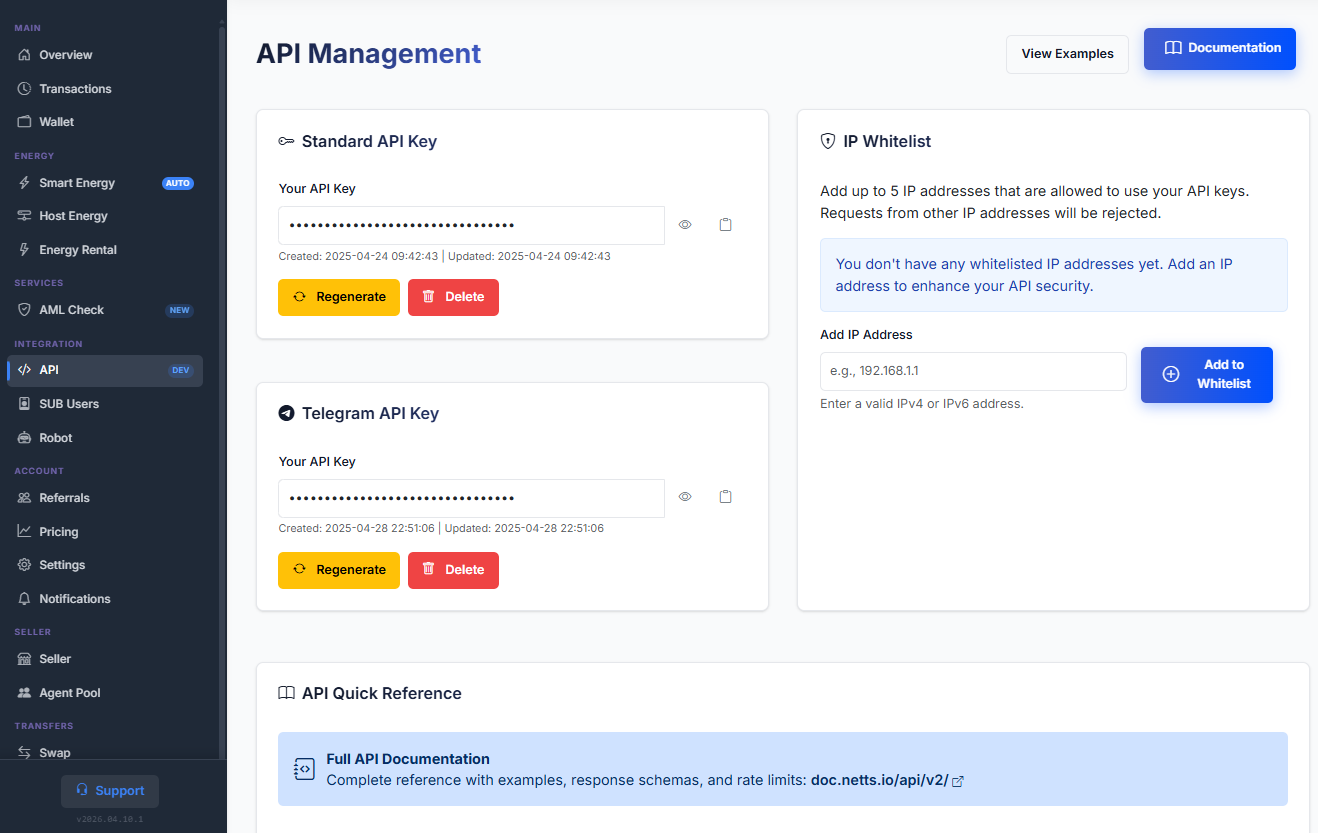
For teams and developers launching onto TRON blockchain — often the same entities behind multi-wallet operations, stake positions or protocol infrastructure — a parallel problem that’s just as familiar is the operational overhead needed to keep transactions chugging along smoothly. TRON Energy management tools have followed a similar journey to DAO governance: manual, error-prone and expensive, but on the path to automated systems that take care of the day-to-day without requiring somebody watching over. Netts Workspace is one of them — a professional Energy management suite providing all: from manual delegation, to auto refill automation with smart triggers, Host Mode for high-usage addresses on continuous usage and API for Tron Energy so developers could integrate automated workflows into their environment. It doesn’t answer the philosophical question of how humans govern shared resources, but it does remove one chronic operational headache from consideration.