Many Programming Languages of Crypto
Why crypto stacks use C++, Go, Rust, Solidity, Haskell, Move, and WASM — and how TRON pairs Java-Tron with Solidity and an Energy/Bandwidth model.
Digital value transfer has been one of the most transformative technology shifts in the twenty-first century. Just as the industrial revolution demanded new sorts of steel and machinery to build skyscrapers and railroad tracks, so too has the blockchain revolution demanded an entire reimagining of the very languages we use to convey information to computers.
The field of software development is frequently likened to a fully stocked workshop, one that brims with all sorts of different specialized tools. A skilled artisan doesn’t use a sledgehammer to whittle a delicate sculpture or a tiny chisel to knock down brick walls. Each tool has it’s own reason to shine - lovingly crafted and honed to perfection that one job. And the virtual world of programming languages is no exception.
And the reason there are so many languages — from old-school C++, which has been used to build everything from operating systems to game engines, to modern safety-first Rust — is that each embodies a philosophy and choice of trade-offs about performance, security and developer productivity. Nowhere is this principle of “use the right tool for the job” more true – or desperately needed, than in cryptocurrency/ blockchain.
In this space, code is literally law and a single typo can lead to millions of dollars in assets being rendered inaccessible, the decision of programming language is hardly just an implementation detail — it’s a fundamental architectural choice that determines everything from security and scalability features through to whether or not built systems will remain viable into the future.
Foundational: Languages of Core Protocols
At the heart of any cryptocurrency is its protocol: The basic premise based on which that network operates, agrees to do so and provides security. These protocols are like the unchangeable constitutions of digital economies, and languages that can write them must be powerful and efficient while maintaining meticulous, low-level control over the computer’s resources. It’s no wonder that Bitcoin, the first of this whole industry, is in C++.
This is a language that’s famous for blazing fast computing, manual memory allocation, as well as a stable eco-system again all things vital when the very last drip of efficiency counts within an international network that’s processing transactions day in day out every 2nd. C++ was chosen specifically, not by accident which made it possible for Satoshi Nakamoto to make the code run extremely fast on very early nodes that had little hardware. It had fine-grained control over how memory was assigned and released, which prevented memory leaks able to crash a node and split up the network. This legacy endures today.
For straightforward performance and control, most big blockchain projects still rely on C++. It allowed for early cryptocurrencies (like Litecoin) to simply fork the Bitcoin codebase, change a few parameters (block time, hashing algorithm), and be done with no need to re-write all of the logic. Privacy coins such as Monero also make significant use of C++ to support the complex cryptographic primitives that are necessary for operations like ring-signatures and stealth addresses, where speed is crucial to ensure that the network does not grind to a halt under high computational loads.
The Trilemma and Language Philosophy
The blockchain industry developed and as developers struggled with the so-called "Blockchain Trilemma" — effectively decentralization, security and scalability at a combined cost — they started to secure funds for themselves but also build what became known as token-based economic models. The selection of programming language also became a significant lever in this tradeoff.
Ethereum and the risk of SPOF The Ethereum project was aware that a single point of failure could spell doom and thus advocated from the beginning a multi-client scenario to keep decentralization central. This was to imply the Ethereum protocol wouldn't be an app, but more of a standard that could be implemented in many languages.
Its most widely-used client — Geth — is developed in Go, a language designed by Google for power and network connected servers styled software. Go’s lightweight concurrency primitives, called goroutines, make it particularly suited to manage the thousands of concurrent network connections that a blockchain node needs to maintain in order to propagate transactions and blocks against its peers. Combine that with a straightforward syntax and excellent standard library for a really good mix of performance vs. dev friendliness, making it possible to iterate quickly as well as attract a larger contributor base.
A second high-profile Ethereum client was (first Parity, then OpenEthereum) itself developed in Rust. Rust, the creation of Mozilla, espouses a different philosophy. It stresses memory safety heavily, attempting to rule out whole classes of programming errors at compile time with an inventive system (ownership & borrowing) all its own.
While C++ empowers developers to manually control memory (and the noose with which they can hang themselves), and Go uses a garbage collector to do so automatically (with some unspecified performance penalty), Rust leverages very literal ground rules during compile time. That means a wide swath of bugs that would crash — or allow an adversary to exploit — these nodes, just can't be expressed using valid Rust.
This variety of languages for the same protocol is not a weakness; it’s an immense strength. If an exploiter is discovered in the Go implementation of Ethereum, then a network can keep running with the Rust client not affected, something that wouldn't be possible without multi-language support. Building at this level requires not just skill with a language, but deep, time-won expertise in distributed systems, peer-to-peer networking and advanced cryptography.
The Logical Layer: The Smart Contracts and Their Jargon
If the core protocol is an operating system, smart contracts are the world-shaking applications that run on it. And it is those bits of self-executing code, with the terms of the agreement expressed directly as lines of code, that unlock the full promise of blockchain for applications from decentralized finance (DeFi) to digital identity.
The language used by most to write smart contracts is Solidity. It was built to run on the EVM and its syntax is intentionally very similar to JavaScript, which not only led to it being quite easy for the world's largest developer community (JavaScript) to learn, but also influenced a large portion of code already written in other languages. It was this accessibility that powered the initial push toward decentralized applications and rapid expansion of the Ethereum ecosystem. Solidity let developers fundamentally think about their code in terms of “contracts,” “mappings,” and “events” — all abstractions that corresponded nicely to a mental model of financial agreements.
Yet the history of Solidity is also a history (like all computer security histories) of hard lessons learned. Due to the immutability of blockchain, bugs in a smart contract might also lead to permanent and severe results as seen with things like DAO hack or in case of Parity multi-sig wallet freeze.
These episodes served as a reminder: though the syntax may be JavaScript like and readable, there are dangerous complexities lurking underneath. Newer blockchains have tried different approaches as a result. Systems like Sovrin and Dfinity have leaned into Rust as well, trusting in its compile-time guarantees to reinforce the security of their smart contracts. Rust aims to prevent “data races” and other kinds of data-race-like misbehavior that high-performance systems commonly suffer from.
Formal Verification, or in Search of Perfection
In a more academically advanced, high-assurance part of the ecosystem, projects like Cardano and Tezos have taken a radically different approach. Cardano took the radical, counterintuitive decision to base its core implementation on Haskell and its smart contract platform (Plutus) as a Haskell dialect. Haskell is a pure functional language with strong mathematical bases.
It views computation as the evaluation of mathematical functions, and eschews “side effects” — changes to the state of the system that may not be predictable. This is what makes Haskell so well-suited to formal verification: a developer can mathematically demonstrate that their code is correct. Instead of testing code with a handful of potential inputs, developers can demonstrate that the code will perform correctly for all possible inputs. That is a trade-off: one that makes the developer pool much narrower as well as being less experienced, in order to offer supposedly unrivaled security and reliability for high-value financial contracts.
Tezos: It is the native language of Tezos called Michelson, a low-level and stack-based language made for formal verifications because when you are managing millions of dollars you want to have an estimation on what your contract will do.
The Rise of Resource-Oriented Programming
More recently, a new paradigm has begun to be concretised in languages such as Move. A Meta (Facebook) project from which Aptos and Sui get their high-performance blockchains, Move was purpose-built to center digital assets. In Solidity a token is nothing more than an entry in a ledger inside a contract. In Move, you can think of a token as a “resource” — that is, some kind of special data structure which can never be copied or implicitly dropped, only moved from one storage location to another.
This model avoids common errors such as double spend and token burn at the language layer by using resources. It changes the mental model from “updating a database” to that of “moving physical objects”, which is more how we innately understand value. With this innovation, secure smart contracts would be “the default” – thinking of the language itself as a guardrail against some of the most common forms of financial exploits.
The Polyglot Future: WebAssembly (WASM)
For years, the EVM has been the reigning champion, but a new contender is approaching: WebAssembly (WASM). Originally built to run high-performance code in web browsers, WASM is emerging as a standard for smart contracts on blockchains such as Polkadot, Cosmos and Near. This is the beauty of WASM, being a compilation target and no source language.
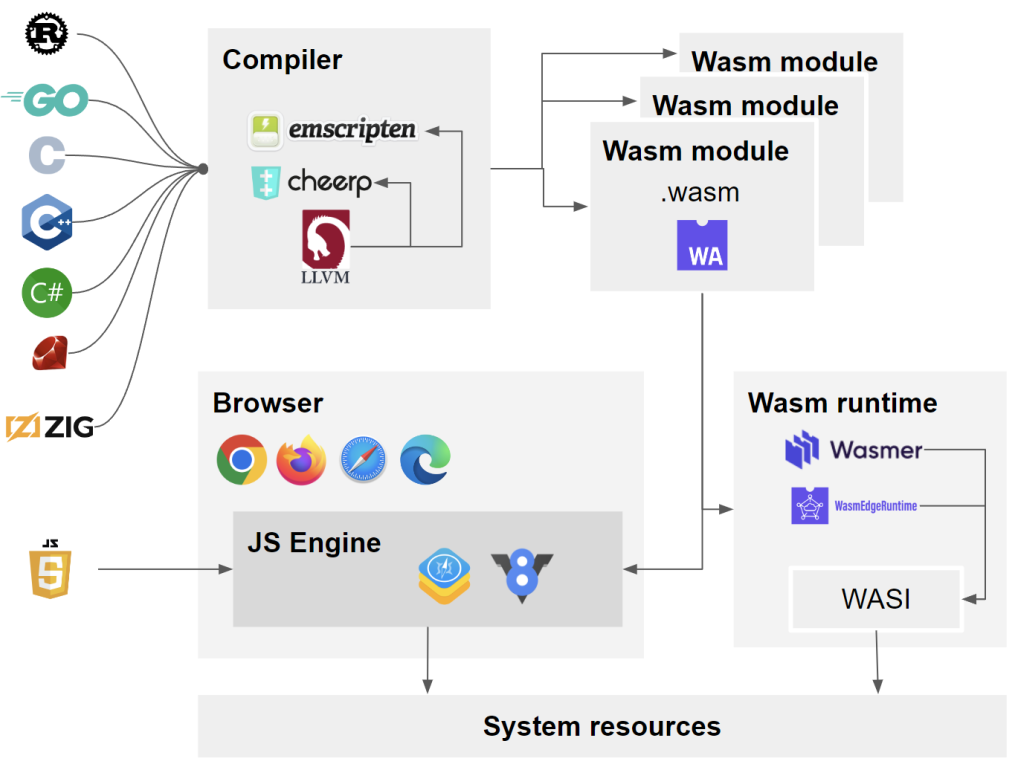
This means developers can now write smart contracts in Rust, C++, AssemblyScript (a TypeScript-like language), or really any other language that compiles to WASM. This disrupts the monopoly of languages that have been specifically designed for blockchain, and instead enables developers to use their tools, libraries and professional knowledge in crypto. It sketches a vision of a polyglot future in which the barriers to entry have been reduced significantly, and where success is more about building great apps than learning new syntax.
TRON Network: Performance and Accessibility.
On the huge ecosystem of blockchain platforms, TRON aims to provide high throughput and scalability, as well as to become a decentralized entertainment and content-sharing platform which eventually will benefit creators without a centralized middleman. The architectural decisions of TRON follow from these aspirations, and provide an interesting example of pragmatic engineering.
The core client, Java-Tron, is coded in Java — which has been the workhorse of the enterprise software landscape for decades. This was an intentional strategic choice. Java is enterprise-hardened, very stable, and it operates on the incredibly efficient Java Virtual Machine ([JVM]), a monument to system software design if ever there was one that underpins a worldwide network.
Its JIT-compilation optimization feature that is built into the JVM ensures that TRON nodes can remain to be high performance over time. It was also a decision that helped TRON tap into a huge, worldwide pool of Java developers and the rapid development of its core infrastructure based on Delegated Proof of Stake (DPoS) consensus technology designed for speed and performance.
For its contract layer, TRON took another key strategic decision: they used a virtual machine that is compatible with Ethereum’s EVM. Which was to say that anyone who could code a smart contract, minnow or whale (this included me during my erc20 phase), could write them for Tron too with the use of Solidity Smart Contract language.
This kind of inter-compatibility has been a major leverage on the growth, enabling existing dApps and developers that have been working inside Ethereum ecosystem to smoothly migrate or expand over TRON. Well, TRON does have you covered on those answers but interacting with it brings a really interesting and complex resource model around Energy and Bandwidth.
The Ethereum “gas” model works as a basic model, in which you pay ETH for each operation. The TRON model does not use the gas charge and it separates resources. Network bandwidth is spent on the bytes of transaction (the body and data size), while Gas is used by computational power/time to process a logic that includes the smart contract.
While this can result in “free” transactions when a user has enough frozen TRX, for applications with high transaction volumes — think: a popular decentralized game, a high-traffic trading algo, or even a busy financial service — the perpetual demand cycle places an enormous strain on operations. Any dApp that runs out of Energy will have its actions fail, resulting in a bad user experience as well as lost business.
This has had the effect of a niche, yet important market for services that can take care of TRON Energy renting automation. Big holders can “freeze” their TRX to produce Energy they can lend to other users. Automation of this process is a necessity for any serious business on TRON. It makes sure that applications run smoothly and cheap without interruption. You can save up to 80% of the cost by burning TRX directly to pay for fees while using these platforms.
The automation of renting Energy turns an aspect of the game that would be a burdensome, daily chore into something non-intrusive and in-the-background so that developers can concentrate on code rather than their resource balance!
Outside the Core: The Entire Crypto Stack
A 2020 decentralized application is more than just its on-chain smart contract. It’s a stack of technologies running your web application on the client side from end-to-end. What the user sees and interacts with, so-called frontend dApp, will be created using long-established web development languages: JavaScript or TypeScript combined with a component-based framework such as React, Vue. js, or Svelte.
On the back end, a myriad of off-chain services are needed for anything close to a robust application. These may be data indexers, akin to The Graph (which employs a query language called GraphQL), allowing complex blockchain data to be readily searchable. A blockchain is a horrible database for retrieving information like “show me all NFTs owned by this user minted in 2023,” so indexers read the chain and organize the data into regular databases.
For this layer, languages such as Go and Node.js is so well-suited to serve this data in scalable APIs that feed it to frontends because it’s really really amazing with handling concurrent network requests. Python is also a favorite, especially for analysis of data movement like scripting or machine learning that can be fed blockchain data. The large data science libraries in Python mean on-chain analysts who track “whale” moves or calculate market sentiment have that home court advantage.
Some projects, such as Lisk, have gone a step further with the JavaScript focus by developing a complete software development kit (SDK) that gives developers the power to create their own custom blockchains from scratch under JavaScript — providing an enormous shortcut for developers launching onto this space.
This full-stack view also sends a signal: Building in crypto is multi-lingual, where you pick different tools for each layer of the stack. But for those writing the backend systems on TRON, having a solid way to rent Energy programmatically is not just a convenience, it’s a similar category of thing as their database management and API routing.
The Human Element — Skills and Carefulness
The astounding variety of programming languages in the crypto industry reflects a profound reality: technology is just as good as those creating it. Building a secure, scalable and truly decentralized network is an enormous task. It takes development teams with years, sometimes decades of experience in these areas.
The language of a project — be it performance-oriented C++, safety-focused Rust, formally verified Haskell, or developer-friendly JavaScript — says what the team values most about computing and how it wants to change the world for better.
The open-source nature of most of these projects drives and connects the world’s brightest minds, it's a healthy ecosystem where sharing is innovation, code is public for anyone to inspect whilst driving the entire industry forward together. Bugs in a Go client can be fed back into the design of a Rust client. Advances in resource model of Move can be adopted in Solidity compiler. It is constant, it is collective learning.
This tangle of technologies and relentless need to optimize demonstrate an increasing requirement for dedicated tools, which can tame the complexity of a given ecosystem. As networks get more specialized, the tooling around them will need to change as well.
For developers and DApps running on cutting-edge networks such as TRON, using one-to-one systems for their resources - such as Energy (TRX) and Bandwidth - often times can be a deterrent due to the cost inefficiency, prone to error associated with manual resource management. If a renewal is missed, transactions may fail; if an over-payment is made manually, capital may be wasted.
And this is where pro platforms step in, abstracting out the necessity for understanding and maintaining such complexity and offering up the “infra as a service” layer that the industry needs in order to stand tall.
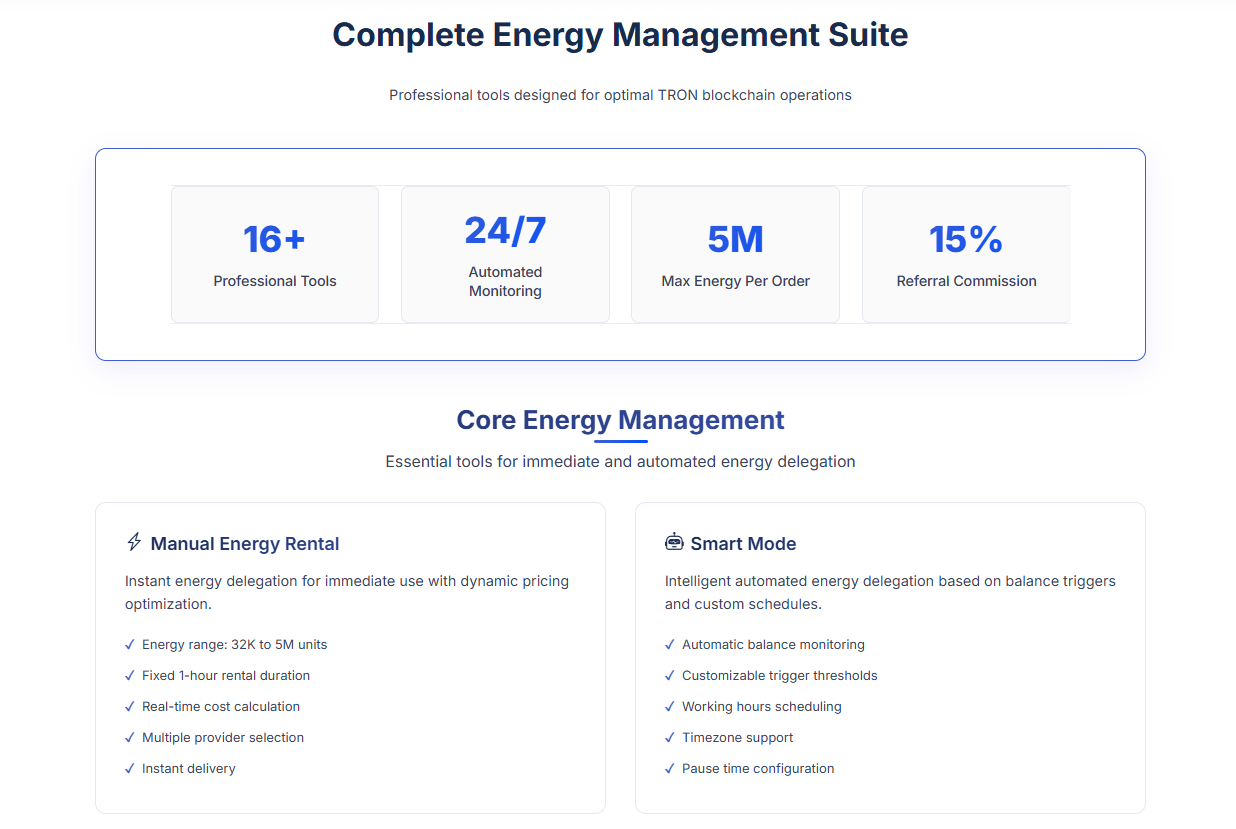
As an example Netts Workspace provides full TRON Energy management suite - smart scheduling, real-time cost optimization and delegated automation. It provides a rich API and complete dashboard for financial management plus analytics — it makes resource management simple, so creators and businesses can concentrate on building their applications without worrying about the upkeep of infrastructure.