Jobs in Crypto - What Are They?
What crypto jobs actually look like — from protocol devs and security to analysts, community, and ops — and the skills that matter in Web3.
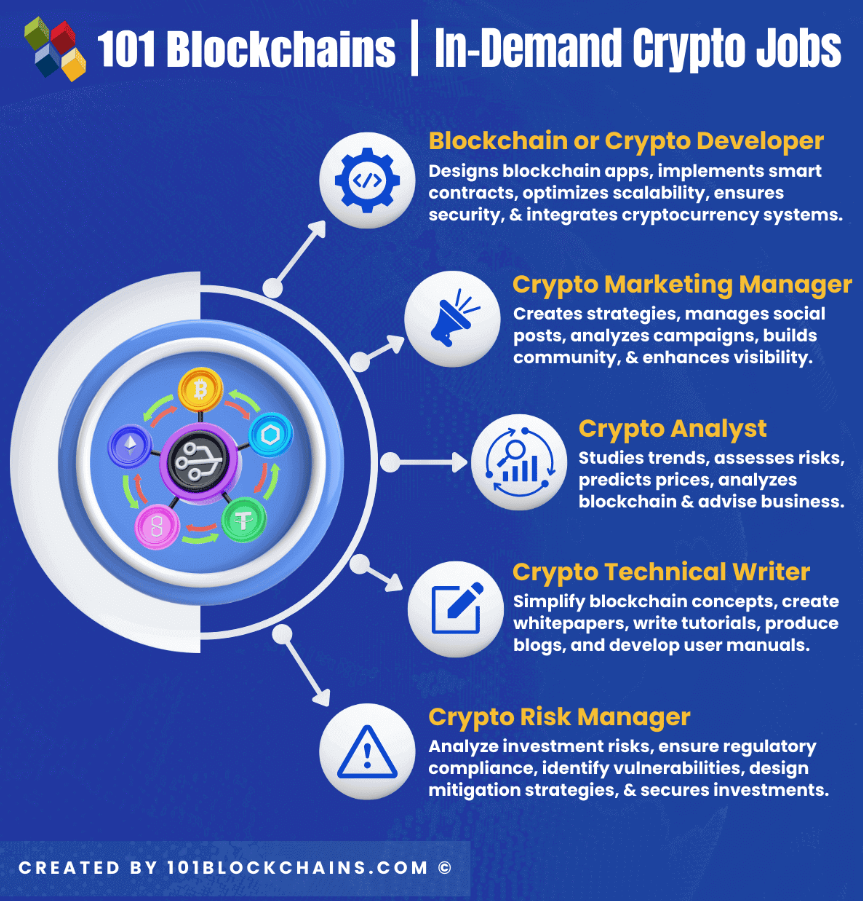
If you were to find a hundred people over the age of fifty and tell them that there exists an entire flourishing job sector based around "magical internet money," you would probably find that the hundred people you've just described would be looking at you either confused, sceptical and maybe a little worried for your mental state. To see how a technology that had its early development as some kind of niche cryptography spinoff has become a global phenomenon that employs hundreds of thousands of people now is a spectacle to behold in and of itself.
But this is the world we are in now. While the crypto community is no doubt global, with members on every continent and in every time zone, the ever-increasing demand for blockchains has birthed an entire ecosystem of jobs surrounding their development. It goes further than day trading and hoping a cryptocurrency goes "to the moon."
This is all part of a real, multi-faceted, rapidly developing industry with a need for engineers, writers, artists, lawyers, and community builders. It's a new digital frontier reminiscent of the first days of the internet, but now with a financial layer baked into the code. What this world is really about is looking beyond the clickbait nature of fluctuating prices and understanding the machinery of humanity that keeps it all humming. There is also an infinite number of roles within this space, too.
It is no longer simply a sandbox for computer scientists and libertarians. As the industry matured, the needs of crypto projects became as varied as those of any other traditional corporate entity. HR, marketing, legal, customer support — all the departments and teams, each fitting the same mold, operating under their own unique brand of constraints and culture in the blockchain world. To understand the why of these occupations, and perhaps, how they came into being; we will have to briefly delve into the mechanics surrounding what these companies — projects, as they are often styled — are attempting to construct in the first place.
They are creating 24/7 decentralized systems, financial instruments, and digital communities based on a model without any centralized authority. The scale of this ambition raises unique challenges that only specialized human labor can address.
Foundation — Developers and Engineers
Let's begin with the one that is the most famous and arguably most important role — the Blockchain Developer. The creators of this new digital world. When Bitcoin was new, there was no alternative, and only volunteers or amateurs contributed their time and talents to create and improve it. But with Ethereum came the idea of "smart contracts" — self-executing code that exists on the blockchain — and the influx of demand for developers who could write this code. So, a website is not only a website for a blockchain developer; it is the ideas of a financial system! The code they write is worth millions or even billions of dollars. If a web developer messes up on a regular site, for instance, the site might disappear for an hour. Blockchain developers can lose millions in the blink of an eye, if they screw up a smart contract.
And this high-pressure atmosphere calls for a certain kind of individual. These roles require an intense set of skills. Knowledge of languages such as Solidity (for Ethereum and compatible chains) or Rust (for Solana and other networks) is a must. But more than understanding the syntax, these developers require an intimate knowledge of cryptography, game theory and economic incentives. They have to be detailed, security paranoid, and able to think like the enemy, always asking — how would you hack this? It is an ideal vocation for someone who likes cryptic, intricate logic problems and thrives under the immense stress of writing immutable code — code that, once deployed, is almost impossible to adjust. A new class of digital engineer has emerged, as with anything, the cost of a failure is so high in this profession that it also comes with some of the highest salaries in the tech world.
This new "Web3″ world can be a little intimidating (especially for developers coming from traditional "Web2" tech), and it takes time to get your head around everything. They are not only learning a new syntax, but a new paradigm in which resources are scarce and every action incurs an expense (gas). Day in and day out they are in dedicated development environments like Remix or Hardhat, simulating networks, testing interactions that would be far too costly to test on the main net.
They also need to be proficient at interfacing with "oracles" (services that input real-world (off-chain) data into the blockchain) and navigating the idiosyncrasies of how various blockchains converse with one another. You are learning every day, because the tech is changing at such a rapid rate. Things you built six months ago are now obsolete or insecure. This never-ending change is what makes the job exciting for many, but it also means that burnout rates are extremely high. The best developers in this space tend to be the ones that are true believers in decentralization and see their code as a building block of a more open financial system.
Community and Design
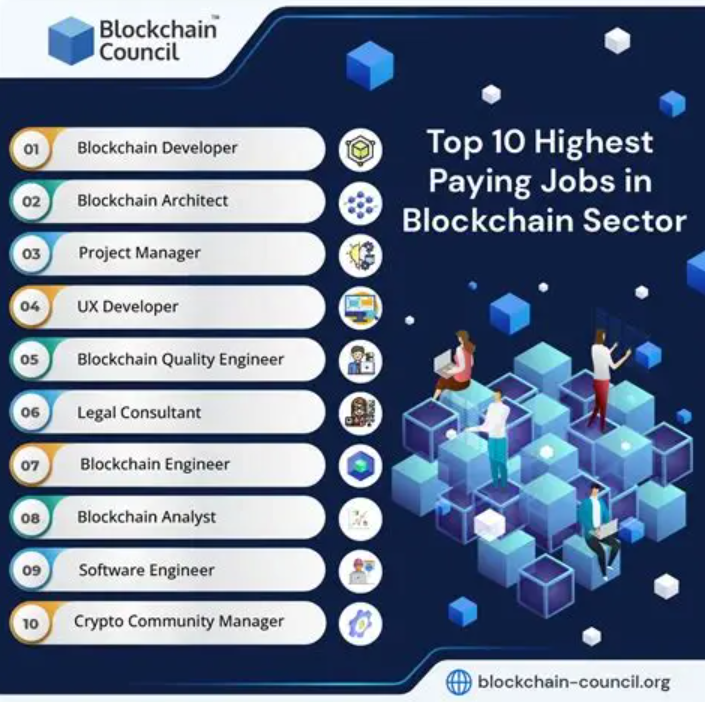
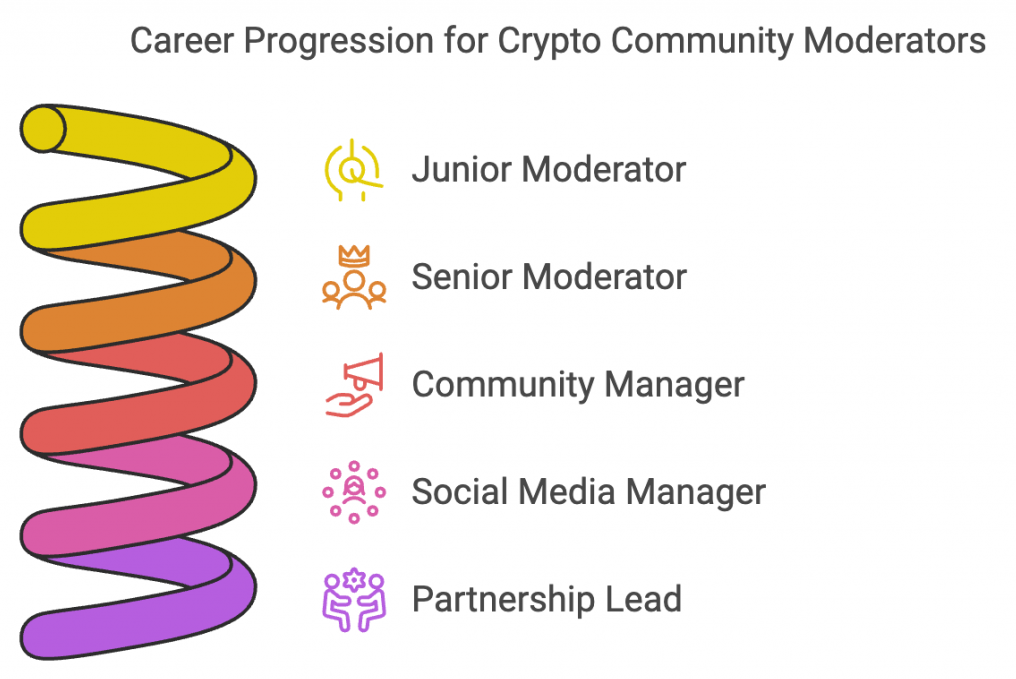
Code is only half the battle. A crypto project cannot exist without users and this leads us to arguably the most unique and common profession in the industry: The Community Manager. In a normal business world, you would have a customer service line or social media manager. In crypto, you have this thing called Community Manager, which is basically a person living in the Discord and Telegram channels in between developer and investor. The reason this role exists is due to the fact that crypto projects are typically community-owned or at least community-governed. Those who have taken stakes in this startup ecosystem are not passive shareholders; they are active voters on proposals, strategy discussions and very vocal critics when the price goes down.
In Crypto, Community Manager is 25% diplomat, 25% therapist, 25% cheerleader and 25% technical support. The crypto market is open 24/7 which means they need to be available for the customers all the time. They should be able to grasp the technical details of the project to explain them to a layman but should also have the soft skills to disarm some "FUD" when the market is red. This is typically the first job in the industry for most. Not only does it take time, thick skin and all that, it also takes a high level of emotional intelligence. The ideal person is an extrovert, a talker, and someone who enjoys a fast-paced sometimes frenetic social setting. Language skills in tandem are usually a big advantage here; crypto is by definition international.
Let us not forget the artists. With the explosion of NFTs (Non-Fungible Tokens) and the "Metaverse", there was a sudden influx of demand for NFT Artists and 3D Designers. Combine that with the fact that there is a ton of demand for UI/UX Designers (User Interface/User Experience) even outside of art and Crypto apps were previously ugly, clunky, and terrifying to use; In the past, this meant copying and pasting random strings of what could look like Latin phrases, just hope you don't make a typo somewhere, and finalizing the send.
To attract "the next billion users," designers are now being recruited to make these complicated systems appear and function as the cute apps we utilize today. There are inherently special challenges associated with being a UI/UX designer in the crypto world. What if the system does not allow me to recover the password. How do you design a Forgot Password flow? If someone just wants one of your digital collectibles, how do you explain "gas fees"? This demands a strong level of empathy and the skill to simplify complexity while avoiding dumbing it down. It calls for the visual thinkers, the instructors, and the user-experience champions. In this highly technical and complex space, the best designers are somehow bridging the gap between what the backend logic could need, and what a grandmother needs to buy her 1st BTC. They are the translators of the visual world, converting hex hashes to friendly green checkmarks.
Sentinels of Value: Security & Legality
The Smart Contract Auditors are the close cousins to the developers. If developers are the architects, then auditors are the safety inspectors. This position exists in direct reaction to the "spectacle" of early crypto hacks. We all heard stories of projects losing everything due to a single line of bad code in 2016 and 2017. The auditor became a mandatory function as the industry professionalised. No good project today isn't releasing with some form of auditor's approval.
These professionals spend their days ripping apart other people's code looking for vulnerabilities, logic errors, and exploits. It's a job where an encyclopedic knowledge of past hacks is essential, along with a twisted imagination to think up novel ways to destroy things. It appeals to the perfectionists, the breakers, and those who enjoy extracting the needle-in-the-haystack for pricking anyone too. In the same landscape are the "White Hat" hackers, independent security researchers working and finding bugs for a bounty. There are now platforms exclusively designed to facilitate making a market in these discoveries by connecting ethical hackers with projects who will pay for them, effectively building a white market for security to match the black market for exploits.
With the industry gusto now from the fringes to the mainstream, these functions have become vital — the Crypto Legal Counsel and Compliance Officer. Back in the "Wild West" days, being lawful meant squat. With governments across the globe putting the digital assets under a microscope, keeping up with compliance is now a life and death situation. These are the professionals among seasoned and known leaders of international finance law.
They learn how to release a token without breaking US securities laws, how to do KYC checks without scaring away privacy-freak users, and how to organize a DAO so that its members do not get sued. It appeals to classic attorneys who have grown frustrated with the pace of corporate law and wish to operate at the frontier of legal theory. It involves a ton of reading, and interpreting laws written eighty years ago about technology that was created yesterday. A detail-centric, risk-averse, articulate defender of innovation job. They are the developers' shield against the regulators.
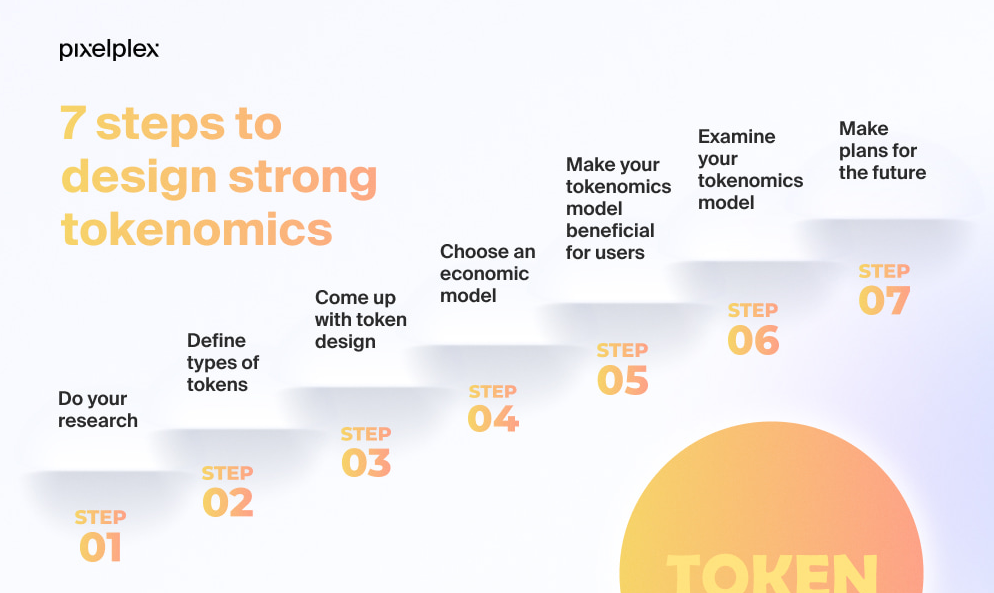
Finally, there are the tokenomics designers. This is a really interesting role that would have simply not existed across most of the last decade. Tokenomics is the economics of a crypto token — how those tokens are issued, how they are distributed, how they provide value, and how they evade inflation. So a Tokenomics Designer is basically a central banker for a micro-economy. They determine the monetary policy of a new digital nation.
Why does this exist? As many of the earlier projects collapsed under the weight of a broken economic model, overprinting of tokens, or not providing users with an incentive to keep them. This position demands a strong foundation in economics, math, and game theoretics. You can no longer run on intuitive thought, you must learn about supply and demand curves, structure of incentives, behavioral psychology. Scenario modelling by a Tokenomics Designer: "If we give users 10% yield, will they sell or hold? What if it crashes in price? This is a task for the strategists and the modelers — the spreadsheet and abstract-systems people. They are the ones who need to be making sure that the project is sustainable for years, and not something here today, gone tomorrow.
A Global Shift in Employment
So, what does all of this mean for the world? It is simple to view the data-challenged oddball billionaires like Vitalik Buterin and assert that crypto is merely being a transfer mechanism for the whiz kids. And while that's part of the story, it's not the whole story. These kinds of jobs ensure the ability to pay bills and even careers for regular people, people who might be living in countries with currencies facing collapse or people who simply do not fit into the 9-5 corporate world. For example: A writer located in Nigeria, writing for a DAO in New York can earn a global rate. For example, a Filipino moderator can make a living out of running a community for a London-based protocol. It signifies disassociating work from location.
In traditional tech, remote work often isn’t really, since you still need to be in a certain timezone or even have a work visa, unlike with crypto work. You get paid in stablecoins (crypto dollars) which land in your wallet immediately, skipping the slow and high cost banking system. This means a new permissionless layer of economic opportunity for the world. Not all of us can get a degree at an Ivy League school, but anyone can learn Solidity and write smart contracts. A community manager is a profession that you do not need a work permit for. Your responsibility is simply to demonstrate that you are capable of performing the work. Letting a few average Joes simply make ends meet, save for retirement, and take part in an inclusive global market they otherwise lacked access to.
Resources and Running Costs
But this economy, too, is based on resources. Gas is to a blockchain what gas is to a car — a car needs gas to move, and so does a blockchain need energy to process transactions. For the high frequency user, managing these costs is just another aspect of the job. Now smart traders and businesses are always looking for methods to cut overhead and thus the TRON network has established a considerable market where one can purchase TRON Energy to basically get rid of transaction fees. At the same time, rather than burning tokens for each transfer, users can use inexpensive TRON Energy via rental markets. Decisions involving this management of resources serve as a micro-job in themselves for many ops managers. The maturity of this industry is underscored by the professionalism of these resource markets.
It is no longer dealing in back alleys but it is dealing via sophisticated platforms also ensuring efficiency. Still an important factor among users that needs to be catered is that when users need to operate, they look for TRON Energy and Bandwidth sources, which can be confirmed by the reliability of TRON. The cryptoverse is rough and it is the service sector of crypto that comes to play here, smoothening those rough edges for a better interaction with the blockchain. It means that the market, and the technology, has tipped from "experimental" to "industrial," where saving money and speeding up processes are the things that matter most.
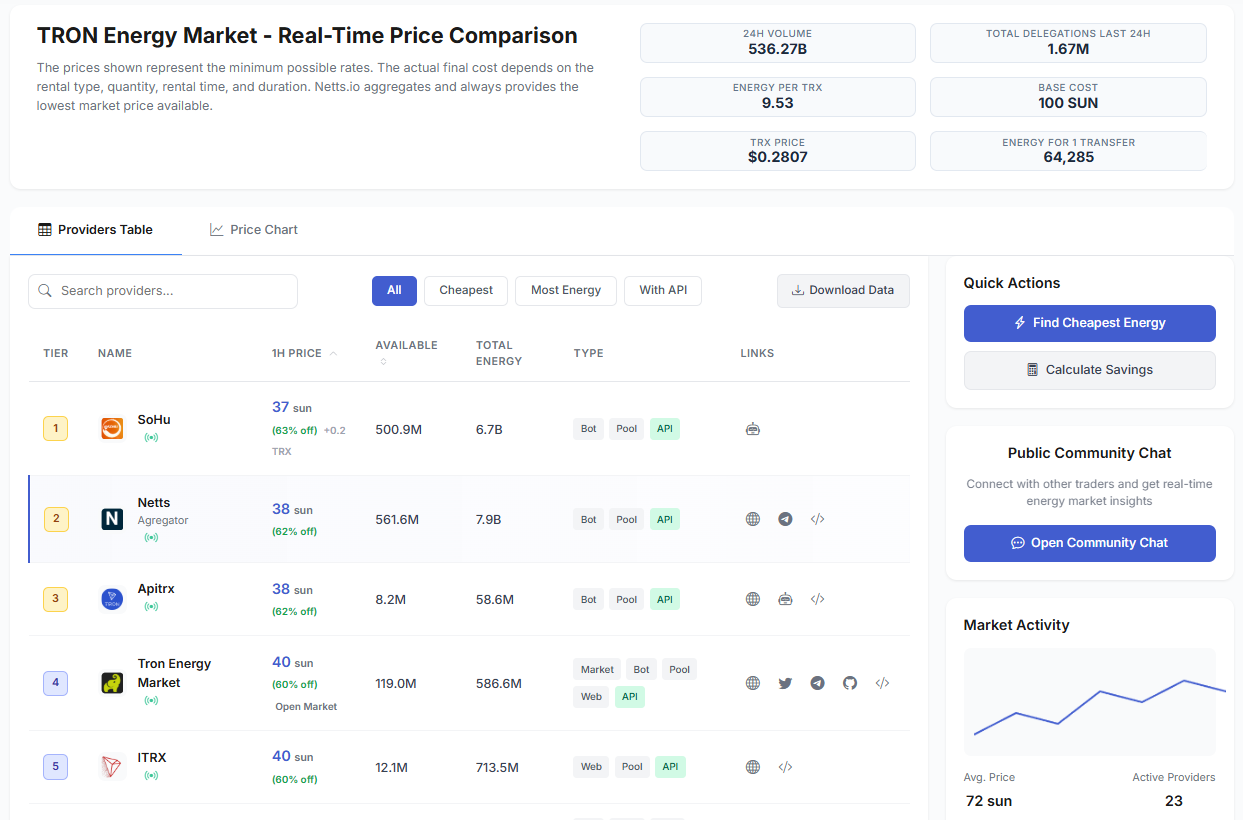
In the name of efficiency with low resource consumption, services such as Netts have popped up to make this very same process easier with their TRON Energy Market. It provides a real-time comprehensive aggregator that compares prices from more than 20 providers in order to fetch the lowest market price that users need via perfect user-to-user comparison-service. It is not only a centre of liquidity, with base costs often hovering around 37 sun — up to 83% discount to official cost — and 24-hour volume exceeding 495bn; it provides an immediate and proven solution for traders and developers to cut down their transaction overhead.