Green Crypto: Why the Environmental Footprint of TRON is Exemplary
Climate action is getting higher on the agenda in the world, and the environmental impact of our financial systems could not matter more.
Climate action is getting higher on the agenda in the world, and the environmental impact of our financial systems could not matter more. With climate change charging full steam ahead and natural resources running out, there is a reckoning due in every sector — all need to take a look at the greenhouse gas footprint of their activities. Often the elephant in the room in these discussions, the financial industry is responsible for a good chunk of this destruction.
Traditional finance has a big environmental footprint — from the needs of paper bills to the coordination of large ATM and branch networks. With the need for more green solutions, industries are turning towards digital to explore blockchain technology and cryptocurrencies. TRON, in particular, shines as an environmental steward and a blueprint for our sustainable, efficient future of finance.
The environmental footprint of finance is more than an abstract issue — it has a significant real-world impact. The amount of resources and emissions consumed by the global financial system is massive. Trillions of dollars worth of banknotes get printed out each year, millions of plastic cards get manufactured, and thousands of metric tons of paper are used for receipts, statements, and documentation.
The energy that powers world banks, ATMs, and payment networks is immense, which is an enormous source of carbon emissions that contributes to global warming. With the population of the world and economies growing, the environmental costs of traditional finance are only becoming bigger. This makes the quest for greener alternatives not only something to strive for — but a necessity in order to sustain future generations.
TRON vs. Traditional Finance — the Eco-Friendly Way
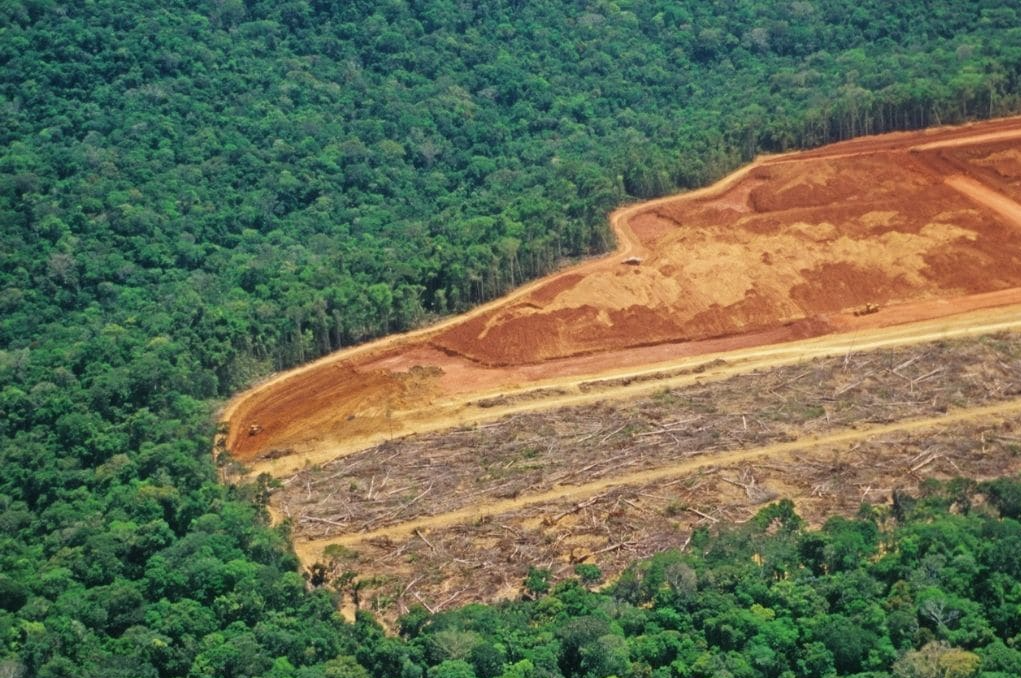
Conventional finance has its roots in a physical infrastructure and consumption-intensive processes. Just paper money production alone requires cutting down millions of trees every year, which in turn leads to deforestation and the disappearance of important carbon sinks. Plastic debit and charge cards have their own drawbacks, as the manufacturing procedure creates additional plastic for the environment and is based on petroleum materials. Each cash and card transaction relies on a system of bank branches, ATMs, armored vehicles, and data centers that require tremendous energy to construct, operate, and maintain.
The ecological cost goes beyond that. Moving cash between banks, ATMs, and merchants utilizes fossil fuels, which contributes to an increase in greenhouse gases. Bank buildings also require a degree of physical security and air conditioning for effective heating and cooling, which further contributes to the sector's carbon footprint. Disposing of old banknotes or expired cards also has waste management issues. Perhaps even more so in cash-dominated economies, much of the infrastructure necessary to accommodate ubiquitous cash, fleets of armored trucks, security personnel, and specialized facilities make up the clandestine ecological price of money in a wide array of countries.
For example, take the life cycle of a banknote. The process starts with tree harvesting, wood pulp processing, and using water and chemicals to create the unique paper. After printing, the note is circulated until it deteriorates, and then it is collected to be destroyed, usually by incineration. Every stage takes up resources and emits carbon. Given the billions of notes in circulation around the world, the magnitude of the problem becomes evident.
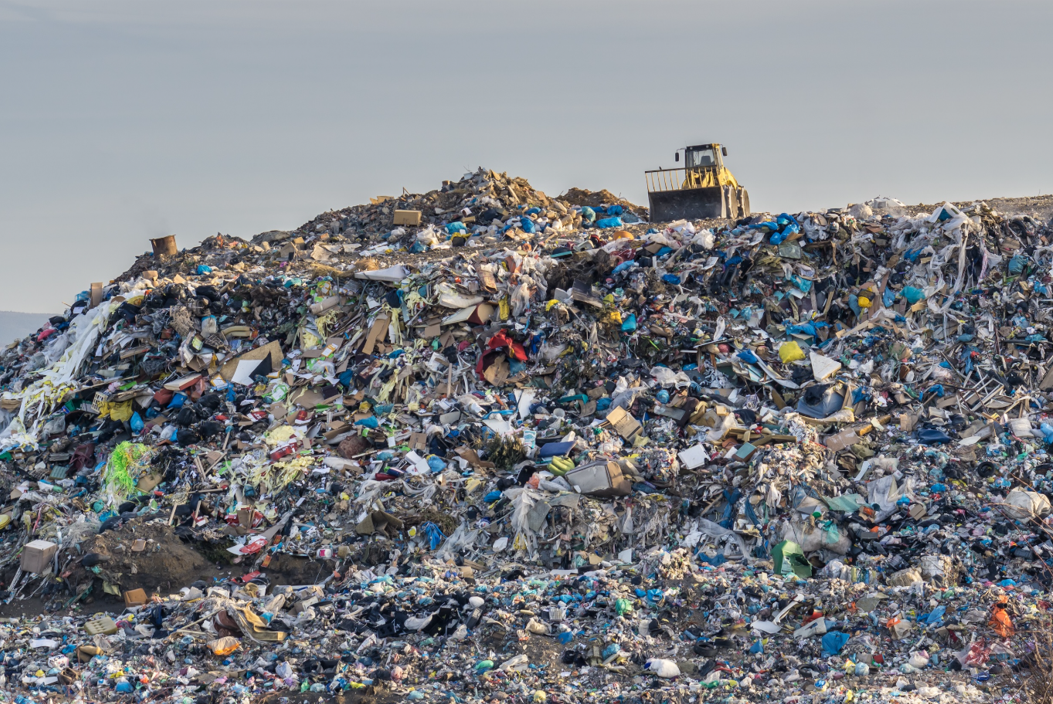
Plastic cards also have a big climate impact. Energy and raw materials come into play with PVC plastic manufacturing, chip embedding, and printout of security features. And that, of course, will result in the need to discard them, which contributes to the increasingly severe problem of plastic pollution. Billions of cards are produced every year for the global payment card industry, most of them ending up in landfills.
In contrast, TRON exists entirely digitally. No need to destroy forests to produce paper currency, no need for plastic cards, no need for endless convoys of vehicles to transfer money. On the TRON network, the transactions are digital and do not need the actual infrastructure and the energy usage that comes with it. Transitioning from traditional finance to digital finance is another huge leap forward in minimizing the ecological footprint of currency. With no physical branches required, the TRON network can be accessed globally (from anywhere you have an internet connection), contributing to financial inclusion — all without the carbon footprint.
How TRON Outshines other Cryptocurrencies
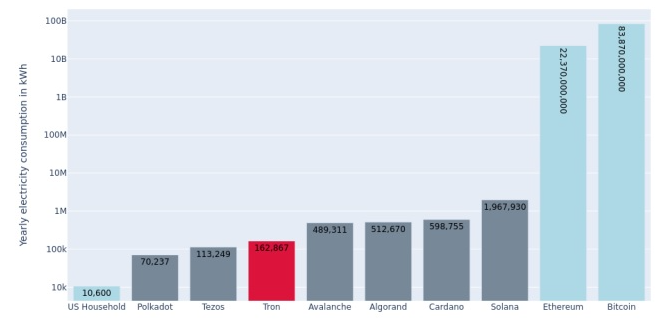
Although crypto as a whole is more green than TradFi, there are significant differences between the environmental impact of individual cryptocurrencies. Take Bitcoin, for instance, which uses a proof-of-work (PoW) consensus mechanism that forces miners to solve complex mathematical problems on specialized, energy-hungry ASICs. This process requires massive amounts of electricity; Bitcoin’s annual energy consumption has been compared to that of entire nations. Bitcoin mining has become a global environmental problem — some places in the world have experienced power shortages and increased emissions due to mass mining.
TRON, for example, employs a delegated proof-of-stake (DPoS) consensus mechanism. Instead of using the thousands of miners to compete with one another to validate transactions, TRON lets a small number of elected validators maintain the network. This method allows keeping the network functional with a fraction of the computational power needed. TRON's "Annual Electricity Consumption Over Time" as of recent data shows that the total amount of electricity consumed by TRON is comparable to only a handful of normal households, and its carbon emissions are a small fraction of those from PoW-based blockchains.
DPoS is not only more energy-efficient but also more democratic. TRON token holders cast votes for the validators securing the network; this decentralizes power and helps keep the system secured and sustainable. This enables TRON to process thousands of transactions per second while consuming very little energy, making it one of the most efficient blockchains operating today.
TRON doesn’t just save energy with its approach, but also has other benefits to offer. The network also bypasses the environmental price of manufacturing, operating, and disposing of those devices, as no expensive mining materials are required. It means reduced electronic waste and decreased consumption of rare earth metals whose extraction is typically environmentally damaging. Moreover, the efficient nature of TRON allows it to rapidly scale to millions of users without the associated increase in energy usage typical for PoW-based systems.
How TRON Minimizes Environmental Damage in its Multiple Forms
There are various environmental benefits TRON has in comparison to traditional finance and even other cryptocurrencies. Here are the most notable ones:
1. Preserve forests and reduce carbon footprint — Paper currency requires cutting down trees. Reducing paper money demand helps preserve forests, the lungs of the Earth that provide oxygen for us and biodiversity. 2. No plastic cards — meaning reduced plastic waste streams and reduced demand for petroleum-based materials. This move also eliminates the production of chips for cards, as well as the electronic waste from card chips. 3. No armored convoy, no armored cash truck, fewer fossil fuels, and fewer emissions. There is no actual movement of money, which means that digital transactions can be instantly completed. 4. Avoids construction materials for ATMs or physical bank branches — energy for facades, lighting, heating, cooling, and ongoing maintenance. Fewer physical infrastructure leads to less land consumption as well as less resource usage. 5. No need for power-hungry hardware to mine (thereby massively reducing electricity usage and e-waste). TRON’s DPoS is built to provide sustainability from the outset by minimizing environmental impact. 6. A smaller number of physical security and waste management is required due to digital transactions. They do not require the risk of theft and do not need to render old notes or cards useless. 7. TRON Energy Market — for optimal resource utilization and rentable Energy on TRON, leading to further enhanced sustainability of the network. TRON's energy consumption approach permits customers to access sources based on requirement and assists in saving energy while keeping the network strong. The renting feature of TRON Energy allows for much more equitable participation, as users without large resources will still be able to afford participation in the network.
TRON Energy Market: Greener Transactions
Here comes the TRON Energy Market, which is one of the most pioneering features in the TRON ecosystem itself. A resource known as Energy is needed for any transaction and smart contract execution on the TRON network. Users would need to freeze a lot of TRX tokens in order to get Energy, which is inefficient and locks up many assets. The TRON Energy Market alleviates this by allowing users to rent Energy on TRON for brief intervals of time, thus providing a more accessible and sustainable way to do transactions.
TRON Energy rentals have become the norm, allowing users to transact without unnecessarily burning TRX. This system not only saves money but also maintains an efficient use of the network's resources. The TRON Energy Market also helps reduce wasted resources and supports sustainability across the TRON blockchain. Renting Energy on TRON is uniquely useful for enterprises and individuals who wish to perform high volumes of transactions while avoiding locking up capital for extended periods.
There are many exciting new features and services being developed to make renting and using Energy on the TRON Energy Market even more efficient and user-friendly. In 2025, the market has never seemed more inviting, with platforms and bots allowing practically anyone to jump in. It is this flexibility and efficiency which is a major factor in why TRON is widely regarded as one of the greenest blockchain networks currently available.
Renting Energy on TRON is an easy process. Through the TRON Energy Market, users can choose the TRON Energy they want to rent, and it can be selected from different platforms according to the amount of Energy users need and the duration of the rental. The market connects users with providers who have surplus Energy as per their requirement, hence optimizing resources. Such a system cuts down costs for consumers and also contributes to supply-demand regulation throughout the network, contributing to sustainability.
To anyone doing frequent transactions, renting Energy as needed can be a game changer. This frees up money that would otherwise be tied up in large TRX locks, freeing capital for other uses and bringing the network to a wider audience. The TRON Energy Market fosters an environment for new services and applications to grow by allowing developers to access resources without requiring a significant upfront investment.
Future Without Physical Finance
TRON is a prime instance that the transition towards digital finance is really a paradigm shift that changes how we conceive of money and its cost to the ecosystem. TRON is also contributing towards a sustainable future by removing the necessity of cash, plastic cards, and the whole industry that supports them. With its energy-efficient consensus process and creative approaches, such as the TRON Energy Market, the network powers on without contributing to the environmental issues that have long dogged both the legacy financial system and older cryptocurrencies.
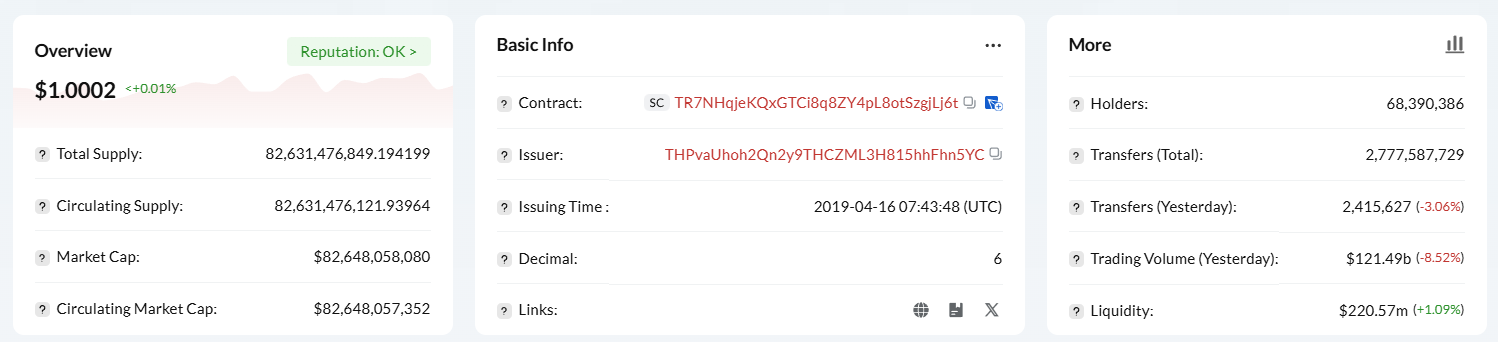
The total environmental benefits will grow as more people and businesses adopt TRON and similar platforms. Changing our behavior could result in significant cuts in resource use, waste, and emissions that would contribute to tackling climate change. We can all help create a more sustainable world by choosing greener financial solutions. Just look at how well the USD's digital double, USDT, is doing:
A world where there will be no need for physical finance anymore is not merely a fantasy — it is slowly approaching. Digital currencies such as TRON will allow hundreds of millions to bank without banks, branches, or cash. The ability for people in rural or disadvantaged regions of the world to earn money in the global economy is a great boon to social justice as well as for the planet through this democratization of finance. When digital finance continues to develop, the benefits for the environment and society will only become clearer.
USDT Transfer Calculator: Smart and Green
Energy and Bandwidth: this is crucial for those who transfer USDT on the TRON network frequently. The USDT Transfer Calculator is a great added feature that helps users calculate how much Energy and Bandwidth are needed for each TRC20 transfer. A visual guide of what you need to make this transaction is as easy as entering the sender and receiver addresses. So, they can rent the correct quantity of Energy in advance without burning unnecessary TRX and save some cost.
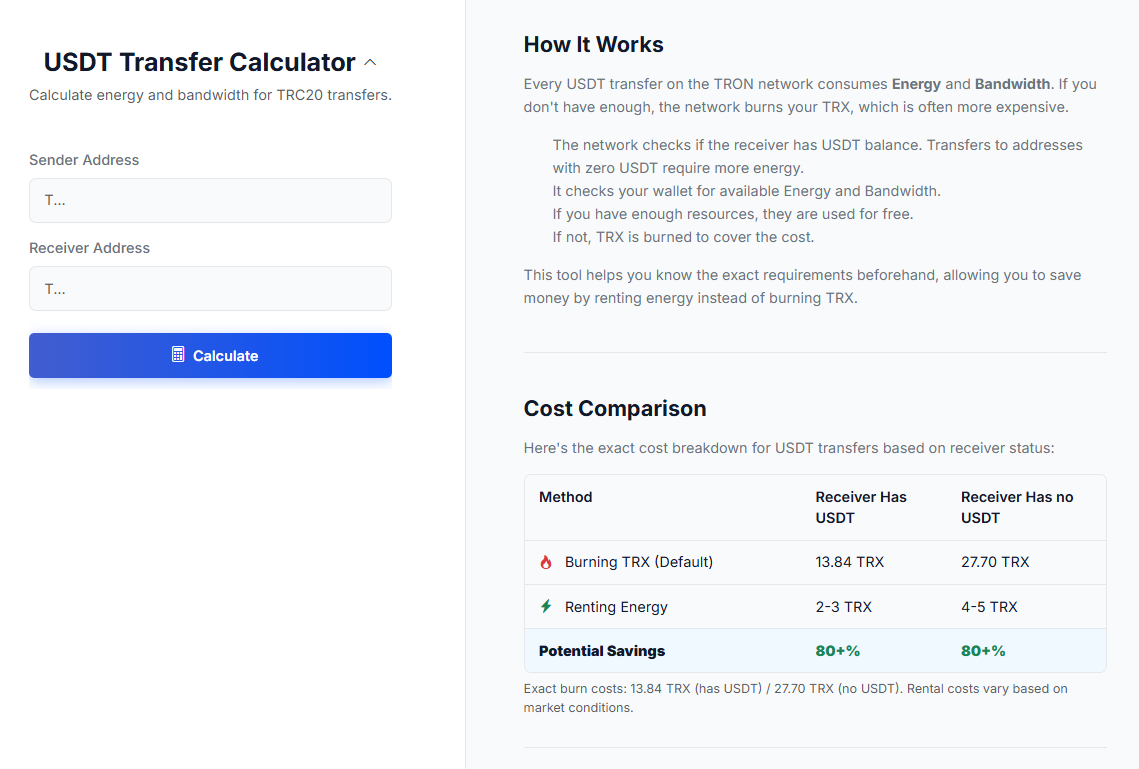
The calculator also offers a transparent cost breakdown, displaying the savings possible by renting Energy rather than burning TRX. This can cut transaction costs by more than 80% for users in many cases. The API is hugely beneficial for developers and businesses since it gives programmatic access to energy calculation data and can easily be integrated with existing workflows. With the USDT Transfer Calculator, users save money while ensuring the effective and optimal use of the TRON network's resources, solidifying its status as a green blockchain leader.