Drugs and Crypto: Ancient Vices Meet New Tech
Drugs found crypto before regulators did — dark web markets, privacy coins, and the AML arms race that defines crypto's most contested chapter.
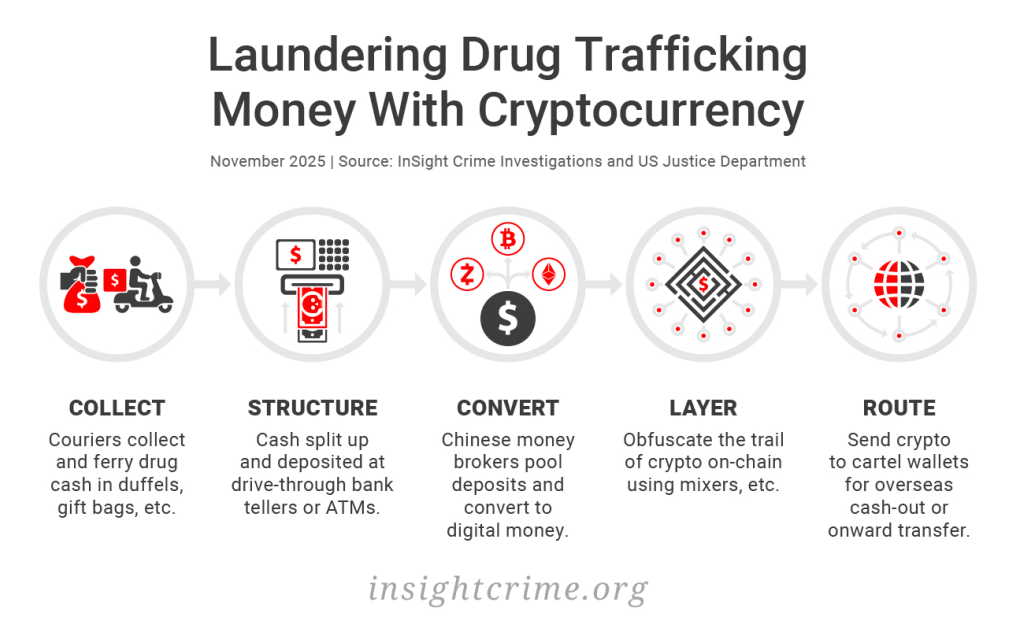
After 50 years of fighting the war on drugs, we're losing to the drugs. This is not a controversial statement — it's a statistical fact. Since Richard Nixon called substance abuse "public enemy number one" in 1971, Western governments have spent trillions on enforcement, prosecution and border interdiction. Supply lines have been ruptured, cartel bosses extradited, distribution webs unraveled. The effect has been, at least, a series of short-lived disruptions. Demand continues if not quite non-stop, then with what feels like mathematical precision, and wherever there is demand, supply manages to find a way to meet it.
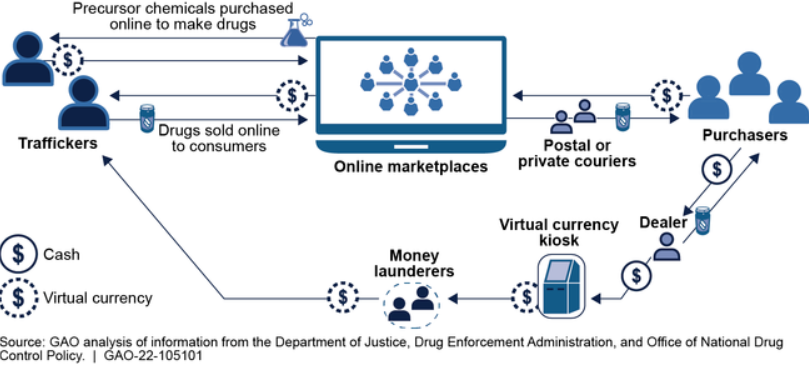
The internet was intended to do the opposite for law enforcement. That means better surveillance, better communications, better coordination across borders. What it did, in practice, was give the drug trade a logistics overhaul. The dark web — that encrypted, mostly anonymous tier of the internet reached via browsers such as Tor — enabled a connection between buyers and sellers that might never have met and likely never would. Distance became irrelevant. Borders became mail-sorting problems. And money, historically the most traceable aspect of any criminal enterprise, found a solution in cryptocurrency.
Bitcoin, Ethereum, Monero, Tether — none were built for narcotics. Satoshi Nakamoto wrote of a peer-to-peer system for transferred trustless value — a financial technology that required no banks and no governments. The vision was libertarian in spirit, utopian in its assumptions. What that vision most likely did not anticipate was the rapidity with which criminal enterprises would appreciate the operational value of a borderless, pseudonymous means of payment. Criminals are first and foremost pragmatists. They saw in cryptocurrency a solution to multiple pressing issues — and they moved more quickly than regulators.
Logic Behind the Ledger
To get a sense of why the drug trade took up cryptocurrency so completely, it's useful to work through the problems it solved. For criminals, traditional money is serious baggage. Cash is heavy, it draws attention and involves risk to transport in bulk. Wire transfers leave an audit trail prosecutors like. Prepaid debit cards have restrictions and they leave audit trails. This creates a need for trusted third parties, in turn themselves potential informants/failure points. Pretty much the whole institution of your regular old finance is purpose built for catching and reporting suspicious activity.
Cryptocurrency offered something different. Bitcoin transactions are logged on a public ledger, but the addresses that participate in them aren't names — they're long strings of alphanumeric characters that have no intrinsic identity. A seller on a dark web marketplace could publish a wallet address, receive payment from a buyer located on the other side of the planet, and never touch or interact with the money once. No face-to-face exchange. No bank with a suspicious activity report. No courier to arrest.
The volatility argument — the standard argument that cryptocurrency is simply too volatile to be a reliable medium of exchange — ends up having very little relevance when it comes to drug trafficking. Dealers who are immediately converting their crypto receipts to cash within a few days aren't sitting on long-term speculative bets. They're treating the blockchain as a transit rail, not a savings account. And when gross margins on fentanyl are in the hundreds of percent, a twenty percent price fluctuation in your currency of choice is an inconvenience rather than a dealbreaker. The risk calculus is very different from the inside of a business where every transaction is already illegal and alternative financial infrastructure is much more treacherous.
Then there is the issue of geography. Dark web drug markets function on a fundamentally international scale. A purchaser in Helsinki, a seller in Belgium, a package passing through a postal system never meant to conduct this type of screening. It would be insane, and dangerous besides, to set up a regular bank transfer to go with that transaction. Cryptocurrency made the transaction as frictionless as the product listing itself. Technology built for borderless commerce delivered borderless criminality just as seamlessly.
The shift toward more privacy-oriented deployments was the logical next step after Bitcoin had begun to be traced through blockchain analytics in ever bolder and more sophisticated ways. Monero launched in 2014, and the serious operators in the darknet ecosystem soon adopted it as their preferred coin. Unlike Bitcoin, which creates an unambiguous record of all transactions on a public ledger, Monero uses techniques like ring signatures, stealth addresses and confidential transaction amounts — methods that leave investigators staring at nearly total opacity. By 2020, White House Market, then one of the largest operating drug platforms on the dark web, had completely ceased accepting Bitcoin and only took Monero payments. Other markets followed. The technology had evolved, and so had the criminal underworld.
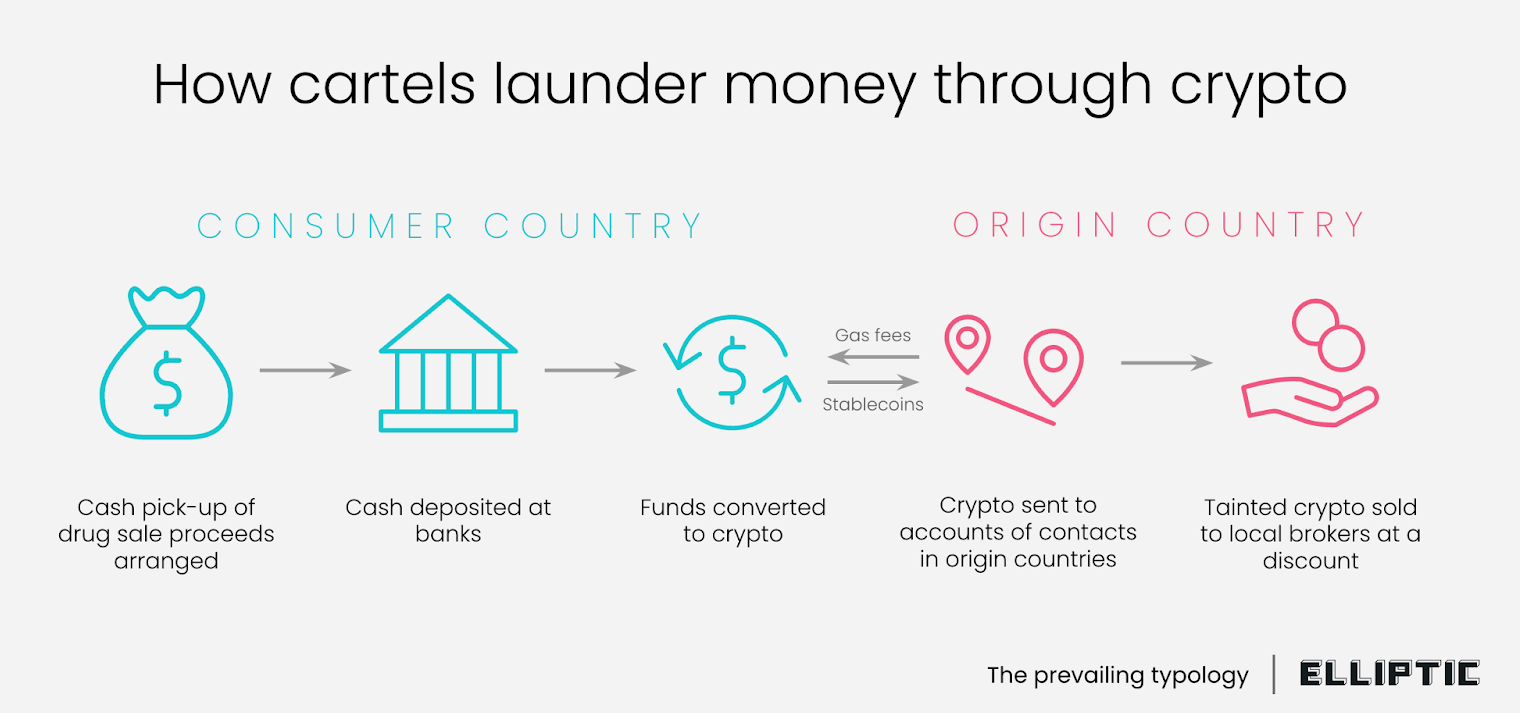
Stablecoins introduced yet another dimension. Tether's USDT — especially as run on the TRON blockchain — became an important vehicle for moving illicit value across borders with limited friction. With its architecture — using Energy and Bandwidth as the lowest-level resources for transaction flows instead of traditional gas fees — TRON became a very favorable opportunity for high-frequency transfers, while energy vendors in the ecosystem limited this cost to be super cheap for ordinary people. TRON represented a staggering 58 percent of all illicit cryptocurrency activity in 2024, according to analytics firms tracking on-chain flows. Latin American drug cartels, such as the Mexican and Colombian ones, use USDT to offer a stable currency with which to settle their deals, as they operate in an environment that is frequently very volatile — having a coin that doesn't flip twenty percent while you try to coordinate some sort of cross-border load just makes it easier.
From Silk Road to the Russian Hydra
There's a clear starting point in the history of crypto and the drug trade: Silk Road. Established in February 2011 by Ross Ulbricht — a 27-year-old physics graduate student from Texas who called himself "Dread Pirate Roberts" — Silk Road was the proof of concept on which an entire darknet economy would be constructed. It was a Tor hidden service and only accepted Bitcoin. The interface modeled real-life e-commerce: vendor ratings, buyer reviews, dispute resolution, customer support.
Transactions from its launch until its shutdown in October 2013 added up to about $1.2 billion. When bitcoin launched with a value of less than one dollar, no one in mainstream finance paid much attention. By the time the FBI shut the site down, they were paying a hell of a lot of attention.
Ulbricht was apprehended inside the Glen Park branch of the San Francisco Public Library — his laptop opened to a live session, all data available to be scraped before he could damage anything. He was convicted in 2015 of charges that included drug trafficking and money laundering, receiving a sentence of two life terms plus forty years. President Donald Trump signed a full and unconditional pardon for him in January 2025, referring to pledges from the 2024 Libertarian National Convention. The pardon was trumpeted in some crypto circles and condemned in others, but it did something else more lasting than either reaction: it put Silk Road and Bitcoin back in the same news cycle, sparking all of the debates about cryptocurrency's ties to criminal enterprise that the case originally sparked.
The void left by Silk Road's closure was swiftly filled. AlphaBay, run by Alexandre Cazes, a 25-year-old Canadian based in Thailand, came to dwarf its predecessor. By mid-2017 it had amassed more than 250,000 listings — on drugs, stolen financial data, hacking tools, forged documents — for total transactions above one billion dollars across Bitcoin and other digital currencies. Operation Bayonet, a joint international operation in July 2017, took AlphaBay offline and arrested Cazes in Bangkok.
A week later, he was dead in his cell, an apparent suicide. Dutch police — who had been working undercover in this same operation — had also seized administrative control of Hansa Market, AlphaBay's most serious competitor, and they ran it for an entire month while gathering data on its users before shutting it down. The two-fer takedown was a symphony of law enforcement coordination. New platforms sprung up in the months that followed to take their place.
Nothing was a starker illustration of the problem at the heart of it all than Hydra. Founded in 2015 and serving mainly Russian-speaking nations, Hydra was not just big — it was dominant. At its peak, it represented an estimated 80 percent of all cryptocurrency transactions that passed through darknet markets worldwide. In its lifetime it had processed around $5.2 billion in cryptocurrency. Hydra had created its own money laundering infrastructure, its own cryptocurrency exchange services and a physical dead-drop delivery system for drugs across Russian cities. German law enforcement, with assistance from American counterparts, seized its servers and closed it down in April 2022 — confiscating $25 million worth of Bitcoin. At the same time, the U.S. Treasury sanctioned Hydra and Garantex, a Russian exchange that had become an essential money laundering pipeline.
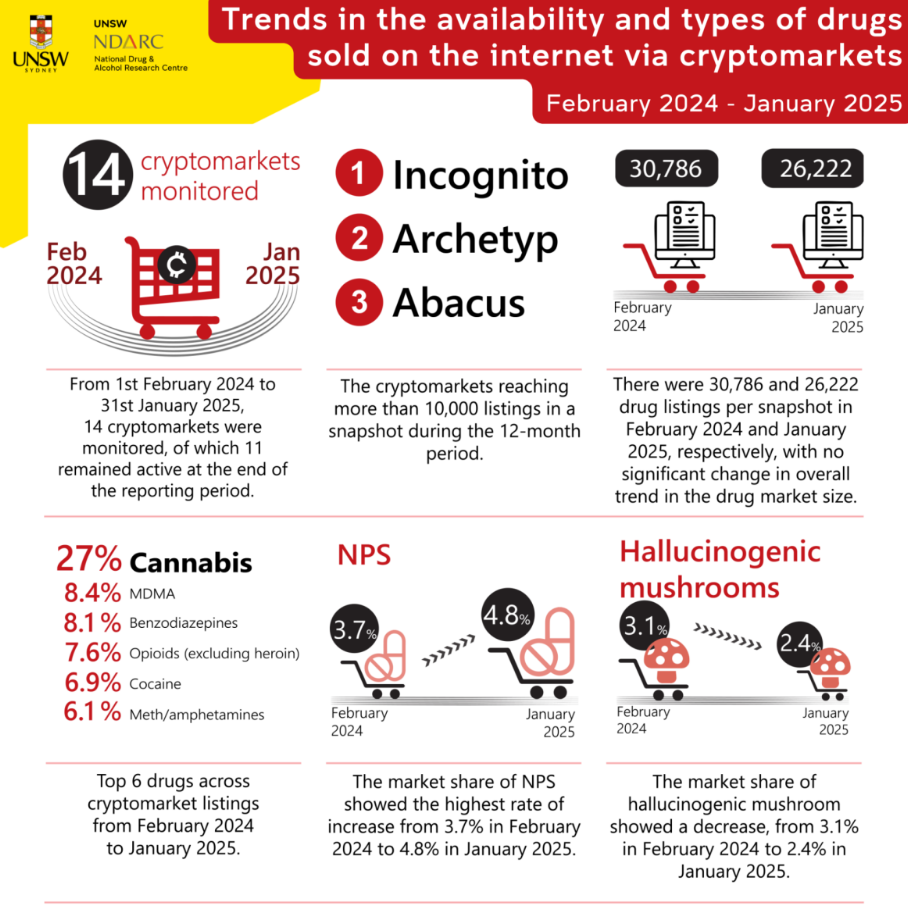
The response of the market was precisely what onlookers were used to. Within eight months, analysts at TRM Labs and Chainalysis recorded a spurt of successor platforms — at least a dozen new Russian-language marketplaces vying to make off with Hydra's former user base. In 2024, Russian-language darknet markets registered more than $1.7 billion in cryptocurrency inflows. For all the platforms combined, darknet market volumes were roughly $2.6 billion in 2025. The demand simply relocated. No single law enforcement action, however technologically impressive, has been able to create a permanent contraction of the market.
The fentanyl crisis introduced an element of urgency that turned the discussion from drug policy debate to public health disaster. Blockchain analytics revealed direct financial ties between Mexican drug cartels, Chinese suppliers of fentanyl precursor chemicals and flows of cryptocurrency payments — with Chainalysis identifying over $37.8 million in suspicious transfers associated with suspected vendors of Chinese precursors.
U.S. authorities imposed sanctions and handed down indictments against fentanyl trafficking networks, in part thanks to this on-chain evidence, in October 2023. A follow-up diplomatic accord between Presidents Biden and Xi resulted in a recommitment to bilateral cooperation on counternarcotics enforcement. The ensuing disruption to fentanyl supply chains — visible as a dip in on-chain transaction data — came before overdose deaths fell through 2024, analysts argued. The blockchain's permanent ledger — the very thing that had made it useful to traffickers — also demonstrated those trafficking networks legible to investigators in ways traditional cash transactions could never be.
Reputational Fallout
The association of cryptocurrency with drug markets has caused a large, long-lasting and gleefully seized opportunity to discredit the technology. Every major darknet takedown provides a news cycle with Bitcoin and drug trafficking headlined at the same time. Politicians uneasy with a financial system that works outside government control discovered in Silk Road, AlphaBay and Hydra precisely the justification they needed to demand heavy-handed regulation — or outright prohibition.
In the United States, Sen. Elizabeth Warren emerged as one of the loudest proponents of this argument, constantly quoting drug trafficking statistics in the context of her support for legislation that would impose stringent compliance duties on crypto actors. The framing was simple and politically savvy: if this technology is mainly used by criminals, then why should regular people be permitted to use it out of sight of the government?
The same kind of rhetoric also surfaced in European parliaments and regulatory bodies, with some officials demanding outright bans on privacy coins. Under regulatory pressure, some jurisdictions have already pressured exchanges to delist Monero. In a strange consequence of Binance's action, which was apparently unintended, Chainalysis in early 2025 said that after it took Monero down from some regional markets on its platform, certain darknet platforms started to steer volume back toward Bitcoin — an asset that is much easier to trace, and arguably helps law enforcement. In their efforts to crack down on one privacy tool, regulators may have unintentionally pushed criminal activity toward one that investigators can follow.
Cryptocurrency supporters responded with data. Analytics firms repeatedly found that illicit activity was a small percentage of overall cryptocurrency transaction volume — about 0.34 percent in 2023 — compared to an estimated eight hundred billion to two trillion dollars laundered per year through the conventional banking system. Cash is still far more critical to the global drug trade than any digital currency. But these arguments struggled to compete against the political and media punch of a clear villain. The nuance wasn't good television.
The ramifications also reached into the world of business. Institutional investors said regulatory uncertainty dissuaded them from making larger allocations. Banking relationships for cryptocurrency companies were hard to establish in many countries, partly because compliance officers at traditional financial institutions still feared the criminal associations of the sector. Payment processors held back. It was more difficult to get insurance products. Every new headline about enforcement added another layer of resistance to the technology's mainstream adoption, worsening a reputational challenge that the industry didn't create but couldn't fully evade.
Compliance Arms Race
The answer from both within the industry, and law enforcement, has been to construct an increasing blockchain analytics ecosystem — a suite of tools created to chip away, piece by piece, at the pseudonymity that made cryptocurrency appealing to criminals in the first place. Chainalysis, Elliptic, CipherTrace, and TRM Labs created platforms that parse public ledgers to cluster addresses into probable real-world entities, flag transactions linked with known sources of illicit activity and give law enforcement technically robust evidence for prosecutions. By 2025, Chainalysis alone had helped facilitate cryptocurrency seizures that surpassed $12.6 billion. Blockchain tracing played a role in the takedowns of Silk Road, AlphaBay and Hydra to some extent. The immutable transparency of the blockchain — its defining difference from cash — turned out to be a double-edged sword.
These tools were accompanied by the development of regulatory frameworks. The Financial Action Task Force's Travel Rule mandates that identifying information about both the sender and recipient travels with cryptocurrency transfers above certain thresholds. The EU's Markets in Crypto-Assets regulation introduced broad AML requirements for exchanges operating on European soil. The Bank Secrecy Act was expanded in the US to apply to cryptocurrency exchanges, and the GENIUS Act, which worked its way through Congress through 2025, extended these compliance obligations to stablecoin issuers.
Within the TRON ecosystem specifically, the TRON Foundation, Tether and TRM Labs formed the T3 Financial Crime Unit, which froze over $100 million in funds associated with drug trafficking and other criminal activity. The industry was, more and more, policing itself.
But each of these solutions comes with a price that is uncomfortably at odds with the technology's founding principles, and the contradiction between effective crime prevention and basic privacy for everyday users has not been solved — only exacerbated. A few of the key contradictions:
1. Blockchain analytics tool law enforcement with the most unprecedented traceability over illicit flows, but this also means that any average user's entire transaction history is potentially visible to corporations and governments — not just your own, but whoever buys access to the relevant tools.
2. Exchanges' KYC requirements produce centralized databases of user identities, which themselves are targets for data breaches and government overreach — concentrating precisely the kind of risk that decentralization was designed to eliminate.
3. Abuse of privacy coin delisting punishes law-abiding users merely wishing to retain financial privacy, all while serious criminal entities easily route around compliant platforms.
4. Decentralized trading hubs and self-custodial wallets have no single operator able to enforce compliance, leading to the still unresolved question of whether open-source software can be held legally responsible for whatever people do with it.
5. Zero-knowledge proof technologies — which could enable identity verification without exposing underlying personal data — offer a promising middle path, but implementation at scale is behind the regulatory curve and most jurisdictions have yet to construct frameworks that would accommodate them.
A 2025 survey found that 45 percent of cryptocurrency users felt KYC requirements undermine the decentralized spirit behind the technology. That sentiment is understandable. It stands, however, alongside the fact that $1.4 billion in suspicious cryptocurrency activity related to fentanyl trafficking was detected in the United States over a single year. Neither of these facts negates the other. They're awkwardly sharing the same policy space, and every proposed solution to one makes the other worse.
The problem is more than a policy issue; it has a philosophical dimension. Cryptocurrency was designed, in part, as a hedge against financial surveillance — a technology that would enable people to transact without permission from banks or states. But its abuse by drug traffickers has provided governments with the very pretext that they required to impose the surveillance and control for which the technology was designed to resist. It is a troubling and deep irony, and one that lies at the heart of every serious discussion as to where the industry goes from here.
There are no clean resolutions. Drug markets will keep adapting — to new platforms, new coins, new obfuscation strategies — at roughly the pace that enforcement adapts to disrupt them. Each major takedown removes an underperforming node from a network that generates replacements. Every new privacy technology both protects legitimate users and gives cover to criminal ones. The blockchain itself is not a criminal entity. There is nothing innocent about it either. It's infrastructure, shaped by the spectrum of people who build on it — those building the future of global finance and, simultaneously, those just trying to purchase drugs without leaving a footprint.
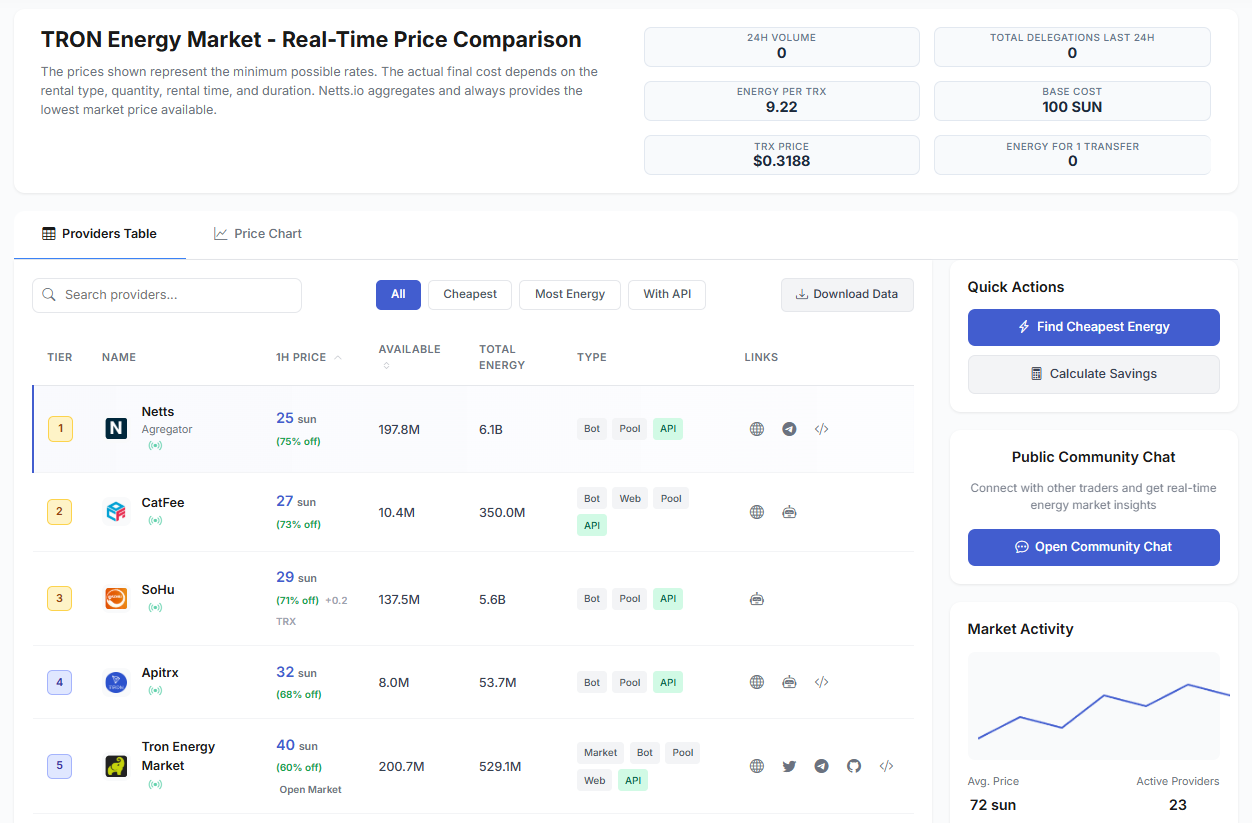
For users of the TRON blockchain who are just trying to minimize their transaction costs on a network that has become one of the most widely used in the world for better and worse, there's a more prosaic practical issue at hand: How do you move USDT without overpaying? Netts (netts.io), a real-time TRON Energy market aggregator, does exactly that — comparing TRON Energy across all active providers and allowing users to identify the lowest available price without checking each of these energy vendors one by one. Tracking more than twenty providers with live pricing shown, and potential savings of sixty percent or greater versus simply burning TRX outright, it is a genuinely useful tool for developers, traders and everyday users transacting on TRON.