Telegram Crypto Wallet: What to Expect?
Telegram’s non-custodial wallet puts crypto next to chat — handy for sending, harsh when a mistaken tap cannot be undone.

Telegram never acted in a polite utility manner. Instead, it was more like a border town that had good encryption but unpleasant neighbours. People were drawn to it because of its speed, its stickers, and the idea that some powerful entity was unwilling to bend. Governments were irritated, banks were irritated, and the compliance departments were irritated too. Yet people continued to join it because the product offered a fantasy which still does: that your conversations are yours, your channels are yours, and the company would prefer to appear difficult than to appear obedient.
That reputation isn't the result of a marketing mistake; it's an incentive system. The feature of end-to-end secret chats, a firm commitment to privacy, and the founder's mythology rooted in exile and defiance have caused millions to see Telegram as the adult alternative for messaging. It makes little difference, in terms of social impact, whether all the claims can be verified by a forensic audit, since what counts is the emotion involved. People feel freer in that environment, and it is that feeling of freedom which ultimately leads to money flowing in. A non-custodial wallet is just the point at which that old feeling finally asks to be turned into cash.
Crypto has always had that sort of atmosphere about it. Even before any wallet button had become acceptable, the app had already become a sort of clearinghouse for tips, OTC deals, scam warnings, alpha groups, and all the kind of commerce that dislikes email threads. Anyone who has seen a deal being negotiated in a private chat is aware of the pattern: distrust, screenshots, partial payments, threats, jokes, and then a sudden shift to trust. Telegram made this kind of rhythm a continuous background presence. A wallet just gets rid of the awkward need to switch to another app in the middle of the conversation. Telegram didn't create crypto culture; it hosted it just as a harbour hosts ships — profitably, chaotically, and with a certain degree of blind spot. The moment a non-custodial wallet finally becomes a first-class citizen within that harbour, the issue isn't whether the code can transfer tokens. The issue instead becomes what kind of human behaviour is amplified when money and chat are shared on the same thumb.
Why Telegram Was Always Going to Touch Money
By adopting a libertarian stance you end up with certain responsibilities. Once you've stated that you don't want to act as a polite telephone company for the state, they soon go on to ask what else you're against. They inquire about freedom of speech. They ask about associations. They look into the grey markets which appear in any situation where moderation moves more slowly than desire. Telegram's response has always been a combination of principle and showmanship: when compelled by law or by public opinion destroy the content that cannot be forgiven, leave the rest in a messy state, and never become WhatsApp with improved fonts.
The position draws in two groups simultaneously. One of these groups seeks privacy in relation to journalism, family, and normal suspicions. The other group desires privacy concerning arrangements which banks would find revolting. Both groups make use of the same blue interface. A wallet doesn't select between them; instead it inherits them.
Think about the channel owner who has spent years earning money through advertisements, tips, and those awkward invoicing procedures. For such a person, a non-custodial button is not merely a matter of ideology; it is payroll infrastructure that has been disguised as freedom. Think about the migrant who is already using Telegram since relatives reside within it. In that case, a wallet is not "Web3"; it is the difference between having to go to a remittance office and simply tapping a contact's name. Take the investigator who needs sources who won't be frightened when asked for a bank statement. For that individual, the app's persistent mythology is essential. The wallet ends up incorporating all three of these considerations and then presents them as part of a single product narrative.
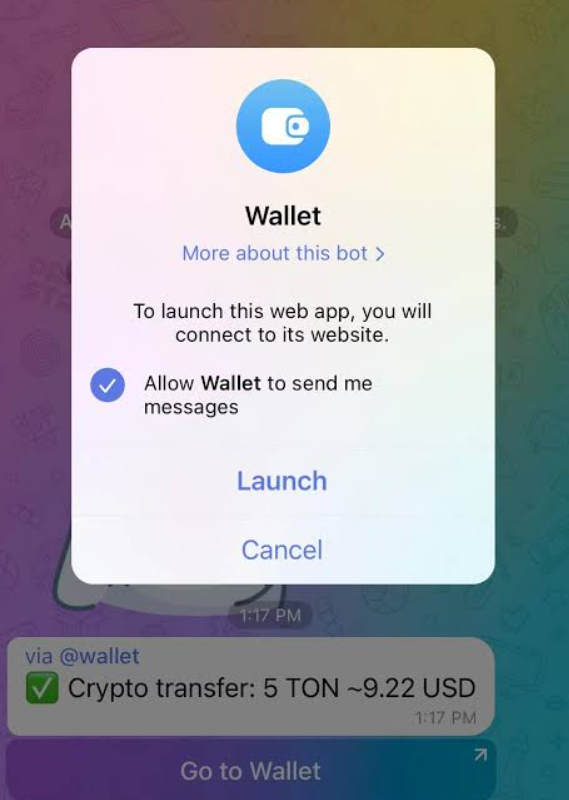
There was also some matter which had not been settled concerning blockchains. When Telegram first tried to set up its own network it caused a public embarrassment — regulators got involved, settlements were reached and the project carried on under new management while the messenger remained at arm's length and continued to long for it. That longing never entirely vanished. TON kept on growing in the shadow of Telegram. The mini apps kept turning chats into storefronts. The bots kept functioning as cash registers. The custodial @wallet phase demonstrated that people would buy, send and trade without leaving the app as long as the obstacles were removed. The following message is about non-custody: not only can you move money around here, but you can also keep the keys here, just as adult people would refuse a banker's apology.
The sermon will be loud, incomplete, and very appealing to those who already place more trust in the chat than in an exchange app that has a flashy logo; what is in fact being extended is trust, the tokens simply serving as the carrier.
What the Non-Custodial Promise Actually Feels Like
In theory, if you choose to have custody of your funds on Telegram, you need to keep your seed phrase on your device, since the service says it does not hold the keys, and you must also maintain your wallet on the blockchain even though the appealing interface may disappear. In practice, though, it's as if Telegram is asking you to graduate. The custodial option is still offered to people who want the convenience of being able to recover their funds. The non-custodial option is provided for those who want to follow the traditional crypto rule: not your keys, not your coins — except that in this case it also includes push notifications and reply threads.
Imagine a freelancer in a city where banks are similar to glaciers. The client makes the payment using stablecoins. So far, the procedure has been annoying: you had to leave the chat, open up a separate wallet, copy an address, hope that you hadn't pasted in a compromised one, and then return to the chat to discuss the screenshots. By incorporating a non-custodial process that is built directly into the messenger, that lengthy series of steps is reduced to the same mental space in which the agreement was made. There is strength in compression, but compression is also risky. The very finger that plays with things at midnight could approve the sale of a month's rent before the mind has even had time to react.
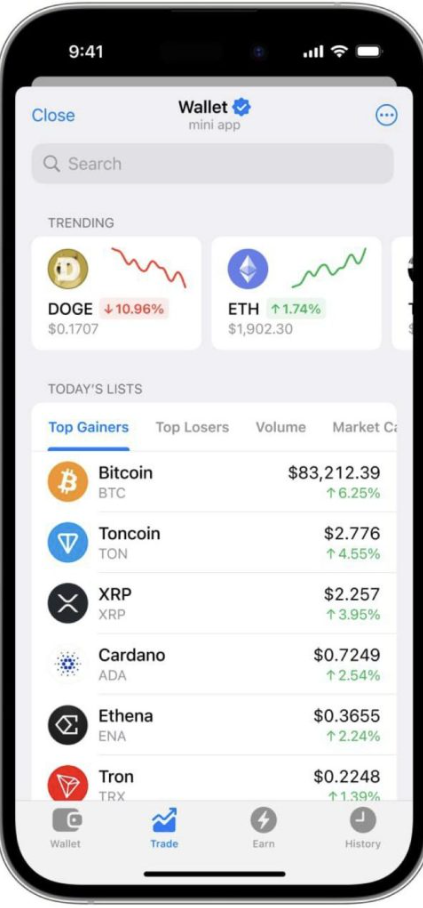
Picture a group administrator who is already conducting tips, raffles, and offering private access. As a wallet is associated with an identity derived from the username, social capital becomes a method of settlement. This is highly attractive to creators yet very intimidating to anyone who understands that errors cannot be undone. Telegram's real strength has always been in shrinking the distance between strangers. Using a non-custodial wallet diminishes the gap between impulse and finality.
What matters more than the technical specifications is the emotional aspect; users should expect TON-first gravity since Telegram has already conditioned them to see the ecosystem as being native to it. They should be given chat-native sending features, the ability to connect with mini-apps, and opportunities for staking as well as access to DeFi for those who are looking for returns and who don't have to install five new icons. Although they should expect multichain capabilities in marketing, in reality the multichain functionality is inconsistent — because providing a wallet for one billion people is not the same as providing a cockpit designed for power users.
So long as the rollout keeps up with its promises, its main strength is in making people develop a habit through the use of messages. In terms of structure, though, it cannot take the place of the firm desktop discipline required when dealing with large sums. Convenience wallets perform better when it comes to distribution, whereas serious investors still stick to simple rituals. It is the ones who fail to see this difference who will end up writing the most angry testimonials, placing the blame on Telegram for a lesson which self-custody has always been free to teach: that sovereignty means having the right to ruin yourself without a appeals department.
Competition Is Not Another Blue Button
The market is full of advocates of self-custody. Tonkeeper and other native TON services have already begun to use the concept of seed phrases without having to get approval from a chat app. MetaMask continues to control the EVM nervous system for those who use browser tabs. Trust Wallet and the various clones closely competing with the exchanges are battling for the multichain user. Hardware devices are there for the security-conscious. Within Telegram itself, bots and mini-wallets multiply as quickly as mushrooms do after a rain — some of them are useful, many of them are predatory.
The reason for Telegram's success is not its better cryptography but rather its ability to attract user attention. Since billions of people already use the app for reasons unrelated to yield farming, wide distribution is more important than purity. This is the reason why established companies should be concerned and why those who insist on purity will ridicule Telegram. Part of that ridicule will be justified. By integrating a wallet into a messaging service, the holy gap between 'I am doing finance' and 'I am scrolling' is diminished. This reduction in the holy gap manages to bring in people who are unsure and causes harm to those who are careless.
Competitors will respond by offering an improved security theater, better hardware pairings, clearer fee displays, and lectures on phishing. Lectures seldom succeed in overcoming the default settings; it is the defaults that bring about the winning of civilizations. Should Telegram make non-custody a default feature alongside stickers, the competitive landscape will be altered even if Tonkeeper is still objectively better suited to power users.
There is also competition coming from Telegram's dual nature. The custodial mode will continue to attract new users through the idea of recovery. The non-custodial mode will on the other hand keep drawing in people who are guided by ideology because it gives them key ownership. Many users won't grasp the difference until they have experienced pain themselves. The fact that there is confusion is no coincidence; it is precisely because of this confusion that the platform is able to win over both groups without making newcomers go through a philosophical test.
Another competitor is more subtle: the longstanding practice of holding “real money” on an exchange and viewing Telegram as something like a gossip club. This practice fades gradually. It disappears the first time a payment made within the chat seems safer than having to wait for the exchange's withdrawal queue. It disappears the first time a mini-app checkout is preferable to using a browser extension. It also disappears when someone mistakes social convenience for financial security and then realizes the difference in public. Competition isn't just about brands; it's also about habits battling one another within the same mind.
What It Is Not — and What People Will Pretend It Is
A Telegram crypto wallet is no miracle defence against the state, fraud, or one's own actions. The fact that it is non-custodial doesn't mean it is invisible. The movements on the chain are still made public in the normal manner. The use of usernames still compromises operational security due to human carelessness. Secret chats may protect messages but they do not alter blockchain anthropology.
One cannot be certain that shady groups will either disappear or flourish in accordance with anyone's moral standards. The record of Telegram's moderation shows a prolonged debate between refusal and the need for action. Those who think that a wallet will clean the app are merely dreaming. So are those who believe that a wallet will use the app's grey areas — and in fact that belief is dangerous. Tools pick up the cultures of the communities that use them; they do not create those cultures.
For the average person, it will not serve as a complete substitute for a cold wallet. Seed phrases saved as screenshots in cloud photos are still funerals waiting for their day to come. Phishing bots which pretend to be support will take advantage of the new generation of self-custodians who are only partly educated. The messenger which taught the world to trust the blue checkmarks will also be used to host the forgeries. That is something to expect.
It isn't available in the same form all over the world. Users will continually be reminded that "freedom software" still includes maps because of region locks, policy switches, and feature gates. The libertarian poem always comes into conflict with the compliance spreadsheet. Telegram is aware of this, and users notice it when a button vanishes.
It can't abolish middlemen so much as it can only reorganise them. Mini-app bridges, swap partners, fiat ramps, and fee routes still remain between desire and settlement. Non-custody arrangements deal with who holds the keys. It doesn't automatically make the world fair.
It won't turn Telegram into a monastery either. The same application which is used for family conversations will still be used for spreading rumours, hosting fake giveaways, and providing accounts that aren't actually support accounts. A wallet raises the stakes in every case of impersonation. The serious risk isn't that cryptography will fail in a dramatic breach. The serious risk is that ordinary people will trust the wrong username at the wrong time because the interface appears familiar. Familiarity is the oldest exploit.
What To Expect From Living With It
Money is likely to seem more like a conversation. It sounds rather poetic until you see someone giving a tip to a stranger for a PDF and then going on to pay a five-figure OTC amount just because the chat has already become intimate. Intimacy acts as a accelerator for financial transactions. Telegram has always offered intimacy on a large scale. A wallet converts that intimacy into a settlement layer.
Scams are likely to become more professionalised as a result of the new trust surface; the most effective form of attack isn't involving the breaking of cryptography but rather borrowing Telegram's social proof for a long enough period to enable a victim to paste a phrase or to approve a blind transaction. Education will not keep up and screenshots of losses will not be taken.
You can expect a sharp cultural shift. Privacy advocates will welcome the fact that users have control of their keys. Regulators will question whether a messenger that has a wallet is still just a messenger. Exchanges will privately dislike the fee reduction associated with in-chat transfers. Regular users will be happy when they can send value as easily as they can send a voice note, only to become panicked the first time irreversibility affects them personally. In the midst of all this change, Telegram achieves precisely what it has always been best at monetizing: relevance. Relevance is not the same as innocence. Relevance means gravity.
There will be a division between ordinary float and serious storage; savvy individuals will continue to keep their spending balances within the app and their sleeping balances elsewhere, while less savvy people will keep all their balances in the places where the stickers are located. The markets are based on the less savvy majority. That should not be seen as an insult — rather, it's a reflection of history.
TON gravity is expected to increase; when the wallet door is opened within Telegram, ecosystem apps receive a lottery ticket for distribution. This results in builders, parasites, and a new wave of 'opportunities' which have the same smell as those of 2021 but with an improved user experience. Part of it will constitute real commerce while the rest will be just a carnival.
It is reasonable to mention a number of practical expectations without indulging in romanticism.
1. Every day, when using peer-to-peer transfers and the mini-apps, the experience will seem natural, though more complicated multichain transactions will still require power users to go elsewhere.
2. Self-custody will give advantages to those who are careful and penalise those who are theatrical; a lost seed will still be a personal apocalypse with no support ticket to conclude it.
3. Competition will not vanish — Telegram will win over people who get used to it, the experts will win on the basis of depth, and the scammers will succeed in misleading those who confuse the two.
The psychological aspect lies beyond that list. Telegram is believing that freedom should be a feature which users can feel when using their fingertips, while the critics believe that freedom without friction is the reason why catastrophes are able to spread. It is possible for both of these views to prove successful within the same week for different individuals.
The fact that Telegram has refused to be a completely cooperative system is what has made it popular and controversial. By including a non-custodial wallet, this contradiction is heightened rather than solved. A business that promotes freedom now offers a tool which can be used both to liberate remittances and to enable thieves with just as much mechanical ease. That is the true character of open rails. The attractive aspect is that users receive keys. The cost is that users have to face the consequences.
Then what should you expect? You should expect a wallet that aims to make crypto as ordinary as a forward button. You should expect a culture war to break out over whether that ordinariness is a sign of maturity or of decay. You should expect custodial comfort and non-custodial pride to exist together within one brand like siblings who hate sharing a room. You should expect competitors to call it unsafe, regulators to call it interesting, and users to call it convenient until the first irreversible error forces them to learn a more sophisticated vocabulary.
Telegram didn't end up in the world of cryptocurrency; it was cryptocurrency that got into Telegram many years ago and has never left. The non-custodial wallet is just the way the furniture is rearranged so that money can be at the same table as gossip. Whether that table ends up being a commons or a trap depends less on the whitepaper and more on the old problem that Telegram knows all too well — that humans who have freedom and humans who have impulses are generally the same people. The only honest prediction is that both kinds of story will turn out to be true at the same time, loudly, bitterly, publicly, and in the same threads.
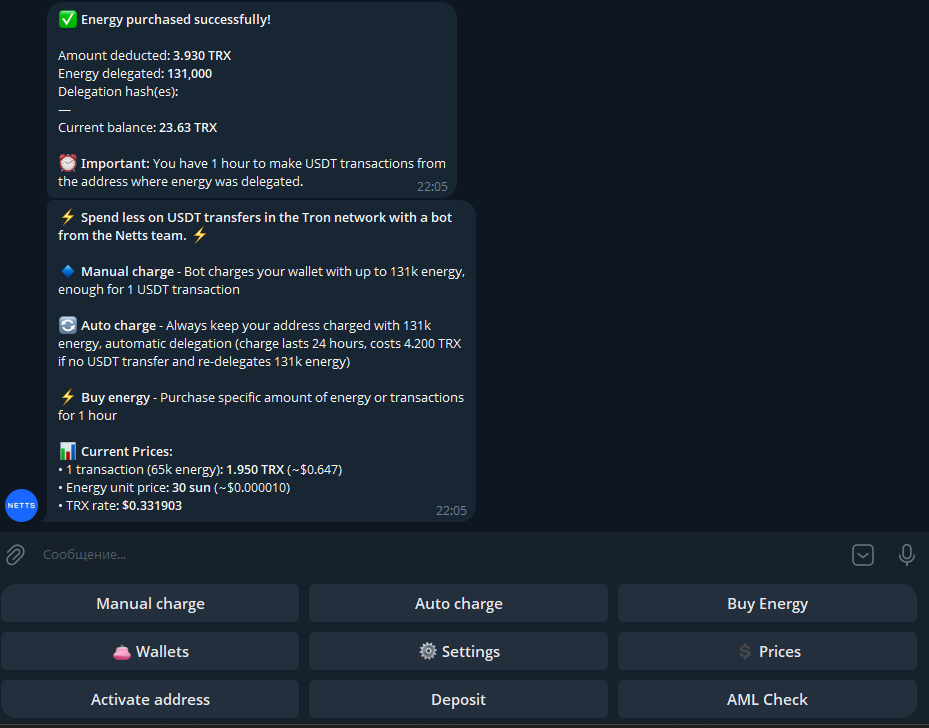
Once chat-money has cooled off and you still need to carry out some dull network maintenance for USDT on TRON, the practical approach comes into play: refilling your TRON Energy before making a payment, getting into the habit of quickly refilling your TRON Energy rather than wasting value, and keeping an eye out for the lowest TRON prices when it's not possible to wait for another reply in the group. The Netts Energy Charge Bot was designed for this unglamorous task — whether that's manually charging for a single transfer, automatically charging to keep an address ready, or making a brief Energy purchase — so that the messenger arguments won't cancel out what the transfer was meant to achieve.