Save on USDT Transfers Using an Energy Market Aggregator
In this publication, we will look into the insides of Tron’s architecture in detail, analyze its history and the most important technical features
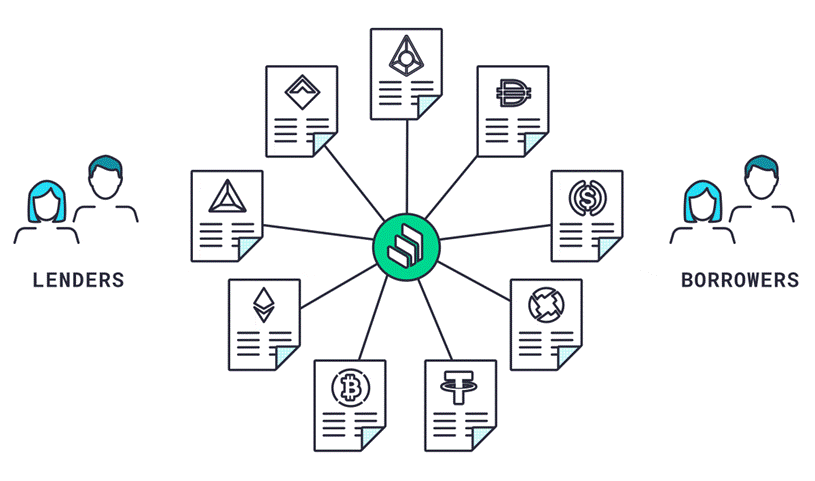
In the cryptocurrency space, all being dynamic and highly competitive, effective cost and speed of exchange submission not only influence a user choice, but the entire ecosystem's sustainability. The Tron blockchain controls the world’s favorite stablecoin, USDT, when it comes to the transfer of funds globally, handling billions of dollars of transactions daily. It was selected because of its speed and, on its face, low costs. But there is a cost, behind every transaction, if it’s not the relatively trivial block size there’s Energy and Bandwidth. In the case of almost all users, including people making a handful of transactions per month to exchanges and online services processing thousands of payments per hour, it is the issue of making these costs efficient.
In this publication, we will look into the insides of Tron’s architecture in detail, analyze its history and the most important technical features, compare all available methods of paying for resources and discuss the most efficient way to save money: making transactions — Renting Energy (paying a small fee to Energy owners) via some specialized services and aggregator platforms.
The Beginning of Tron: from “Ethereum Killer” to Stablecoin King
Before we discuss transaction fees, it’s important to cover the basics as to why Tron is so damned popular. Introduced in 2017 by the brash, media-friendly entrepreneur Justin Sun, Tron was originally presented as a so-called “Ethereum killer”. It has a very simple and straightforward mission – to build a fast, scalable, and inexpensive platform for decentralized applications (dApps) by addressing the same issues that were already stalling the expansion of Vitalik Buterin’s network.
DPoS Consensus Mechanism — the Heartbeat of the Network
Tron’s primary differentiator and competitive advantage is its consensus process, DPoS — Delegated Proof-of-Stake. In contrast to the costly and time-consuming Proof-of-Work (PoW) in networks such as Bitcoin or the original Ethereum where thousands of miners from all over the world attempt to solve puzzles based on complex cryptography, in DPoS, the management of the network is delegated to a limited set of block producers. In the Tron network, there are only 27 such nodes, and they are privileged with the honorific title of Super Representatives (SR).
These SRs are voted in by the entire community constantly via voting and the weight of any individual user’s vote is based on frozen (staked) TRX coins. Votes are tallied every 6 hours and SRs are rotated, instilling a competitive landscape and incentivizing them to do what is best for the network. Super Representatives (SRs) produce new blocks (every 3 seconds) and validate transactions, in exchange for a reward in TRX. It is human understandable, more centralized at first look model, but, nonetheless, it can provide an outstanding performance: 2000 tps via transactions for simple TRX transfers practically for free. For reference, Ethereum’s TPS, despite multiple updates, is somewhere in the range of 30–100, and transaction fees at peak load explode into the tens of dollars.
This combination of speed and low cost was what made Tron the perfect platform for stablecoins. Tether itself, the creator of USDT, was among the first to realize this benefit, and put its smart contract on the Tron blockchain. And users finally got the thing they’d been missing so much: the ability to move stablecoins around the world in mere seconds, at very low and, importantly, highly predictable costs. This has become the deciding factor for whether traders, arbitrageurs, exchanges, payment gateways and millions of ordinary users to adopt or not.
Anatomy of a Tron Transaction: a Deep Dive into Energy and Bandwidth
Another core feature which sets Tron apart from other blockchains is the fee system. Instead of the Ethereum single dynamic “gas fee,” where cost depends on the instantaneous load of the network, a more predictable and stable resource model is employed here. Two vital resources on which the chain relies are Bandwidth and Energy.
Bandwidth. You can think of this resource as the “right to a place” for your transaction in a block. It’s taken by every single operation, no matter if it’s a basic transaction or a complex smart contract invocation. The transaction size in bytes is used to calculate the number of Bandwidth units you’ll use. All of Tron’s active accounts are granted 600 units of Bandwidth every day at absolutely zero costs. That will allow several uncomplicated TRX transfers a day without fees. Bandwidth is not an issue for the majority of USDT users, as it is needed in small amounts, and can be acquired when freezing a mere few hundred TRX.
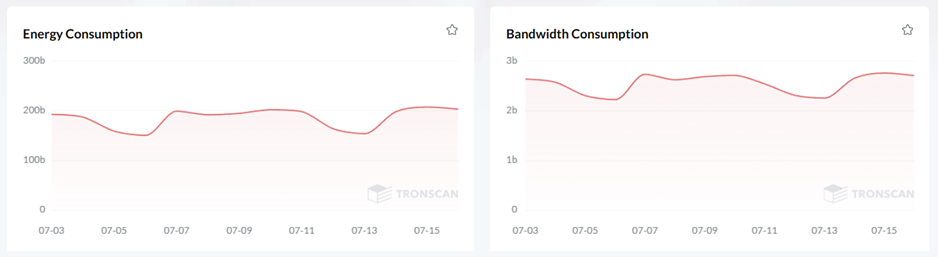
Energy. When we talk about smart contract code running, we’re talking about the “computing power” of the network. As transferring any TRC-20 token is an interaction with a multi-level smart contract, it costs a lot of additional Energy. Energy is not free (unlike Bandwidth). To obtain it, up to now, there were only two ways: either you risked a large amount of your TRX, or you let the system burn your TRX for direct payment of the transaction. A standard USDT transfer transaction costs from 65,000 to 131,000 Energy units, being applied depending on whether the recipient’s wallet has USDT at the time of the transfer (even more would be spent to carry out transactions with an “empty” wallet since it is needed to create a “cell” for it in the smart contract’s state).
If your wallet does not have enough Energy for a transaction with USDT, the system will convert the necessary amount of TRX and burn the corresponding number of coins from your funds. And here is the big problem and big money item for 99% of users.
A Comparison Between Payment Methods to Transact: from Being Wasteful to Making Sense of Savings
Below, let’s do some detailed analysis of all options to pay fees for USDT transfers on the Tron network with concrete numbers to see good and bad parts, and what is the most economical option of the three.
Direct payment in TRX (burning). This is the simplest, most apparent, but also the most costly method. In times when you lack Energy, the network merely draws TRX from your account. That is, a transfer of one USDT for a user will cost ~14-28 TRX (or even less), depending on whether there are stablecoins on the balance of the recipient or not.
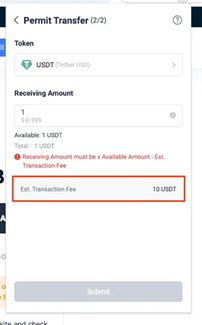
GasFree function from Tron. Then in those early days of 2025, Tron Foundation introduced a new option, pay fee directly in USDT. It’s even more expensive, because of a convenience premium. In the same transaction, the system is able to charge up to 8 USDT. This strategy is only an emergency option if no TRX or rented Energy is available.
Staking TRX to get Energy. This was the “classic” and intended by its makers way. You “stake” your TRX and get paid a portion of the total Energy produced on the network. However, to obtain 131,000 Energy every day, you have to freeze around 12,000 TRX. It is not affordable to vast numbers of average users. Now consider how much will be withdrawn from the turnover of an exchange, which must make, for example, 100 transactions in a day. This is an immediate lost profit few can tolerate. Well, and you couldn’t help but notice that over the year the Tron’s native crypto has increased by nearly 123%, and in concrete, it has already been entrenched in the top 10 cryptocurrencies.
Renting Energy on special services. This solution has actually been an absolute savior for most people. It’s a simple yet brilliant concept: instead of freezing your capital and allowing it to thaw, you can borrow energy for a short period of time from the large TRX holders (energy pools) or power lending platforms established on the Tron network. The price of renting 131,000 Energy for 1 hour is variable, but on average is 6 to 10 TRX. It is easy to estimate the savings relative to burning TRX (30-80%, depending on the conditions laid out by the service). Not only is this profitable, but it affects how the network is used at a core level.
Modern Solution — Aggregators
The rental market of Energy has grown rapidly, and there are currently dozens of services under different terms. That has led to a new problem: How do you find the best, most reliable offer? A penny-pincher was forced to spend countless hours on the search while running through links to dozens of pages, kept track of rates which changed every second, comprehended complicated interfaces and took a chance, dumping all his funds to little-known platforms.
Luckily there is a neat, little trick that solves this convoluted problem — an aggregator that does all the “nasty work” for the user, merging the whole mess of Energy in one place (ok, on one page). An example of such a platform is Netts.io, which not only pulls in data from other new sites but also serves as a multi-tool toolset for Tron's users. Its Energy rental market aggregator aggregates and visualizes crucial parameters — price, available volume, and rental time frame — and also offers information regarding features of each rented service.
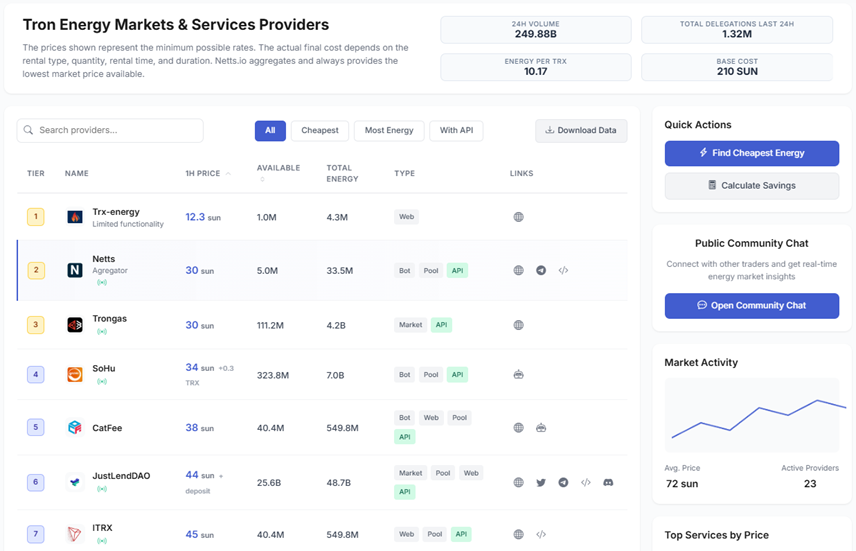
Consider a dashboard where all the latest information of the Energy rental market on the Tron network is gathered and presented in real time. It’s not just a list. It’s an actionable tool you can use to make decisions in a much more informed way! Platforms like Netts.io go above and beyond just aggregating, with features like a Telegram Energy Bot (for those who don’t plan renting in advance) and quite nice & vast API documentation for those who want to integrate checking and renting Energy directly in their applications.
What Can You Expect to Find on the Aggregator Page?
Full list of the top providers. Names (and other vital statistics) are visible not only at a glance.
Live data: See the current available and total Energy in each provider’s pools. This allows you to see the reliability, size, and load of each service.
Transparent pricing: you can view the minimum price offered for 1 hour of use from each vendor in SUN (the lowest multiple of TRX). This means you can immediately find the best offer. Advanced dashboards enable you to adjust the costs of the “Cheapest” or the “Most Energy” providers as well, depending on which aspect the user is more in control of.
What kinds of service are available: The main thing is how it’s categorised — how you are able to interact with a particular rental service. It’s usually presented in clear icons or tags such as Bot, Web, Pool and, crucially for businesses, API. This enables a user to make an immediate principled decision if they want to choose for the convenience of an easy online tool or a programmatic interface for batch processing.
It’s because of tools such as these market overview dashboards that the murky and obscure market of renting Tron resources is now also transparent, accessible, and illustrative. Today, you do not have to be a professional to cut your costs on USDT transactions; it’s no longer necessary to spend many hours searching for the complex solution on the Internet. Now it is sufficient to open one page and spend one minute to select your best checkout deal in order to save not only money, but time — the most valuable of all resources! Being able to view the entire market environment from one location allows product creators to leverage data to drive decisions, which then leads to a more seamless and competitive environment for all participants.