Restaking: Yield on Yield or the Next DeFi Jenga Tower?
Restaking promises pooled security and yield on yield, but beneath the marketing lies a fragile tower of rehypothecated ETH and correlated risks.

Do you remember the scene in The Big Short where Ryan Gosling takes a Jenga tower of wooden blocks representing AAA rated, collateralized mortgages from the bottom of the pile and places them on the top as increasingly risky, non-investment grade B rated mortgage loans go in the middle? In a neat demonstration of how the CDO market worked, he shows how financial engineers extracted value from this particular asset class by making a convincing argument to rating agencies that the whole messy sandwich of loans represented a diversified risk profile with an attractive yield.

As the Jenga tower wobbles precariously and the math breaks down, the whole room realizes just how deluded the whole system really was. It works so well because it captures the feeling of something deliberately obfuscated, buried deep inside a prospectus and made inaccessible to normal people, and then manifested in something physically tangible. We need this right now; history seems to be repeating itself with spooky accuracy as DeFi’s builders construct their own Jenga tower of increasingly complex financial instruments atop plain old staking.
Restaking is a promising concept offering pooled security for a variety of new services as well as substantial capital efficiency gains and yield on yield. You stake your ETH somewhere that secures either the mainnet or some secondary data-availability or oracle service and get paid to do it, and then the same ETH is used to secure another service where you can also get paid to stake it. It’s a clever scheme that appears to deliver on the promise of DeFi security and efficiency, if you’re willing to ignore the math behind it: that the very same quantity of economic ETH is backing substantially more obligation than it previously did. The neat thing about this is that there are many levels to this particular brand of mathematical prestidigitation. First, you take ETH that’s been staked as a liquid staking token (LST) somewhere, say on Lido or Rocket Pool, and you use that same ETH to secure another service, perhaps via EigenLayer’s EigenDA data storage product, which in turn can be used to collateralize a DeFi position. Then, you can earn points on top of staking rewards on the security provided for EigenDA via some other protocol, and then maybe use a leveraged liquidity pool to boost those points into even more yield. And all of this is built on a foundation of the initial ETH stake. Every step of the way, each protocol assumes that the ETH below it is as good as gold.
People who want to live now increasingly wish to live in the future because the present is frequently unbearable. Restaking is frequently positioned as a genuinely positive innovation in DeFi that enables everyone to feel like they are contributing to the decentralization of the web and the long tail of Ethereum applications. When you engage in restaking, you’re not “doing it wrong” by being greedy and seeking maximum yield; in fact, you’re “doing it right” by being unselfish and willing to boost capital efficiency throughout the ecosystem in order to realize a collective vision of decentralized apps. EigenLayer, which is rebranding itself as EigenCloud, and its liquid restaking rivals all engage in this kind of speech because it works; the technical underpinnings of EigenDA data-availability are genuinely interesting and appealing to many would-be cloud providers. But it’s also reminiscent of casinos repackaging themselves as social causes to avoid regulators, if the analogy is not overly far fetched.
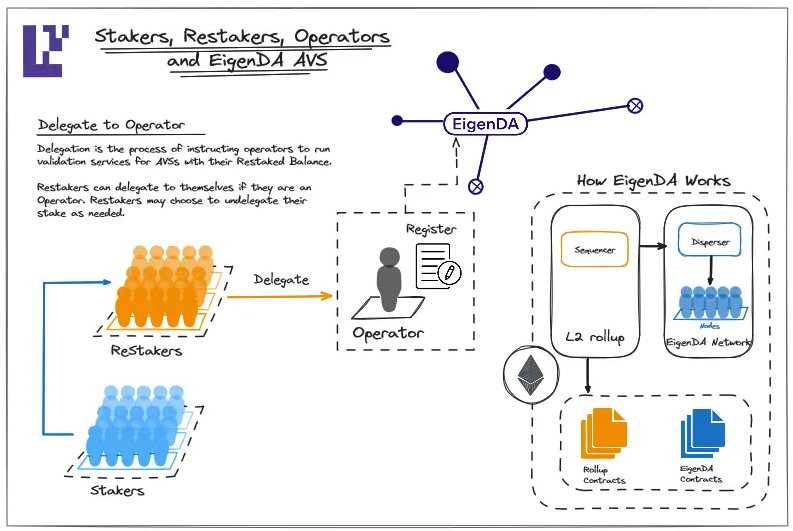
Once you’ve climbed to the top of DeFi’s Jenga tower, you’ll notice that there’s significantly less stability with every additional block. The moment there is a slashing incident, a depegging of a liquid restaking token (LRT), an exploit in an active validator (AV) service, or a bank run of any of the above-mentioned protocols, the fantastic yearly percentage yield (APY) that you captured for posterity on Twitter turns out to be significantly less valuable than the next liquidity event. The promise of pooled security and the infrastructure layer is undeniably enticing to developers, if for no other reason than these solutions frequently provide much-needed liquidity to the projects that must utilize them. Restaking can be seen as a necessary evil in situations when a developer needs to create something that requires pooled security but doesn’t have enough ETH to lock up on its own in a proof-of-stake (PoS) network. It is, however, prohibitively difficult, complicated, and time-consuming. A closer examination of the industry’s purportedly virtuous economic foundation reveals a much more dubious position.
Shared Security and Infrastructure Facade
A review of the major players in the restaking space — EigenCloud, Ether.fi, Renzo, Kelp, Puffer, Symbiotic, and the others — reveals that they offer the same sorts of services: pooled security, liquid restaking tokens, arbitrary points programing, exit queues, and slashing exposure. And it’s true that the industry’s entire business model is built on a con — the same ETH is being counted twice, if not more! After months of buildup, EigenLayer’s much-anticipated slashing went live in April 2026, but thus far, it has failed to demonstrate the practicality of this particular brand of economic cryptography. To understand just why that is, let’s take a closer look at the much heralded EigenDA launch and EigenLayers’ innovation of “intersubjective forking” that would allow the slashing of any AV operator who’d attempted a fault on chain. An incredible concept, intersubjective forking is based on a theoretical attack vector in which a majority of token holders must collude to create a slashing fork, and so far it has only existed on paper. Meanwhile, EigenLayer’s governance tokens are charting a familiar trajectory downwards after their initial airdrop.
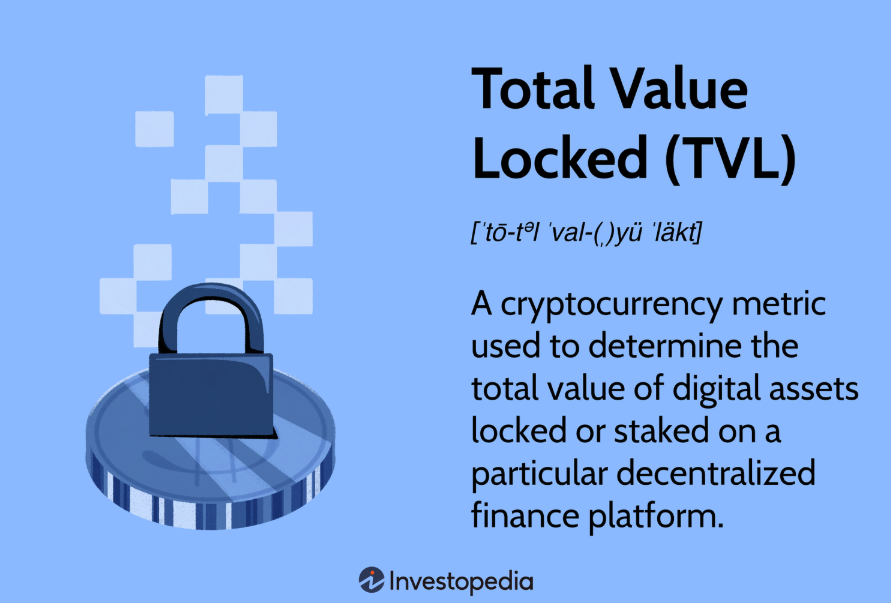
The value of this particular brand of economic cryptography truly comes out when we take a closer look at the industry’s marketing materials — more specifically, at the projected total value “locked” (TVL) across the restaking ecosystem. As of this writing, the industry has a TVL that’s frequently measured in tens of billions of dollars — but what would that number look like if we adjusted for the double, triple, and even quintuple counting of liquid staking tokens that have been layered on top of each other in lending protocols?
Ether.fi and Puffer both have incredibly compelling numbers when it comes to their respective billion-dollar+ TVL figures, but how much of that is “real” liquidity and how much is “printed” liquidity? Printed liquidity typically comes right from the on-chain issuance of governance tokens, which are frequently used to subsidize the comparatively anemic yield that would otherwise be found in active validator services that have TVL figures in the tens or even hundreds of millions of dollars. Take a deeper look at any one of these services’ yield figures. Chances are, the “organic” yield generated by their AV services — which are frequently much more lucrative than their points-program counterparts — will turn out to be significantly below the points programs’ “TVL-weighted” yields that regularly entice ordinary users to deposit their ETH with them. Look at how far EIGEN has fallen from its peak — a staggering 96 percent! Within the industry’s echo chamber, EigenLayer’s advocates continue to insist that their TVL represents real economic value and that EIGEN truly is foundational infrastructure. But the broader market disagrees, and not without justification, since there’s little reason to believe their TVL represents anything other than freely issued governance tokens with no value capture mechanism.
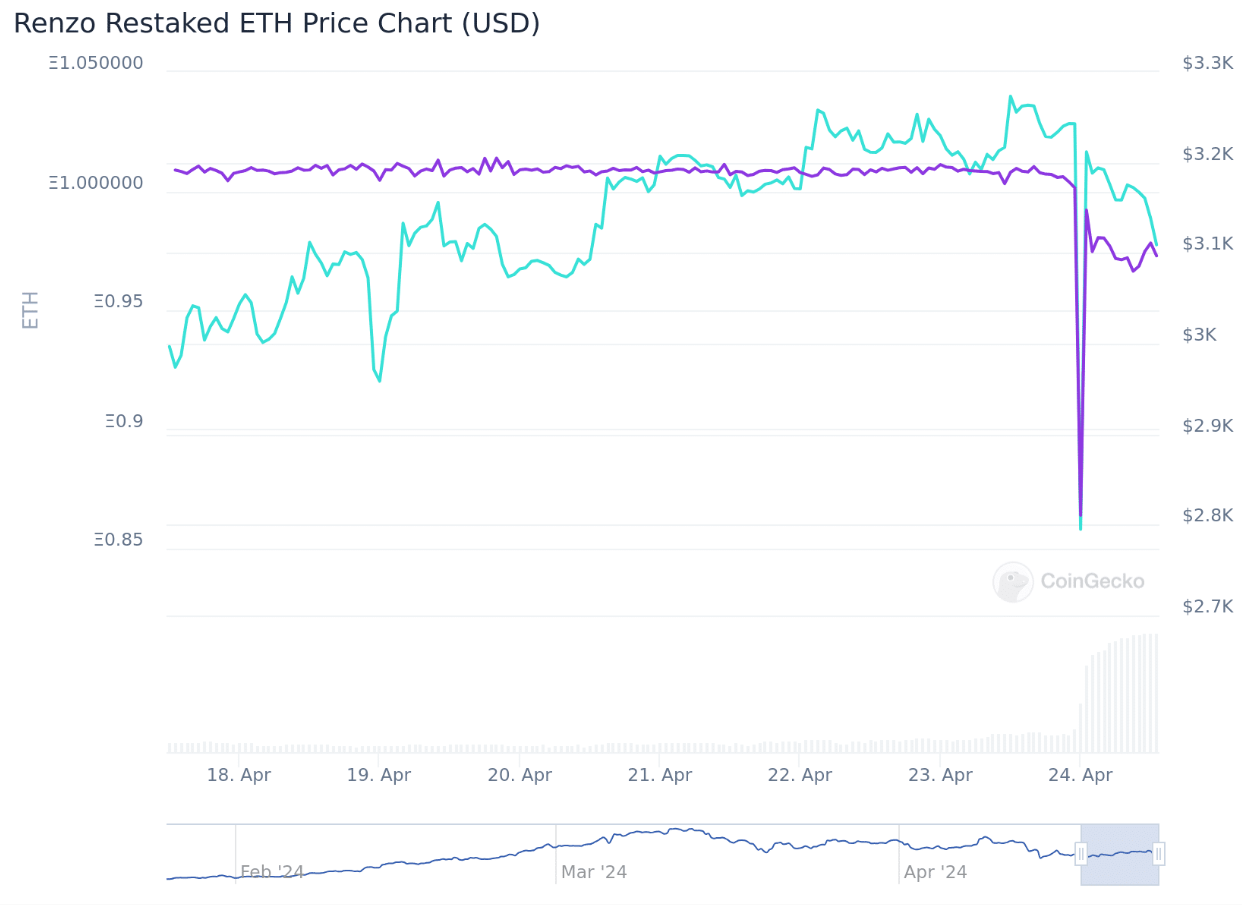
The moment the tower starts shaking is when everyone realizes that TVL (total value locked) is often the only true indicator for yield-generating protocols. Take for example the Renzo ezETH depeg debacle in April ’24 that left leveraged traders in despair, as billions of TVL for the liquid restaking protocol got vaporized. The liquid restaking token (LRT) of Renzo was used as collateral for leveraged loans issued through protocols like Gearbox and Morpho, which saw traders depositing ETH into Renzo and taking out leveraged loans against their deposits to magnify yields.
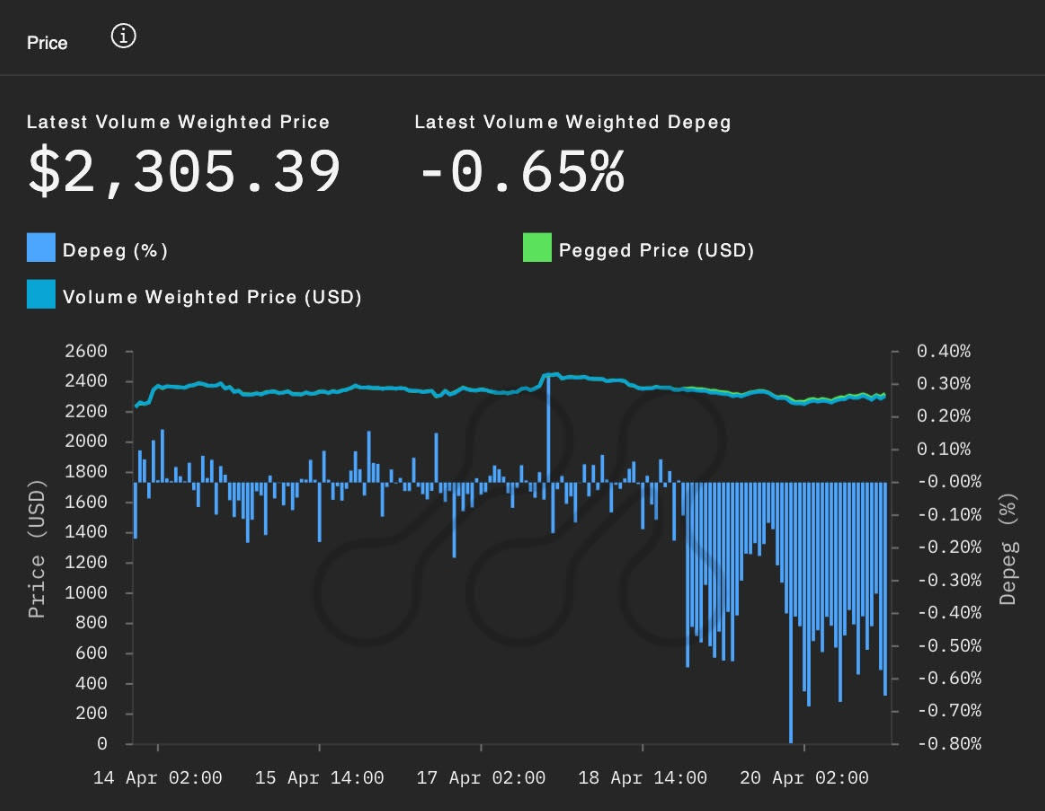
When Renzo announced an on-chain airdrop of their REZ governance token to LRT depositors, many users criticized the size of the airdrop and unfairness of the token distribution schedule. Traders who had deposited their ETH into Renzo and taken out leveraged loans suddenly found themselves in dire straits as the value of their collateral eroded. With Renzo not allowing native withdrawals to maintain their TVL, these users were forced to dump their ezETH tokens on secondary markets like Uniswap, leading to a depeg of Renzo’s token against the 1:1 ETH collateralization. Consequently, the traders who had leveraged their positions via loans found themselves facing massive losses as the value of their collateral dropped by almost 50%, triggering a cascade of liquidations across DeFi. Loopers — traders who had deposited their ETH into Renzo and then deposited the same (or a fraction of it) into various lending protocols to take out leveraged loans against them to deposit back into Renzo to collateralize more ETH loans — were the worst hit. They created artificial scarcity for ETH supply by demanding more and more loan liquidity in the looping process, creating an imbalance in the supply-demand dynamics of ETH.
Millions of dollars worth of liquidations occurred within minutes as leveraged traders scrambled to deleverage their positions and limit their losses.
The Kelp bridge scandal of April ’26 is just one example of the cascading composability failures that occur in DeFi. In this incident, the weakness was not in the on-chain smart contracts but the off-chain verifiers used by the bridge to facilitate cross-chain transactions. It seems that Kelp DAO’s developers designed the bridge with a 1-of-1 LayerZero verification system to cut costs.
The absence of any form of decentralization in the verification process left the bridge vulnerable to attacks, with bad actors being able to poison the off-chain data sources utilized by the bridge contract.
As a result, the fake verifications triggered Kelp to mint 116,500 unbacked rsETH notes on Ethereum, forging a false narrative that these notes were redeemable for ETH on the source chain. The attackers then utilized this liquidity to collateralize a $25 million Aave flash loan, which was subsequently deposited into the Aave liquidity pool as WETH. Because Aave relied on an incorrect pricing oracle, the flash loan was never repaid by the attackers, who effectively stole nearly $25 million from the Aave liquidity pool. Aave then froze the DeFi lending market in an attempt to prevent further losses, which caused tremendous instability throughout the decentralized finance space. The entire episode served as a sobering wake-up call to the industry, as the enormity of a composability attack — especially one involving millions of dollars in flash loans — became apparent to everyone.
Greed and Exit Liquidity
Sreeram Kannan is selling shared security as if it’s the next great civil engineering feat, but there are still those among us who lost life-changing sums of money because of their belief in the peg. Ethereum cofounder Vitalik Buterin has authored several blog posts criticizing the design of EigenLayer and other restaking protocols, arguing that their tendency to reuse validator infrastructure posed an existential threat to Ethereum consensus security. More specifically, Vitalik warned that restaking protocols should not rely on Ethereum’s social consensus to rescue them in the worst-case scenario. What then is the industry’s reaction to concerns about consensus overload and the possibility of shared security becoming a critical vulnerability? Why, they double down on the risk, of course!
When it comes to the economics of the space, it’s important to remember that smart contracts are backed by actual humans who are frequently quite self-interested. Founders want TVL and liquidity because that means VCs will buy their tokens.
VCs, for their part, want to establish an exit liquidity event because they know their heavily discounted seed tokens will only retain any value at all if there’s a market for them. Node operators want to maximize their revenues by providing the least viable infrastructure they can get away with while pocketing all the fees; this frequently means massive centralized infra providers dominate the market due to economies of scale, even if that concentration creates systemic vulnerabilities. Delusional gamblers want yield on yield so that they can claim bragging rights on Twitter, even if it means risking total insolvency in the process.
If you want to understand the particular ways in which this industry is structured to fail, all you have to do is examine the specific failure modes:
1. Shared security represents enormous correlation risk if a major AV service is slashed, triggering cascading liquidations throughout a variety of DeFi services that rely on its security guarantees.
2. Operator delegation creates systemic concentration risk, as large-scale node operators will always dominate the market due to economies of scale, creating single points of failure within the system.
3. Liquidity mismatches will inevitably occur when users demand instant liquidation of their LRTs or other derivatives while their underlying collateral is trapped within withdrawal queues.
4. Points programs represent completely unfounded obligations that may or may not come to fruition, depending on the whims of the issuing protocol.
The whole system is built on a foundation of greed and the desire to accumulate wealth, so it’s little surprise that failure modes are similarly motivated. Why do we feel the need to make money make more money all the time? What’s wrong with wanting four percent? This line of thinking, so eagerly embraced by the industry commentators, is what gives rise to the phrase four percent is for peasants. The desire to generate outsized returns through leverage, combined with the sheer lack of yield anywhere else in the system, is what leads us down this road of nested derivatives and correlated risks.
Regulatory Risk and Backing Securities
It’s one thing to believe in the industry’s lofty pronouncements regarding pooled security, liquid yield, and so on, but it’s another to examine the industry’s true financials and realize just how deeply embedded exploitative dynamics are within the system. The TVL figures and projected yields serve to inflate the perceived value of the protocols, but they rarely tell the whole story. Consider EigenLayer’s EigenDA cloud, which is supposedly in the midst of a multi-billion dollar fundraising round as it prepares to launch its data-availability product. The company is losing more than a million per year, having burned tens of millions in inflationary supply to attract capital, but its purported yield is little more than a subsidy for said inflation.
It may come as no surprise that many of these companies’ business models are effectively predicated on continued token inflation in order to maintain the appearance of value. Take a look at the massive token unlocks that regularly occur in this space, month after month, as early investors sell their shares. Retail investors who are eager to purchase liquid restaking tokens are frequently completely unaware of the enormous sell pressure exerted by large-scale token holders who sold their vast volumes of tokens in order to realize liquidity gains.
These early points multipliers, favorable seed-stage allocation terms, and large-scale third-party liquidation events have all occurred frequently enough in the past that it’s reasonable to suspect that future restaking industry participants will plan their token distribution strategies around them as well. In other words, these companies know that there must be someone willing to buy their tokens in order to facilitate an exit liquidity event, and so they leave room for one. It’s not difficult to see why regulatory scrutiny is intensifying: when one considers how these companies operate, it’s no surprise that securities regulators are beginning to take notice. Restaking protocols have begun to relocate some of their operations overseas in order to avoid domestic regulators, whose actions threaten to derail the entire industry by freezing numerous protocols’ operations entirely.
As financial markets have evolved, their essential dynamics have remained remarkably consistent: the same basic principles of human psychology and economics that governed the markets of centuries ago still apply today. When it comes to the CDO market shortly before the 2008 financial crisis, for example, Wall Street banks took individual subprime mortgages and bundled them together in large CDOs, claiming that the risk was diversified and that the entire package was a triple-A investment. The entire process is identical to how liquid restaking tokens function: individual ETH collateral assets are bundled together to form a supposedly diversified product with dramatically increased yield. It’s no secret that the CDO collapse was precipitated by a large-scale default in one of the subprime mortgages, resulting in a cascade of downgrades throughout the CDO market. Something similar will almost certainly happen in the liquid restaking space when a single LRT defaults or slashes — if history is any indication, all it takes is one default in a large portfolio for the entire thing to unravel due to correlated risk.
The LRT space bears a striking resemblance to the shadow banking system that dominated capital markets prior to the crisis, with many of the same risk factors, such as the rehypothecation of assets, which allowed institutions to post the same collateral against multiple short positions in order to increase their leverage. When a default occurs in one of these short positions, the losses are magnified and frequently passed on to other investors who were completely unaware of the risk. It’s also worth noting that the market for money market funds suffered a similar fate when the infamous $2 billion fund broke the buck and suffered steep losses, causing panic throughout the industry and prompting a wave of redemptions. The systematic risks that were inherent in automated portfolio insurance were also largely responsible for the stock market crash of 1987, as well as the numerous flash crashes that have occurred recently in the cryptocurrency markets. Even the infamous yen carry trade unwind that occurred a few years ago is instructive in this regard; when traders leveraged their positions far too heavily, a large-scale unwind of the trade resulted in massive losses for those who had anticipated a prolonged period of easy profits. Restaking, with its promises of enhanced yield and liquidity, is poised to become the next chapter in this long series of financial disasters.
Despite the billions of dollars in capital commitments and the vast number of talented cryptographic engineers who have dedicated their lives to solving these “scaling” issues, it appears that human nature will always triumph over structural obstacles. This is particularly true when it comes to the economics of the situation: no matter how clever the math may be, it will ultimately prove to be no match for the fundamental economic realities of limited supply. The Jenga tower of DeFi will continue to grow and change as long as the financial incentives encourage it to do so. But when the music finally stops, when the liquidity crunches and the queued withdrawals burn the token supply, the DeFi markets will once again learn a lesson that has been reinforced time and time again throughout financial history.
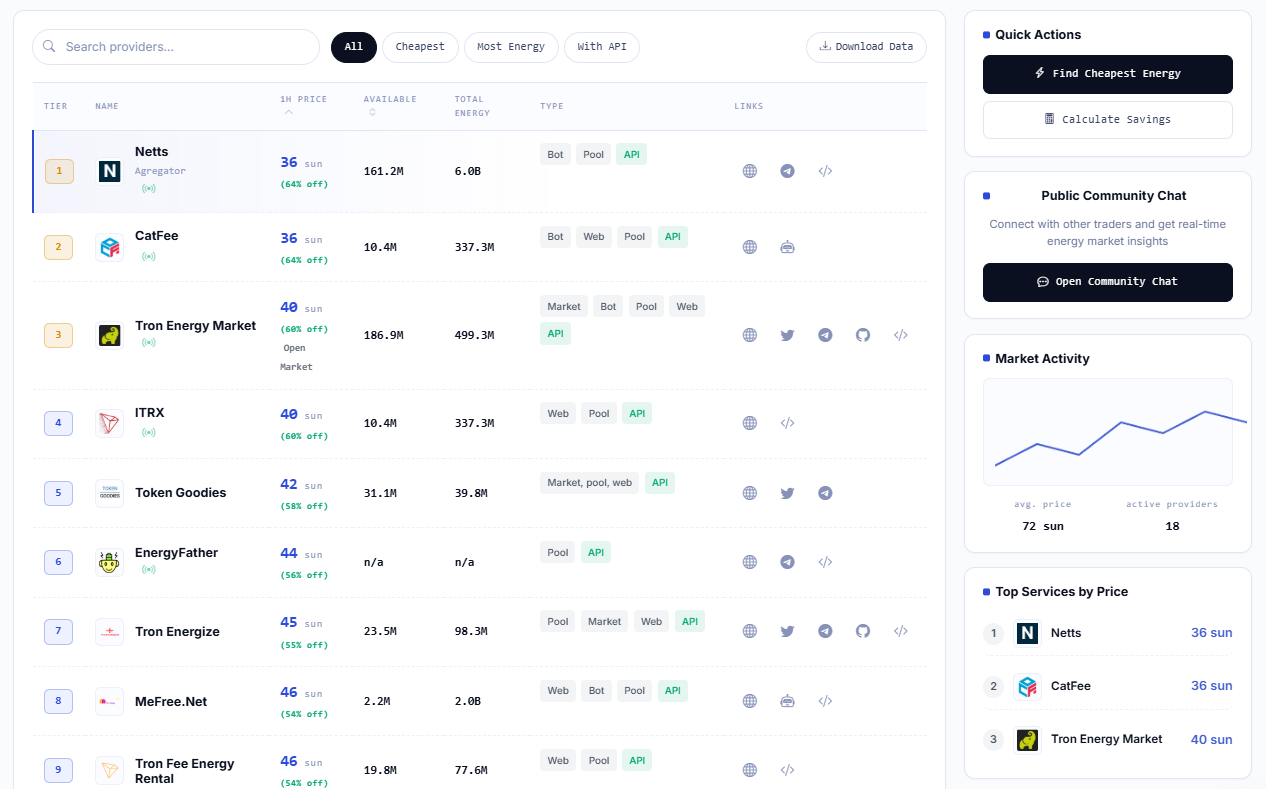
After all the usual rumors about "towers," "rehypothecation," "points," and "yield upon yield," it is also worth focusing on the more standard crypto issue - making the costs lower and the errors less frequent for both individual and institutional actors. In particular, Netts' TRON Energy Market appears to serve a more conservative and dependable role than one might expect from a platform promoting its energy-efficient features on the front page. By providing the comparison of prices from different suppliers, discussing the liquidity and transactional activity, and facilitating the acquisition of TRON Energy instead of wasting TRX on USDT transactions and paying the gas fees for smart-contract transfers, Netts appears to aim to be a reliable partner to any regular TRON blockchain user or developer. At the time of this writing, Netts and its rival CatFee were tied at 26 sun with 161.2M Energy and 6.0B Volume to 24h respectively, while the rest of the market's active suppliers provided higher prices on average. It is unclear if it is exactly moral enough for someone worried about DeFi's "Jenga" tendencies to rent what they need for their own operations on the TRON network using cheaper and more reliable services, but it is a sensible step for anyone actually using its functionality to avoid the unnecessary costs.