Is Crypto the Last Chance for Free Press?
How crypto funds independent journalism — from the WikiLeaks blockade to anonymous donors, stablecoin subscriptions, and bounty-based investigations.
Only the real kind of journalism is one of the most dangerous professions on the planet. The actors sporting the journalistic label on cable news or in the byline of a wire-service rewrite are rarely threatened, because there was nothing in their work that could threaten a powerful person. The imminent threat is for the ones who really go out — the investigative reporters, the freelance correspondents, the stringers who get to the places where polite media does not go. This is why they sometimes end up breaking a window, with what police call an apparent suicide. They get hit by burglars who steal only their laptops, or at work by auditors who give their tax records an extra careful look, or who have their publishers shaken into silence under the combined weight of claimants with enough money and lawyers on retainer to crush a conspiracy.
And the threat of real journalism is not limited to unfriendly states, either. In nominally free countries, the tools are more subtle but no less effective: the smear, the instigation of coordinated outrage, the career-ending accusation (which does not have to be true to end a career), the jurisprudence of defamation in a "friendly" suit, the off-the-record word from an advertiser to a publisher. The result is the same as the literal version of the defenestration we talked about above, just more politely delivered: a story doesn't run, a reporter stops asking, an independent outfit dies. What this article struggles to take seriously is the question: for all cryptocurrency's myriad of other, mixed effects on the world, might it be the single most important new piece of infrastructure that existing, passionate, idealistic journalists can actually use?
Why Money Is the Real Censor
Very few journalists are cowards. Many of them will fly into a war zone on the perfect story, speak with people who would have no problem killing them, or hem and haw inside a country whose intelligence services are closely watching them instead of doing it. It is of course danger (and not, for example, financial risk) that is the binding constraint for the temperamentally inclined. At the end of the day, all we know is the same boring old binding constraint: bills. Rent. Children. Mortgages. The everyday hammer of the grind of life on people who must decide if they want to go in pursuit of a hard story or pad the family bank account.
The scary investigation does not pay and the large outlet pays reliably, so most journalists eventually end up sitting pretty in the cushy position at the big outlet. The trade-off is never couched cowardice — it is merely what adults with responsibilities do. That said, the outlet itself has its limits. It has advertisers. It has owners. It has political relationships that it simply cannot sever. Instead, the journalist who took the staff job to pay rent works for an institution whose bounds of acceptable stories narrow by the year, not because anyone ordered it, but because every uncommissioned story is a story averted. This is not a conspiracy. It's gravity.
Sometimes, a journalist of a different type enters the picture and foregoes a dialogue. Part of the reason Seymour Hersh, in his heyday, could investigate My Lai and the Abu Ghraib abuses on his own recognizance, was that in large part, so many editors were willing to take a chance on him. His Nord Stream pipeline work skipped traditional publishing altogether and appeared on his own Substack decades later. A whole generation of readers found confident independent voices not because they were featured in newspapers but because they were presented through direct-subscription platforms, and those platforms, for all their mistakes, demonstrated one essential truth: When readers trust in a particular writer they will pay that writer directly, at volumes that will sustain authentic independent work.

The most famous example of this, despite him not being a journalist, is Jordan Peterson. His income from audience contributions skyrocketed to levels universities never ever reach when he started to speak publicly about topics that lost him institutional support. It was a lesson not only for Peterson. The take away was that many will fund a voice they value, particularly a voice being punished by current mainstream channels. This is only half a cultural problem when it comes to applying the lesson here to journalism. The larger part is infrastructural.
WikiLeaks Precedent
And the most educative case study is the oldest one. WikiLeaks began releasing embarrassingly frank U.S. diplomatic cables in December 2010, a coordinated response to which was created, it seemed, as if in anticipation. All of them terminated the organization's ability to accept donations within days, including PayPal, Visa, Mastercard, Bank of America, and Western Union. However, a court order did not impose the funding freeze. It was legal, coordinated, and crushingly effective financial blockade that showed how fragile any outlet is when their donation pipeline runs through a few payment processors. The obvious and awful lesson: you do not need to arrest a publisher in order to silence him. All you need to do is to make sure that there is no one that could possibly send them money.
This was about six months prior to WikiLeaks taking Bitcoin donations. The selection was initially hesitant — to tie the young network, just as the only resource on which its value depended was beginning to appreciate, to something as politically sensitive as WikiLeaks would have drawn attention, warned Satoshi Nakamoto himself, before it was strong enough to bear it. However, the organization had no choice. The number of BTC received by WikiLeaks in the first week of accepting crypto was 171. The total grew to about 4,100 BTC in the years ahead, which is worth around one quarter of one billion dollars at current market prices. Somewhere in these numbers is built-in fundamentals; and a price appreciation — modestly calculated in terms of percentage at about 233,000 percent — that speaks for itself about what happens when censorship-proof infrastructure meets a cause that people actually want to put their hands in their pockets to support.
It brought the Assange story full circle by 2024. Once he was finally freed after a 14-year legal fight, getting home came at the price of a huge debt for the chartered aircraft. Hundreds of thousands of dollars — over 8 Bitcoin at the time — were sent from an anonymous donor to pay. There is no way that donation could have been made through normal channels without implicating the donor in whatever political fallout he was presumably trying to evade. It might have been rejected by a bank, or frozen by a processor. It would have created a paper trail. The crypto version was blunt, conclusive, and irreversible.
These are not theoretical cases, and these cases matter. They are the current evidence for the alternative rails working when the normal financial rails won't carry the money. The basic demonstration is already done; whether they work for journalism at the scale journalism needs is another question altogether.
Donors Want to Give, Carefully
Less well parsed is the funding problem on the other side of the coin, the psychological side. There are lots of people who would likely be interested in supporting authentic journalism. Also, for good reason, do not want to end up on a list. None who would ordinarily be subject to retaliation, and in the example of a donor who is a wealthy professional who contributes in secret to a report on pharmaceutical industry malfeasance, for example, they may even have no direct retaliation from the source, but the chilling effect of their name showing up on the donor records of an outlet opposed to them is real. Employers notice. Social circles notice. Regulators (in some sectors and some countries) notice. Whistleblowers are not the only ones who require anonymity. For supporters, this is also a genuine worry, as they do not want their career to be seen as favouring politically combative reporting by going public.
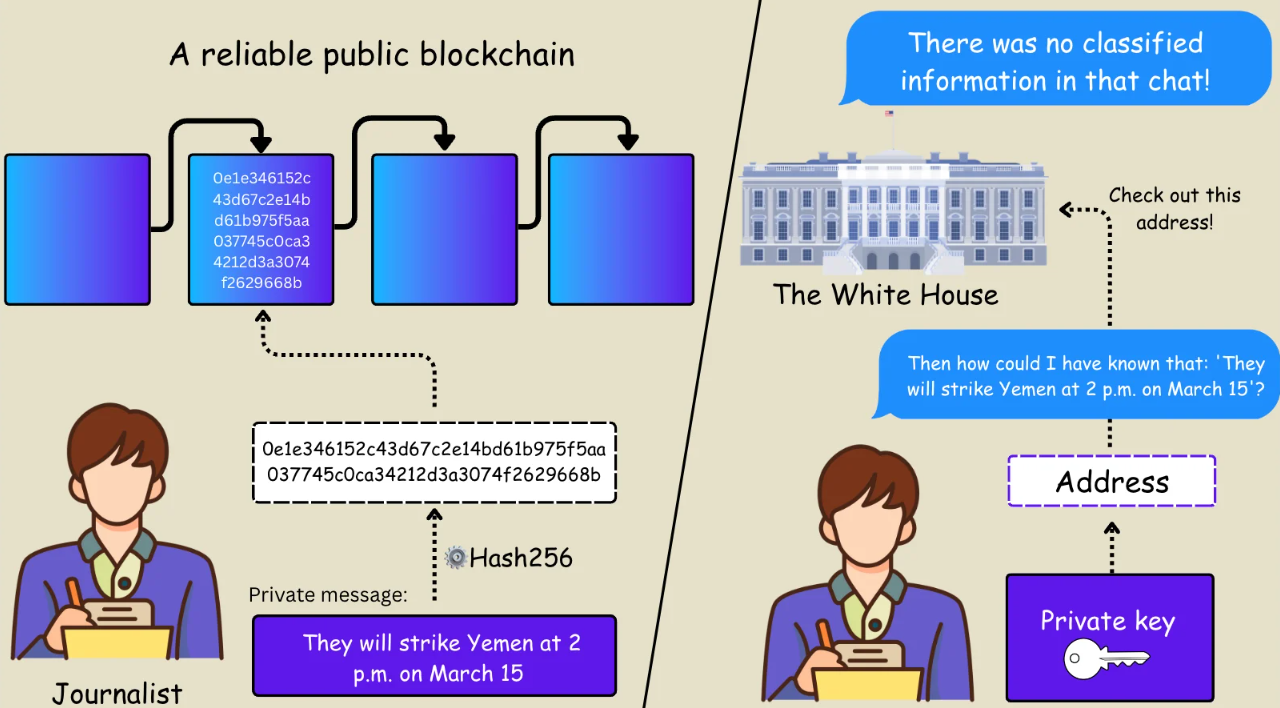
The problem with conventional donation platforms is that there is no structural way of their being able to create a real semblance of anonymity. Your credit card companies already know who you are. PayPal knows who you are. Bank wires create paper trails that can be subpoenaed. Existing cryptocurrency donation infrastructure is still flawed; a donation from a KYC-identified exchange leaves a trail that even (extremely sophisticated) analysts can reconstruct due to Bitcoin's public ledger. Yet, the difference between "imperfect crypto anonymity" and "no anonymity at all due to traditional finance" is sizeable enough to sway many donors.
The incentive structure here is unique. And there, the journalist goes without institutional strings attached, for cash. The only problem is the donor wishes to send it without penalty to his career. Cryptocurrency in general — especially in conjunction with privacy coins, non-custodial wallets, and a mixer here and there — is one of those technologies, and only a few novel technologies can cover up both of those needs at the same time. It does not make the donator untouchable. That does not make the journalist impervious. That does, however, make the stated specific attack to go in and cut off funding much more difficult to do cleanly.
Mechanisms That Actually Work
Some of them are already used for funding journalism in various ways and some others are at least theoretically possible but have not been widely implemented at the time of writing this text. All the common methods can be considered as follows.
1. Direct wallet donations. News outlets post a wallet; followers send money. This is the most straightforward model, and has funded organisations such as WikiLeaks, the Freedom of the Press Foundation, and an ever-growing number of independent Substack-style publishers. It is also limited, without the built-in accountability for how money flows long-term, the mechanism for re-subscribing, the system for distinguishing small supporters from big ones.
2. Stablecoin-based subscriptions. This solves the volatility problem for both parties by charging readers a monthly fee in a stablecoin — such as USDT or USDC. A new type of journalism that provides predictable revenue in dollar-equivalent terms for the former and a subscription that at least cannot be taken away by a payment processor for the latter. Chains like TRON or Solana make this trivial to implement in smart-contract versions, and platforms exist out there with turnkey options.
3. Bounty-based investigation funding. A specific story is pitched publicly, with a portion of the funding held in escrow by a smart contract. If the goal is met, the funds are released to the journalist to undertake the investigation. If it is not, contributions are returned. While this mechanism has been used in limited scope for research funded by crowdfunds the implementation of this has not been so far to journalism.
4. Tip payments with built-in confidentiality. Information providers can be rewarded through privacy-preserving channels that all the while do not display them to be identity providers. This is a narrow form of whistleblower protection, but it is all the more essential when the alternative is that important sources do not come forward because they cannot financially afford to do so.
5. Milestone-based disbursements. Funds held by a trusted third party are released to the journalist only once certain milestones — initial research complete, sources verified, a draft composed, and the piece published — are verified. That calms potential donors who might otherwise be concerned that their money is buying a story that never actually gets told.
All that, of course, comes with real-life challenges. Donors must understand how to move crypto for direct wallet donations. There are also costs involved in running or funding the technical infrastructure outlets need to publish content as well as paywalls and subscriptions. Concerns about editorial independence with bounties — if you pay a journalist to investigate, should the journalist be free to conclude whatever the donors do not want to hear? Milestone disbursements bring in an intermediary, and with that an opportunity of failure or capture.
None of these are dealbreakers. And they are nothing more than the routine implementation hurdles any new model of funding must overcome before it becomes implemented widely as standard. And even for the newsrooms that are already active here, the mechanical layer — wallet management, normalised deposits, cost management via batching TRC20 transfer, etc — shows that an editor can comfortably settle a dozen freelancers at the month's end without bleeding TRX to the network as overhead on every payout (an editor can wire a decent API for Tron Energy directly into the backend).
What Stops It From Happening Already
If the infrastructure works, the obvious question is why independent crypto-funded journalism is not already the dominant model. Some responses should be considered seriously.
First, regulatory pressure is severe. Cryptocurrency mixers have been sanctioned. Major exchanges have moved on privacy coins. Most regular donors will never put forth anything close to the effort it would take to obfuscate who they are because they cannot do so meaningfully at on-ramps without a concerted effort. But they require a kind of technical literacy that bears on who can donate — the tools are there, but they tend not to be used.
Second, legitimacy still matters. A crypto-only donation outlet might seem fringe to an audience weaned on credit-card philanthropy. Traditional press-freedom organizations are adding crypto to their donation options partly because it seems so modern to some audiences and also keep offering traditional options for the rest but the transition is slow. There are the indicators of growth: annual crypto giving in 2025 was at its highest level ever, with a single major crypto-donation platform processing upwards of 100 million dollars (and over 300 million dollars total since 2018) across its network — yet as a proportion of overall philanthropic flow, it remains small.
Third, editorial infrastructure has not caught up. Funding an independent news site off crypto donations is logistically arduous. This means the publisher minds wallet security, tax reporting, fee harvesting, payout timing, and the raw bookkeeping of an entity whose cashflow streams into their orbit largely in an opaque, undulating stream. Most wannabe independent journalists are not also crypto engineers. This gap between "the technology works" and "I can actually run my outlet on it" is very much a real one and is exactly the kind of gap that specialized service providers aim to bridge. When newsrooms process lots of TRC20 transfers monthly — particularly small ones — using automation for Energy purchases and other unsexy tooling is increasingly a must-have: If any of this stuff does not work, the business model can be a no-go.
Fourth, the donor behavior is not yet in the region of habit. It's a familiar motion: donating to Wikipedia at year's end because a billboard begged you to. It is not second-nature yet, even for those who have crypto in their Coinbase account, to type a motion to give to an investigative journalist just because their wallet address is printed on their Substack. Habit is also very hard to shake, and (certainly in retrospect) most of the big shifts that ended up transforming an entire infrastructure felt gradual until they suddenly didn't.
So, none of this means that crypto is going to rescue journalism. It might not. Ambitions and principles aside, the structural forces arrayed against independent reporting are deep- and well-funded, and no payment technology alone can overcome them. Crypto effectively removes one particular attack vector (the financial blockade) that historically has proven effective for silencing undesired outlets. That is not everything. It is also not nothing. Since the press-freedom story of every preceding century has been, at heart, a story of who holds the purse strings for writers, a truly censorship-resistant payment rail is much more of a paradigm shift than it initially seems.
The most realistic expectation is a two-tier system. How would journalism institutions look if your autonomy was not influenced by ownership structure and advertiser relations? The existing large traditional outlets, constrained by their ownership structures and their relationships with advertisers, will continue to exist. A parallel layer of smaller independent outlets — more precarious, more varied, some brilliant and some conspiratorial — will increasingly self-fund through crypto rails, direct subscriptions, and bounty-based investigations. Over the next decade, you will probably derive the most interesting stories from the second layer as opposed to the first layer. Some of them will be significance-worthy. And a few will be nonsense in brave garb. The reader will have to separate the two, and always has.

It all starts with plumbing — none of this exists without plumbing. You do not need enterprise-grade accounting software, but you do need decent Energy management, so that your USDT payouts do not bleed TRX to the network one transfer at a time, as a little independent outlet run on TRX-based stablecoin subscriptions paying a few freelancers each month. And herein lie services like Netts Workspace: an enterprise level TRON Energy management platform which acts as an automated delegation tool complete with intelligent scheduling, smart-mode triggers tracking wallet balances and topping them up based on thresholds, perpetual monitoring of host mode Energy provisioning for high-volume addresses and even proper API access for teams wishing to bolt the whole thing into existing backend systems. It is not glamorous infrastructure. It is the hidden plumbing layer that gets the rest of the story working — and for any editor running an independent outlet on a shoestring cannot afford to lose operating capital on network fees, is precisely the kind of ground-level tooling that separates a model that looks good on paper from one that can actually pass muster in the real world.