Developer's Guide to Building on TRON with Tronscan
This guide will take you through everything you need to know in order to leverage TRON for your projects.
The TRON network has become a notable high throughput and scalable blockchain specially tailored for decentralized applications (dApps). It's the current environment giving way for potential new Web3 tools to be built given its high TPS and low transaction costs. Central to this ecosystem is Tronscan, the official (and, for all practical purposes, only) blockchain explorer. But it's more than just a window on the network; it's a core development, debugging, and analytical tool.
From the basics of getting started, the core concepts of TRON, an introduction to TRON's vibrant DeFi ecosystem, to utilising TRON to help save you money in your operational costs, this guide will take you through everything you need to know in order to leverage TRON for your projects.
First Steps: in TRON Development
If you are a developer with Ethereum experience, TRON will feel like home for you — it is that smooth of a transition. The architecture is designed to resemble the former in many respects, yet with significant differences that sustain its efficiency. These are the fundamentals that must be understood before writing code.
The main differences between TRON and Ethereum are in how it achieves consensus, how resources are being used, and some virtual machine details. TRON also uses a dual-resource system, Bandwidth and Energy — TRON does not use Gas, but instead uses Bandwidth and Energy. For most transactions, such as transfers, bandwidth is consumed, while Energy is needed to run the computational steps in smart contracts. Related to the above is the fact that this separation is also responsible for how this network handles resource allocation.
You will need your tool kit to start building. For developers, the TRON ecosystem has a collection of known tools:
1. TronBox. A command-line interface (CLI) tool which serves the same purpose as Truffle on Ethereum for compiling and deploying smart contracts.
2. Tron-IDE. A graphical user interface (GUI) tool similar to Remix, offering an end-to-end environment for writing, deploying, and debugging contracts.
3. TronWeb. A Web3-like JavaScript SDK which enables your dApp frontend to connect with the TRON network and its smart contracts.
4. TronLink. The MetaMask-like browser extension and mobile wallet that lets users use dApps and a must-have for any developer running their tests.
Environment Setup, Tronscan API and Debugging
First, make sure to install TronLink (this will be your wallet for TRON). After that, linking TronLink to Tronscan and other development tools is a piece of cake. When it comes to developing smart contracts, this is mostly done using TronBox for local development or Tron-IDE to write and test the contracts directly on the chain. TronBox would be a great fit for anyone who prefers to work with terminal, but Tron-IDE would give a visual experience.
Tronscan itself is more than just a blockchain explorer — it is a developer Swiss Army knife. It provides the ability to programmatically access real-time data on blocks, transactions, accounts, and smart contracts through its API. This will help immensely to build monitoring dashboards, analytics tools, or even automated trading bots. Using Tronscan API, for instance, you can get account balance and resource allocation, transaction history and transaction status, block production and Super Representative activity, and smart contract event and log.
Use case: Imagine you are creating a tool to track Energy consumption of the users of your dApp. A fast way to integrate with Tronscan API that enables you to pull real-time resource consumption, notify the users if they're running low on TRON Energy, or even automate fetching Energy on TRON during the transaction via an external service.
You can invoke smart contract functions from the browser, view transaction logs and debug failed transactions via the contract interaction panel on Tronscan. This is particularly handy for development and testing, since you can rapidly cycle in writing, testing for contract function without exiting the explorer. If your dApp requires real-time or off-chain integrations, you will need to track emitted events — the event log feature also assists you with that.
DPoS Consensus, Finality and Network Security
Delegated Proof-of-Stake (DPoS) consensus mechanism allows TRON to achieve a high throughput. This is a very scalable and democratic system which is developed for fast getting confirmed blocks. While there could be a nearly limitless and immeasurable number of miners/validators, the DPoS model runs on a set number of block producers.
On the TRON network, these are referred to as Super Representatives (SRs). The entire community of TRX token holders determines the 27 SRs at any time. Each holder of the TRX has the ability to freeze their tokens for voting power, and you can then use votes to select SR candidates that best serve the network. These elections are ongoing to keep the SRs accountable to the community.
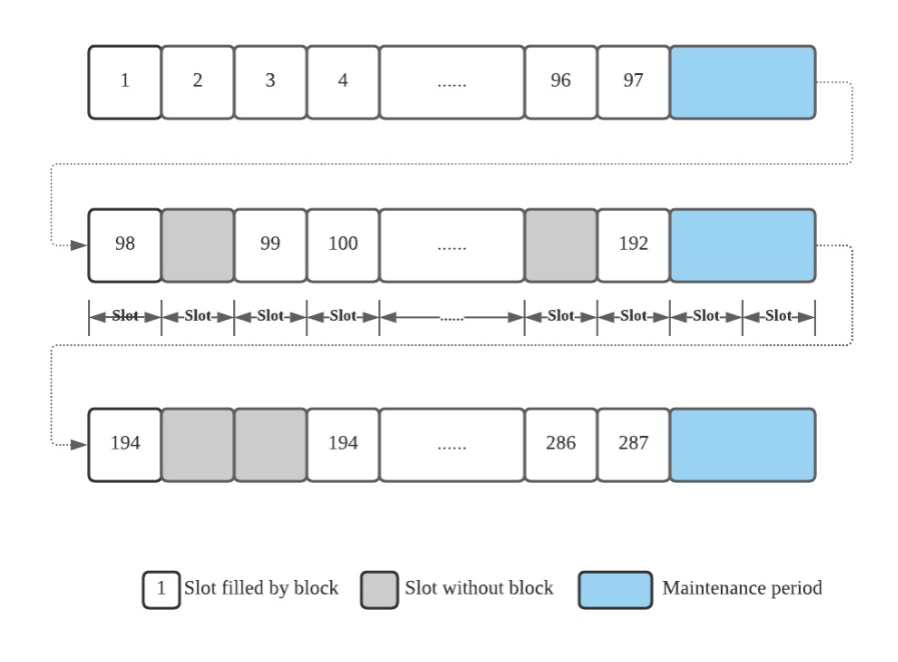
27 elected SRs produce blocks one after the other in a fixed rotating order. In this round-robin approach, blocks are created about every 3 seconds. This drastically lowers the latency present in most other blockchains and is what allows the TRON network to support thousands of transactions per second. This translates to quicker transaction finality for developers, and an improved UX for their dApps.
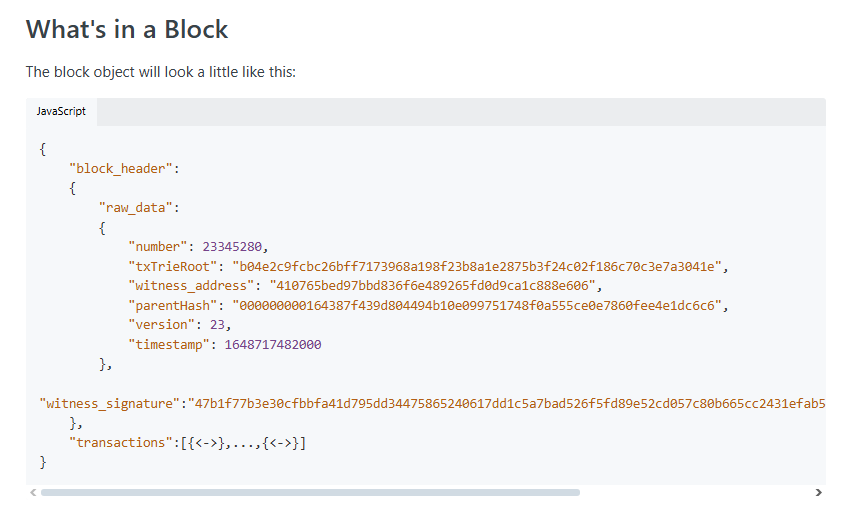
Every block created by an SR consists of a batch of transactions, reference to a previous block and a digital signature. Once the block is created, it is broadcasted to the network and other nodes confirm its validity. If an SR is unable to create a block in its slot, the right automatically transfers to the next SR, and so on, which makes the network robust to any downtime and malicious behavior.
Voting is not simply an instrument of governance but also a reward mechanism for users. Users get a portion of the block rewards for voting for SRs, which provides the incentive to stay active. It promotes a good ecosystem, one where interests of developers, users and network operators stay aligned.
TRON also has mechanisms around forks and finality built into its consensus protocol. This is because blocks are irretrievably confirmed as soon as a supermajority of SRs have voted on them. Like other major blockchains, if a fork does occur, the network operates on the longest chain rule. This guarantees the consistency and security of the ledger — despite network disruptions or attacks.
The TVM, Solidity and How It Differs From EVM
The TRON Virtual Machine (TVM) is the environment in which all smart contracts on the TRON network are executed. A small, but Turing-complete, virtual machine for performance and safety. Perhaps its biggest strength is its almost complete compatibility with Ethereum Virtual Machine (EVM).
This compatibility allows for developers to create smart contracts in Solidity — the most used smart contract language — and have existing Ethereum dApps move to TRON with very few lines of code changed. Notably, TVM is not just an EVM copy. Its architecture has been optimized for TRON. As already stated, the most important difference is the fact that it has a resource model. In contrast with the EVM where the price of the Gas is fluctuating through the network, this more stable Energy system in the TVM provides more predictable transaction costs. This is a huge advantage in applications that have some compute-heavy computations involved. TRON Energy management is a crucial skill for a serious TRON developer.
TVM uses Bandwidth + Energy, and EVM uses Gas as its resource model. This will play a part in how developers will optimize their contracts and user costs.
Four transaction types: TVM supports transaction types similar to the Ethereum protocol, with types to represent transfers and contract transactions.
There are extra precompiled contracts based on batch signature verification, resource delegation, voting, and similar features, enabling dApps with richer functionality.
For example, if you want to deploy a TRC-20 token contract. With TronBox, you compile the Solidity code, deploy to the network, and then use Tronscan to verify your contract, call its functions and follow your token transfers. The TVM guarantees that each function call burns a predetermined amount of Energy, which can be tracked and optimized through analytics on Tronscan.
Smart contract security is paramount. Auditing: always audit your own code, use well established libraries, and test as much as humanly possible on TRON’s testnets (Shasta, Nile) — never deploy unsafe code to mainnet. The contract verification and event logs on Tronscan are very useful for monitoring and debugging after deployment.
Deep Dive into TRON: the Landscape of DeFi
TRON has developed a robust and mature DeFi ecosystem surrounding the network, primarily due to the speed and low price which are perfect for the high frequency of transactions normally seen in DeFi. With little to no costs seen on other networks, and no gas wars, users can trade, lend, borrow, and chase yield freely.
The DeFi scene of TRON is centered around its several flagship platforms. JustLend DAO is one of the easiest decentralized lending platforms where users can supply their crypto assets to earn interest or borrow other assets. Sun.io is a one-stop platform providing a DEX for token swaps and liquidity provision.
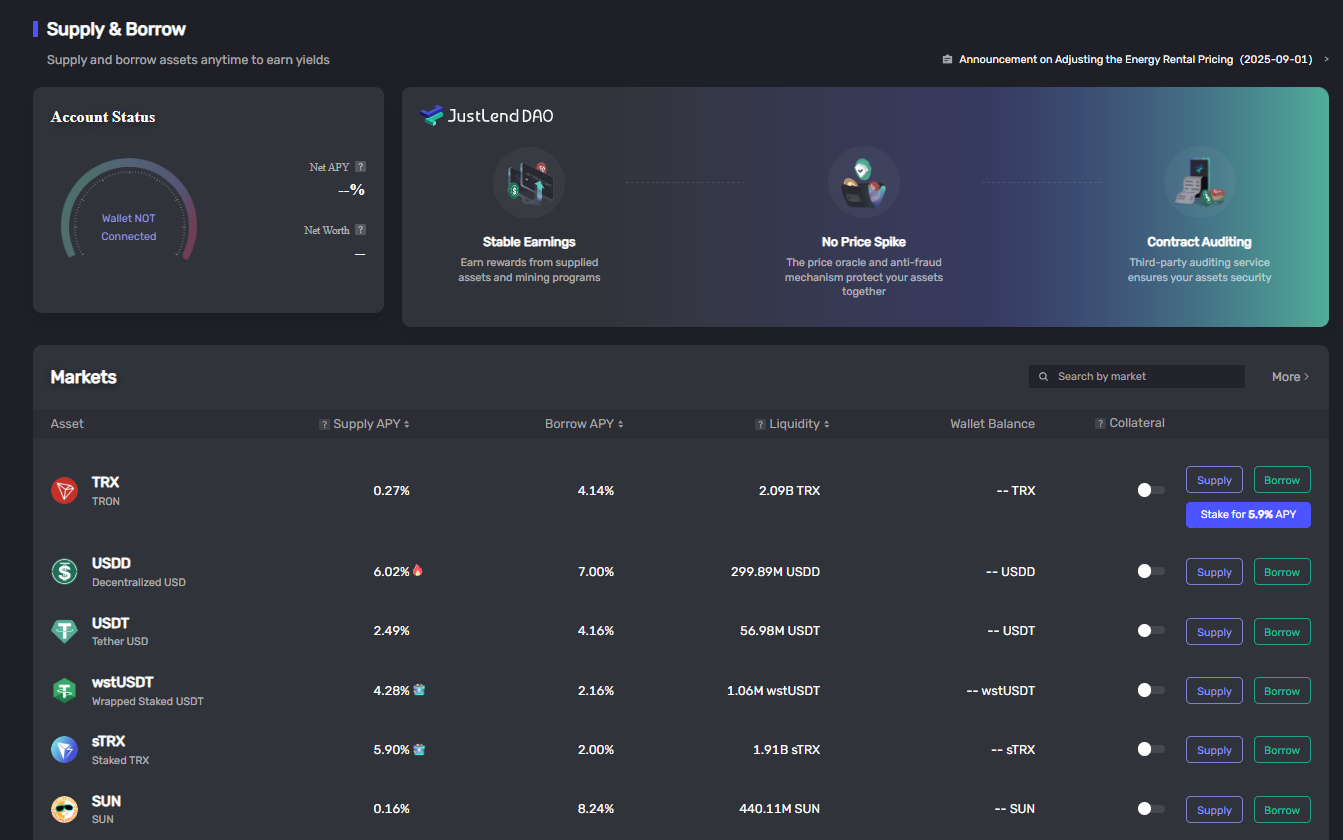
But the ecosystem is so much wider. As a leading stablecoin transfer channel, TRON now supports stablecoins like USDT, TUSD and USDD which move in billions of volume. Projects developing cross-chain bridges to allow asset flows from TRON to Ethereum and to BNB Chain (such as BitTorrent Chain (BTTC)) to multiply DeFi opportunities. Through yield aggregators such as stUSDT and a few different liquidity mining protocols, users can automate strategies to get the most out of their yield. A large ecosystem of digital collectibles and gaming assets powered by TRON NFT standards (TRC-721, TRC-1155) NFT markets.
Devs can create automated trading bots using Tronscan.co API for live data, portfolio trackers that keep track of balances, yields and rewards, personal dashboards for liquidity providers and stakers, tools for resource, such as automated Energy rental or Bandwidth management for optimal usage.
TRON Energy and Renting Energy on TRON
All transactions and execution of smart contracts in TRON require resources. Energy is needed for contract execution while Bandwidth is only for simple transfers. By freezing TRX, users are capable of obtaining Energy, but that might not fit everyone's purpose since it ties up capital. That's why renting Energy on TRON is very important, especially for dApps or high-frequency users.
Platforms like Netts.io collect Energy from different providers to provide instant and affordable Energy. By integrating Netts.io's Energy rental API, developers can allow their users to automate their Energy rental, keeping everything up and running seamlessly, even during peak demand. This should both save cost, and create a better user experience by avoiding failed transactions out of resource exhaustion.
Best Practices and Security Considerations:
- Develop and test on testnets.
- Use Tronscan to watch contract events and resource usage.
- Audit your contracts regularly and use proven libraries.
- Teach your users about resource management and why they should rent Energy on TRON.
- Stay tuned with TRON’s protocol upgrades and community proposals.
Conclusion and Tips for Resource Management in dApp
The best of both worlds — Ethereum compatible AND high performance. With an understanding of its unique DPoS consensus, the subtleties of the TVM, and the tools at their disposal, developers can build powerful and efficient decentralized applications. Managing the TRON Energy your smart contracts consume during deployment and user interaction is essential to guaranteeing an inexpensive and smooth user experience.
The native way to gain Energy is by freezing TRX, which tends to need an amount of capital to be locked. And it's exactly the reason why a vast segment of developers and high-uptime users go for specialized services. Resource management is the last step in launching a successful project as a part of the whole TRON ecosystem.
This is where a platform such as Netts.io transforms into an essential utility for any developer. Netts.io is an energy rental aggregator, offering developers and users on-demand availability of billions of units of Energy at the lowest market price. You do not need to lock tons of TRX anymore — you can rent Energy for a tiny amount of money and usually not long-term (one hour is possible). With this service, you can reduce transaction fees significantly, getting up to five times lower than if you burn TRX directly.
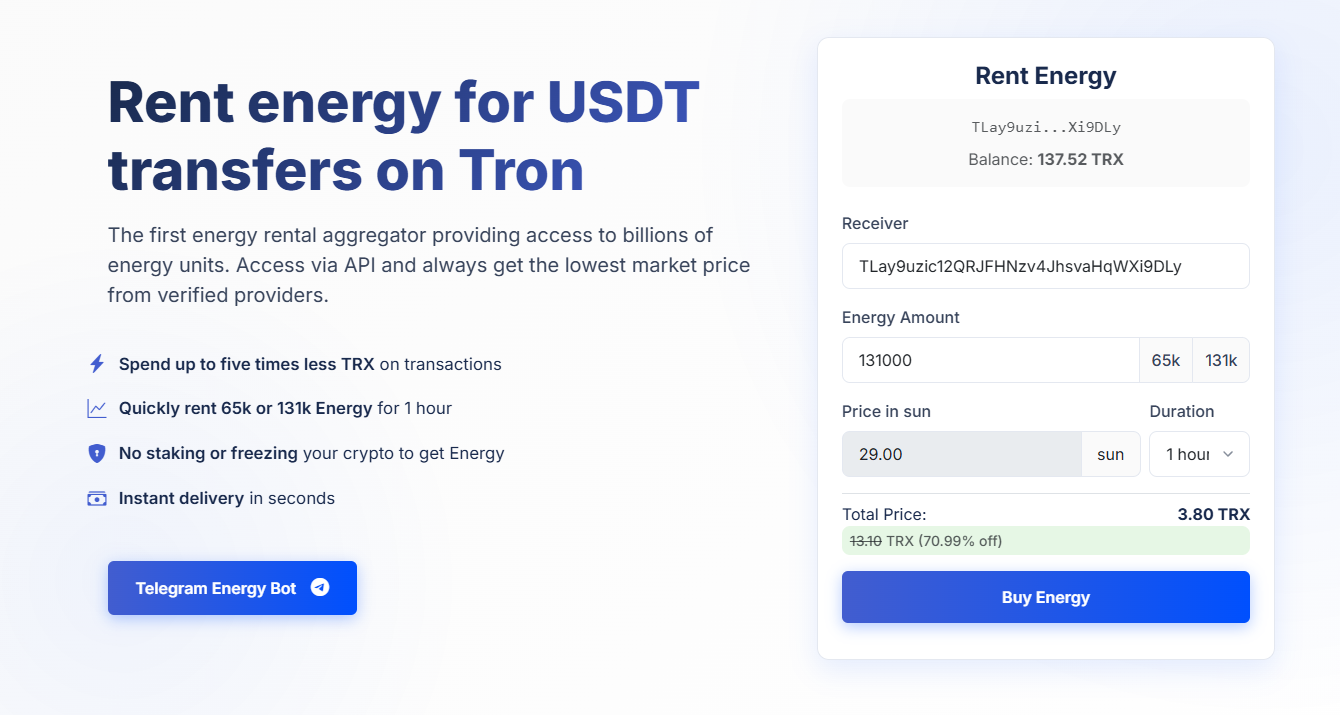
Netts.io presents an affordable, simpler answer to the problem of resource management so you can concentrate on what you do best: developing great applications.
Tronscan is more than just a blockchain explorer — it is a launch pad for developers, an information hub for analysts and a gateway to a new era of decentralized finance. Armed with its tools and knowledge of the mechanics behind the TRON network, you can create, deploy and scale up-to-web3 economy applications.