Crypto Custody: Who Actually Holds Your Keys?
Custodial wallets are convenient — until the exchange collapses. Non-custodial is safe — until you lose your seed phrase.
The question sounds technical. And truth be told, choosing an exchange can be one of the most impactful things anyone makes when interacting with crypto and for the vast majority of people, is likely answered by happenstance rather than design When you open an account at a well-known exchange, install an app or follow the most comfortable route into crypto assets, you are in a sense leaping without looking; no one stops to clarify the terms of custody on your behalf. The answer, in nearly all instances, is because someone else is holding your keys. And that someone else also has their own incentives, vulnerabilities and unique relationships with regulators who have every right to grill them.
Custody, at its most bare-bones stripped of all technical dressing is about control. Complete command of a crypto address is determined by who controls the private keys. No customer service number, no dispute resolution services, no bank branch manager who can confirm your identity and issue you a new account number. The key is the account. The money is yours if you have it. If someone else holds it, it's theirs — and you have at best an unsecured legal claim against them entirely dependent on their solvency, their goodwill, and the law of whatever jurisdiction you're in. This is a new type of financial relationship for most people, and its ramifications are broader than many introductory guides recognize.
Custody 101 — What Custody Really Is
Bitcoin and the rest of cryptocurrencies were built from the ground up as non trusted third party systems. The whole reason was to eliminate the need for a bank, a clearinghouse, or any authority that could freeze your funds, reverse transactions or simply stop working at an inopportune time. In the original white paper, Satoshi Nakamoto explained a method for electronic cash that uses a peer-to-peer network to prevent double-spending by using cryptographic proof instead of trust. What really mattered was the private key.
This was indeed serious business back on the earlier years. Folks would run nodes on their home computers, keep keys on USB drives, print paper wallets and memorize seed phrases. The culture was fiercely self-reliant. "Not your keys, not your coins" wasn't a catchphrase — it was an almost religious principle recited by anyone who had been in the space long enough to see what happened when you entrusted someone else with your money.
Historically, what happened was often an outcome most of us would disallow. Mt. Gox — which once processed between seventy and eighty percent of all global Bitcoin transactions in early 2013 at its peak, around 850,000 BTC which at the time amounted to almost $450 million was stolen over a long period before Mt. Gox filed for bankruptcy protection. In the immediate aftermath, customers that had trusted Bitcoin to the exchange were left with nothing and forced to wait years while only receiving pennies back from bankruptcy proceedings. The lesson remembered and much talked about. Until, for the next decade, however, people went into something relatively similar with other exchanges.
That behavior, after all, was not illogical: It is really hard to manage your own keys and there are so many ways how you can lose them? There are enough cautionary tales about custodial history to scare a person away from self-custody.
One example was that of James Howells, a bitcoin pioneer in Newport, Wales, who accidentally threw away a laptop hard drive containing the private key for a wallet with 8,000 BTC on it back in 2013.

Those coins, locked in a sealed landfill site and legally out of reach after the High Court ruled he could not sue the local council — was worth around £600 million by early 2025. Howells finally threw in the towel in the summer of 2025 after twelve years of campaigning and elaborate plans to excavate the site using machinery that was powered by artificial intelligence. The coins are still buried.
German software engineer Stefan Thomas, an early Bitcoin contributor who worked as Ripple's briefly CTO, forgot the password to an encrypted IronKey USB stick containing 7,002 BTC — now worth well over $700 million at peak prices. The IronKey wipes its contents after ten failed password attempts. Thomas had 8 tries total, missed them all and quit with 2 tries to go. In a vault in Switzerland sits the drive. The password is still missing, and the coins remain inaccessible.
These are not fringe stories. Estimates suggest between two and four million Bitcoin have been lost forever under similar circumstances — around twenty percent of the entire supply, wiped out not by design but by simple human error.
The appeal of custodial wallets has been easy to see, especially when matched up against this backdrop of permanent loss. Give somebody else the keys, an exchange, a wallet provider, a financial institution and they must work hard to protect them. If you forget your password, they can check who you are and restore access for you. Lose your device — nothing is lost permanently because you never had the keys. You have effectively rebuilt the banking relationship: the institution custodizes your assets for you, and you hold a claim against the institutions.
This is comfortable and familiar. As anyone who has watched the cryptocurrency industry for long enough knows, it is also an entirely trust-based system: you are wholeheartedly reliant on the trustworthiness, integrity and credit of the institution towards which you have entrusted your assets.
From the start, custodial services have had a corrupted incentive structure. Exchanges and custodians are businesses. They really are not doing this to protect your property, their main goal is to make money. The arrangement goes like this — when those two objectives come together (and they often do!) it works really well. The same diverge and rise the danger of catastrophic results. For years, Sam Bankman-Fried came across as a level-headed caretaker of customer deposits and an advocate for prudent industry-building. He was also depositing customer funds at FTX and using it to finance speculative bets through his hedge fund, Alameda Research. FTX went bust in November 2022 with over eight billion dollars of customer deposits evaporated. Users who had risked their funds with FTX were left without assets.
The Celsius Network freeze was also filed for bankruptcy in July 2022, freezing from approximately $4.7 billion of customer funds.

Celsius had sold itself as a crypto bank promising high return rates; return rates were real for some time, the model's sustainability was not. In April 2021, the Turkish exchange Thodex closed its doors with two billion dollars in user assets unrecoverable and its founder fleeing into hiding. In 2018, Canadian exchange QuadrigaCX ceased to be functional after its mystery founder had died — or as further scrutiny later asserted, had faked his own death — with the passwords essentially lost to cold wallets that held around $190 million. The losers in each of these cases were the users who treated a custodial service as though it were effectively a bank — they never bothered to ask whether the actual diligence was there.
This is more than just handing over your assets when you sign up for a custodial service. A custodial account with today fully onboard might require:
State Issued ID verified against world eliminating databases
Know your customer (KYC) documents with proof of residence: you can provide utility bills or bank statements
Selfie or live video based matching against ID documents
You must provide your tax identification or social security number in many jurisdictions
Monitoring transactions and potential requests for source-of-funds documentation
Each of these steps consists in collecting data. That data exists somewhere in the custodians system, can be subpoenaed, subject to mandatory reporting obligations to regulatory authorities and is therefore potentially at risk of breach. Centralized platforms were responsible for 79% of the reported crypto security incidents in 2025, with hackers stealing around $2.7 billion dollars just within the first half of that year. The custodial model does not completely remove risk — it just shifts and concentrates that risk to a different location.
What custodial services do actually offer in an honest exchange for these risks is recovery. None of this needs to be part of your life, but is a real and genuine service that allows you the power to reset forgotten passwords, or recover locked accounts after full identity verification or contacting some support team if something breaks down in some manner. If you're new to crypto, if you lack technical confidence and are not accustomed to the discipline that is required to keep a seed phrase safe, custodial is at face value not a bad option. It is a set of trade-offs. The debate is whether the entity on the other side of those trade-offs is worthy of this trust — and in many situations, you honestly lack the information necessary to know.
Non-Custodial Wallets — Freedom That Bites Back
The responsibility for key management lies entirely with the user when we talk about non-custodial wallets. You create a wallet, you get given a seed phrase — usually twelve or twenty-four words randomly generated and selected from the dictionary — and that is literally your full access key for your funds. It cannot be reset. There is no contact information for support. Its a wallet on a blockchain no human nor organisation controls and your private key exists (wherever you have decided) to keep it. Lose that seed phrase and if you have no backup then the funds in that wallet are inaccessible to anyone, including you, until the blockchain runs.
This was deliberate in their technical architecture. The private key is a value computed from the seed phrase using a deterministic cryptographic function, so anyone who has your seed phrase can gain access to your wallet on any machine in any geography. Lets say the security of the wallet is a direct function of if the seed phrase is secure. A slip of paper in a drawer, a note on a phone, a screenshot uploaded to cloud storage — all these can be points of failure, and all have been used by an attacker or lost by an owner being careless.
Hardware wallets — physical devices from makers like Ledger and Trezor — store private keys in a secure chip that never exposes the key to a connected computer. Transactions are signed internally by the device. What hardware wallets do not protect against is the loss of the seed phrase used to set them up — lose the device and the seed phrase, and the funds are gone.
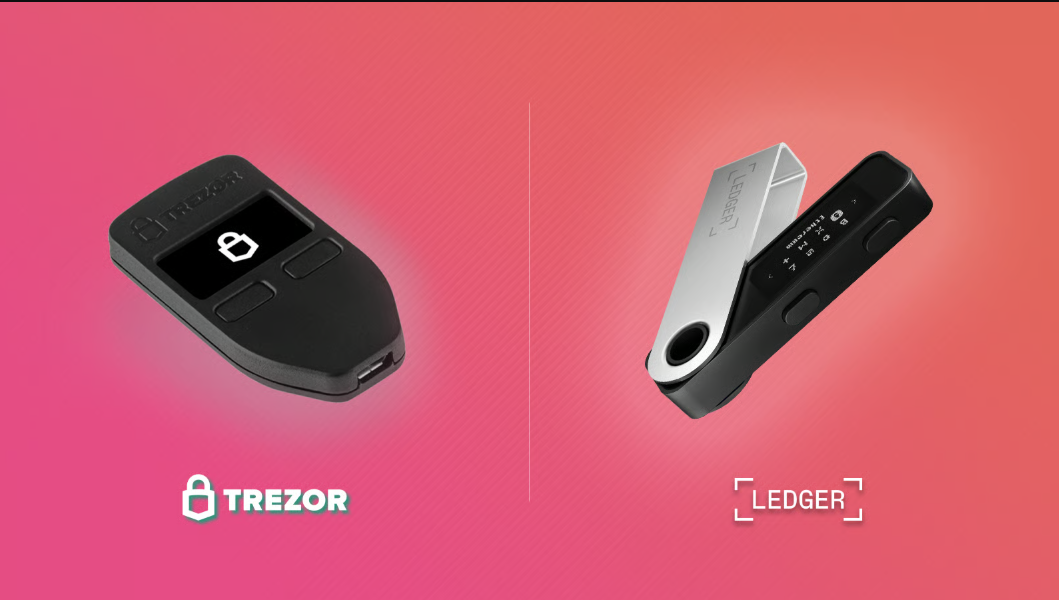
Sales of hardware wallets increased 29% year-on-year to 2025, and survey evidence from this period shows that around 59% of crypto users prefer non-custodial wallet arrangements. This is years of experience in exchange failures where you are a different breed of user, many of whom learned what not to do by losing money in the process. Self-custody is a real trend, driven more by scepticism of institutions than excitement for seed phrase management.
The only relevant privacy avenue that one can take as a crypto user not wanting their funds tied to an authenticated identity is to use non-custodial wallets. If you transact directly on a public blockchain from a self-custodied wallet, your transaction will be publicly visible — every transfer is traceable — but the address will not automatically be tied to your name / home address / bank statement. That string of characters is what your counterparties see — not who you are as a person. How much that matters ultimately depends on who might be looking and what they intend to do with the information.
Privacy, Regulation and Who Is Watching
The chasm of privacy between custodial wallets and non-custodial wallets is glaring and getting larger by the day. Almost universally now, any custody service mandates full KYC compliance: government ID, biometric data, proof of address, almost always a tax identification number also at the time of writing. It is all gathered, held, shared potentially under regulatory requirements and could be compromised in a breach.
92% of the top centralized exchanges by volume have KYC done by 2026. The so-called FATF Travel Rule is now the law in 85 jurisdictions and requires collecting sender and recipient details on every transfer above a certain threshold. Custodial crypto's surveillance ecosystem is now nearly equal to that of the traditional banking system, and in many ways exceeds it since block chain provides a public ledger of every single transaction.
From regulators point of view, custodial wallets are a lot more unremarkable than non-custodial ones. Your identity has been confirmed with your custodian, they are monitoring every transaction you make, and if you ever started doing business in a way that perfectly matches with one of their risk profiles your account is frozen and the activity must be reported to the authorities. That makes you a milch cow — a known, written person that any compliance framework can observe and stop his behavior. You exchange privacy for legitimacy and access to services that will be offered only if you clear the compliance hurdle.
The space for non-custodial wallets is a separate regulatory sphere. In a self-custodied wallet, you can hold as much cryptocurrency deposits without the need to identify yourself to anyone. You are doing it without triggering any institutional reporting mechanism. Regulators have taken note and the response is changing. As of 2026, the regulation of DeFi and wallet compliance has become a live issue with regulators increasingly viewing Anti-Money Laundering (AML) and counter-terrorism financing controls are baseline requirements for any kind of financial activity even if activity is routed through decentralized protocols. More and more custodial platforms are also soon going to have to document interactions with unhosted wallets.
That whole privacy question can be a two-way street. Custodial wallets expose you to identity data collection; non-custodial wallets expose you to seed phrase theft and phishing. In 2025 the FBI reported combined losses in U.S. cryptocurrency fraud of more than $9 billion across both categories. Both models do not make you safe by default — they expose you to different threats, in various ways and with different degrees of consequence, so depending on your context knowing which threat is more relevant matters much more than having a categorical preference.
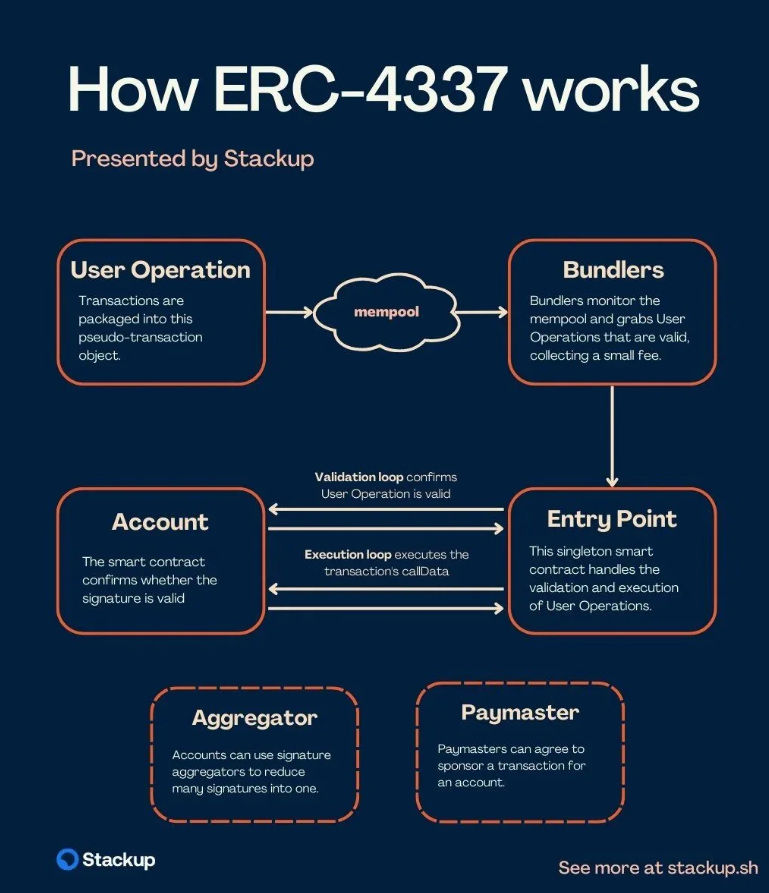
Standards such as ERC-4337 for social recovery wallets provide a possible middle ground — with designated guardians able to restore access but no single seed phrase and better permanence by leaving control on-chain instead of with a centralized custodian. Adoption is still low and the security models are still working, but they will continue to push human-friendly key management rather than complete setting leg involvement.
Profitability — Does Custody Affect Your Returns?
The custody question overlaps the profitability in ways that are not necessarily apparent visually. Custodial exchanges normally have easier trading interfaces, deeper liquidity, faster execution times and often inherently offer some form of staking or yield. You can earn yields on your assets without ever interacting with a DeFi protocol, and without maintaining a hardware wallet. The platform bake in complexity and charges more or less for it. The convenience is very real and the yield, where it is made available, tends to be real as well — a point that 2022 proved literally with respect to any yield offered on an institutional (custodial) bitcoin platform remaining contingent on that platform's continued solvency.
Custodial wallets such as those provided by centralised exchanges restrict access to the entire toolset of DeFi protocols — allowing users only potential exposure to liquidity pools, lending and yield strategies that custodial platforms cannot offer. In principle, someone in charge of their own keys has access to everything built in decentralized finance. They could also lose everything to a smart contract exploit, an accidental transaction approval or a compromised seed phrase. In many ways, the DeFi ecosystem is as innovative and more dangerous than anything we have seen in the last 20 years of cyberspace.
Custody model as a lone determining variable is not true from pure returns perspective. Otherwise like self-custody without DeFi activity, the collateral appreciates but no income. Staking on a custodial platform generally generates four to ten percent annually on eligible assets, after taking the platforms cut. But active participation in DeFi while using non-custodial wallets can earn orders of magnitude more — and lose orders of magnitude more. The custody model represents a risk category, not a financial product in itself.
The largest profits anyone ever captured in the history of crypto from self-custody were mostly early adopters who held private keys to assets that have increased by orders of magnitude without losing access. There are losers in both the "With" and "Without" categories: exchange failures, personal key mistakes, DeFi hacks, outright theft. On a risk-adjusted basis, neither custody model consistently beats the other. The risk is still large, but the difference is the character of such risk.
When users use their cryptocurrency instead of freezing or holding it, the price quoted for moving the assets from one place to another becomes a daily topic for all users following either custody approach. We see fee optimization not only on the level of company custody structure itself in case anyone was lookin for making USDT transfer cheaply enough to use regularly (or if they wish to send free usdt by using skilled management of blockchain resources). Users USDT calc fee requirements prior to transferring on TRON, which accounts for the majority of USDT activity, meaning users know exactly if their current Energy and Bandwidth will cover the cost or that TRX is burnt at the default rate which is well in excess of renting energy preemptively.
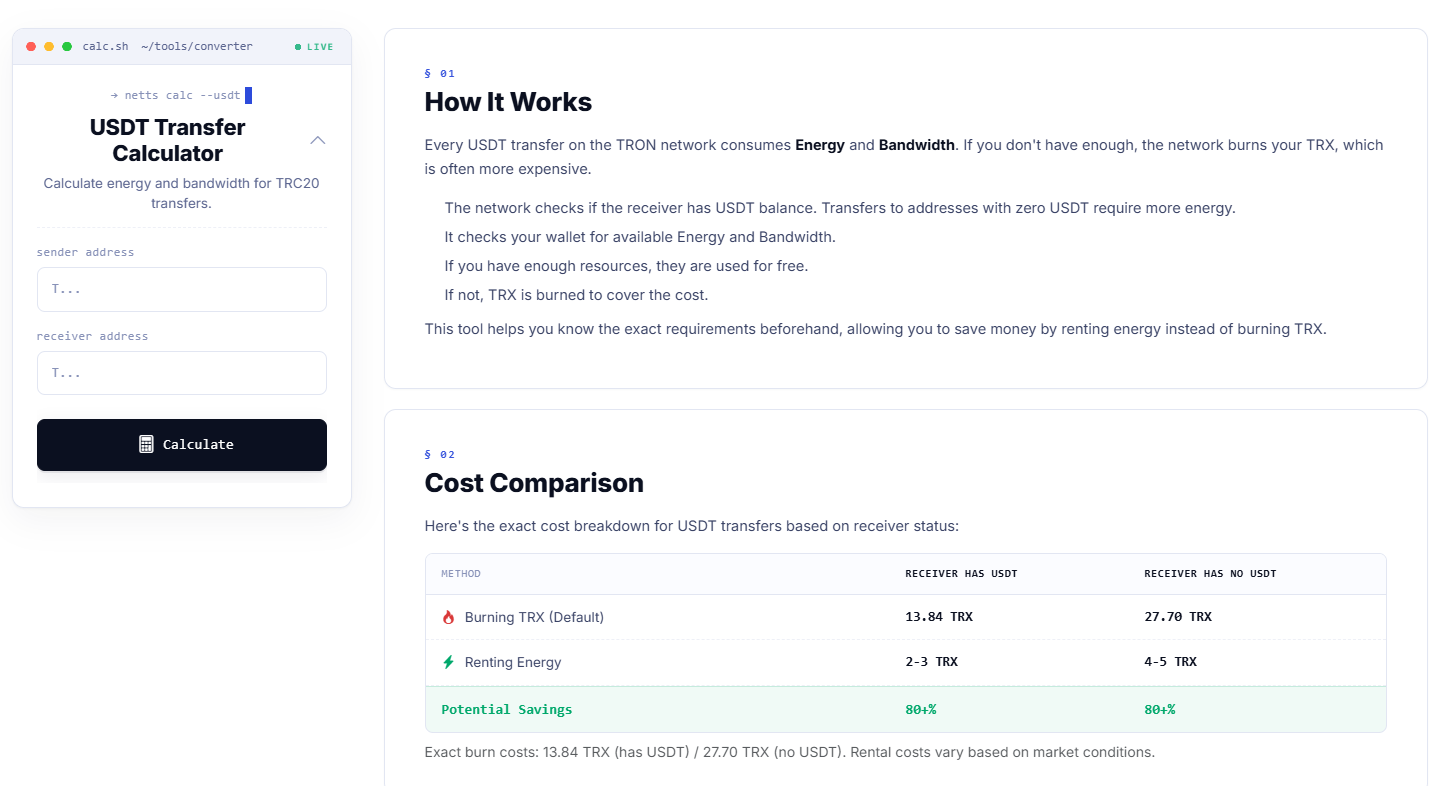
Netts.io offers a USDT Transfer Calculator that takes sender and receiver addresses, checks available Energy and Bandwidth, and shows exactly what each transfer will cost under default TRX burn versus Energy rental — typically 80% cheaper — starting at 2 to 3 TRX versus nearly 14 TRX burned by default.