Crypto and Telegram: Match Made in Heaven
Why crypto teams meet users in Telegram chat windows instead of making them download desktop apps - the format works.

Almost every single time someone attempts to introduce a non-technical person to a piece of crypto software, there is this moment of friction. The person is interested. The pitch made sense. They will give it a go. No one goes to a site they never heard of, download an arbitrary .exe file from it, run it over the screen-filling anti-exploit warning Windows SmartScreen makes flash angrily bright red, go past a permission dialog asking for elevated privileges and assume that nothing bad will happen. The intent was good. The conversion is killed by the user experience. When presented with that chain, most people just shut the window and return to their night. This was however an opportunity lost, not because the product was bad but simply because the entry door was wrong.
A generation of crypto teams has quietly solved this problem by recognizing something that the rest of the software industry took longer to internalize: You meet the audience not on the audience's hard drive, but inside apps that the audience is already using. For many parts of the globe, that is Telegram. These are partly incidental, and partly structural — Telegram's bot framework is relatively aged, its developer ergonomics are reasonable, its presence in crypto-adjacent communities is pervasive, and linking to a Telegram bot feels like the world's most mundane thing to do for most users. There is no installer. There is no permission warning. You have nothing but a chat window that pops up and a friendly note explaining exactly what the bot does.
Door That Is Already Open
Trust doesn't come from marketing copy. It is constructed from all the little ways you have been conditioned to experience something similar in the past. By the end of 2020, most Telegram users that regularly interacted with bots had over a dozen different bots in use for various purposes — receipt notifications from services they subscribed to, food delivery, packages tracking, as well as gaming and customer support for businesses. With each of those interactions, the user was trained — entirely automatically — to believe that Telegram bots were just a regular part of the internet. Even when the crypto project had come up and offered a bot purchase of Energy, refilling TRON Energy, or some wallet operation, fine — that unfamiliarity barrier had been sufficiently filed down over years of use.
Of course, security expectations operated under a different (and more complex) dynamic. But users were safer using a Telegram bot than they would have been with a downloadable application, not necessarily because the bot was inherently any more safe from a technical perspective — it could be just as unsafe depending on the team making it — but rather because of the form factor: namely, people are familiar with messaging apps and familiarity is king when it comes to measuring how safe something feels. This is not necessarily a positive and we will come back to this shortly. But it is real, and it drives what gets created and what gets used.
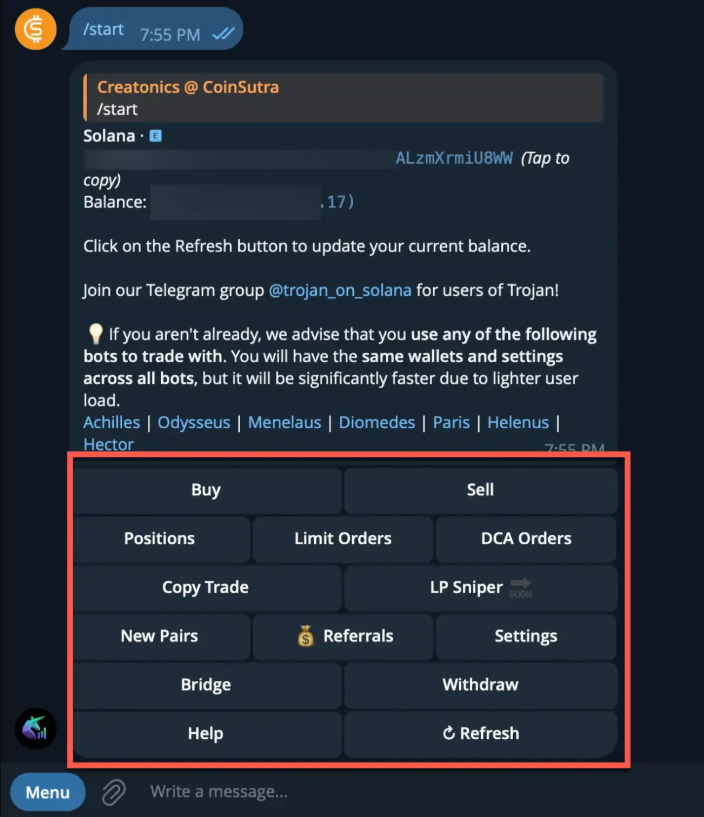
The other benefit of the chat interface is functionality that reflects something more like reality; conversational latency. Web interfaces are even more complicated since they are all stateful, but native applications and chat bots demand over-the-air updates and online matching, respectively — a chat bot responds in the same window that the user is already typing in, with the same latencies as a friend standing next to you. The cognitive load is lower. The interaction feels lighter. That lower-load format is, for most people, just more desirable for everyday tasks — checking a balance, doing a small transfer or looking up a price.
Why the Big Projects Went With the Chat Window
From the outside, it seems that instinct would lead established crypto companies with plenty of engineering resources to make their own native applications and fix them up. Some of them did. The ones who were using Telegram more intensely even built Telegram bots for their important user segments. This was a banal reasoning: the users were there. It was not rocket science for a crypto project when it had the decision to make of whether they could build a Windows app that 5% of their audience would download or a Telegram bot that would be used without thinking by 60%.
All major exchanges operate Telegram interfaces — sometimes notifications, other times trading, still others customer service but often all three. Largest DeFi protocols roll out bots to execute the most popular user actions within chat window while not letting users even leave it. Telegram bots created by the projects of wallets in which users can send and receive transactions right inside Telegram. TRON Energy bot providers in the energy market are ready to instantly refill users' wallets at prices comparable with virtually any web interface. The user does not switch apps. Typing into the same window that they are also chatting with their friends and following news channels, and the transaction in the background completes.
This was the same logic which drove all big corporates onto YouTube and Facebook in the 2010s instead of waiting for customers to come to their corporate websites. The audience lives somewhere specific. You go where your audience is. Your audience does not come to you. With the exception of situation-specific technical limitations, crypto has only too obediently conformed to this pattern despite its defiantly individual self-image.
Famous Bots and What They Really Do
By now your catalog of crypto Telegram bots that are actually useful is so long it would take a couple pages to list all of them. A brief look at the most influential examples gives a flavor of the options.
From 2022 to early 2024 we saw projects like Maestro, Banana Gun, BonkBot and Trojan grow into serious infrastructure rather than novelty toys. They enable users to trade tokens across all chains, set limit orders, manage portfolios and execute their snipes on new launches — from within Telegram. These include ones which process hundreds of millions of dollars in volume per month. The teams behind them scale from anonymous developers who've taken a side project to commercialize it, to engineers working for professional trading firms who saw the opportunity and built an execution infrastructure that just happens to run in a chat window.
Users of Wallet bots such as Wallet, by Telegram and many third-party alternatives can access custodial (Wallet) or non-custodial (Zebedee, Bitrefill) crypto features within one bot experience without triaging an additional app. This made it inefficient to ping TRON nodes manually for USDT transfers, so energy bots — the kind that let users refill on demand — became infrastructure as standard for anyone who uses USDT on chain on a regular basis; they simplified complicated optimization problem into one chat command.
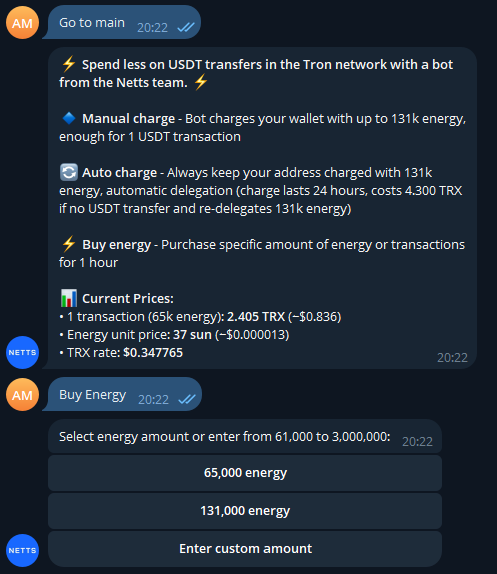
There are currently several providers out there in this space and except for pricing, delivery speed etc, the user facing experience is fairly similar across them owing to all of them conforming to some specifications as well as set automation modes.
Whether it be news feeds, on-chain alerts, whale movements, gas prices, governance votes or really any other kind of signal that crypto users want to track — this has been the role of information bots. Others are operated by professional analytics firms and involve a fee for use. Some are simply pet projects by one developer or another that still attract very loyal niches through raw functionality. The threshold for entry is low, and the feedback loop tight — good bots proliferate quickly while bad ones flicker out of existence without breaking a sweat.
What I think is interesting about the ecosystem, is how it absorbs so much economic activity without too much noise. A lot of trading volume, a lot of Energy market activity, a lot of regular payments — all within chat windows that look no different than the grandkid chatting with their relative about where to eat. That's the point, not a bug — an intentionally banal feature of mass-market consumerism.
Something You Should Probably Just Say Out Loud
Just because the Telegram interface is familiar does not mean you are safe. A bot is a software created by someone. The writer can be careful and truthful. The writer can be sloppy and truthful. The author can be neither careful nor honest. Even if the user interacts with the bot through a familiar chat window, that does not alter any of the realities of who gets access to what.
Files downloaded through a Telegram bot are not more secure than files downloaded from any other location. A wallet address that a bot has had access to is known, at least, by whomever owns the bot and may even be recorded, sold, or otherwise processed in ways users did not expect. Actual signed transactions through a bot interface on the underlying chain, and an evil bot can create transactions that do something different when broadcast. From crypto history, there have been plenty of bots that either turned out to be ruses, some which were legit but hacked and others could never execute because the code was poorly written in such a way as to put user funds at risk beyond what developers intended.
The paper defenses are the same as for any crypto interaction; don't sign anything until you've properly reviewed it, use hardware wallets for large amounts, opt for well-known bots with public teams and audit histories rather than newcomer anonymous ones, keep in mind that the ease afforded by a chat-window interface does not absolve one from needing to verify what is actually being signed. Familiarity is a useful onramp, but a dangerous shortcut. The bot that reminds them of every other bot the user has ever seen may also be the one that wipes their wallet.
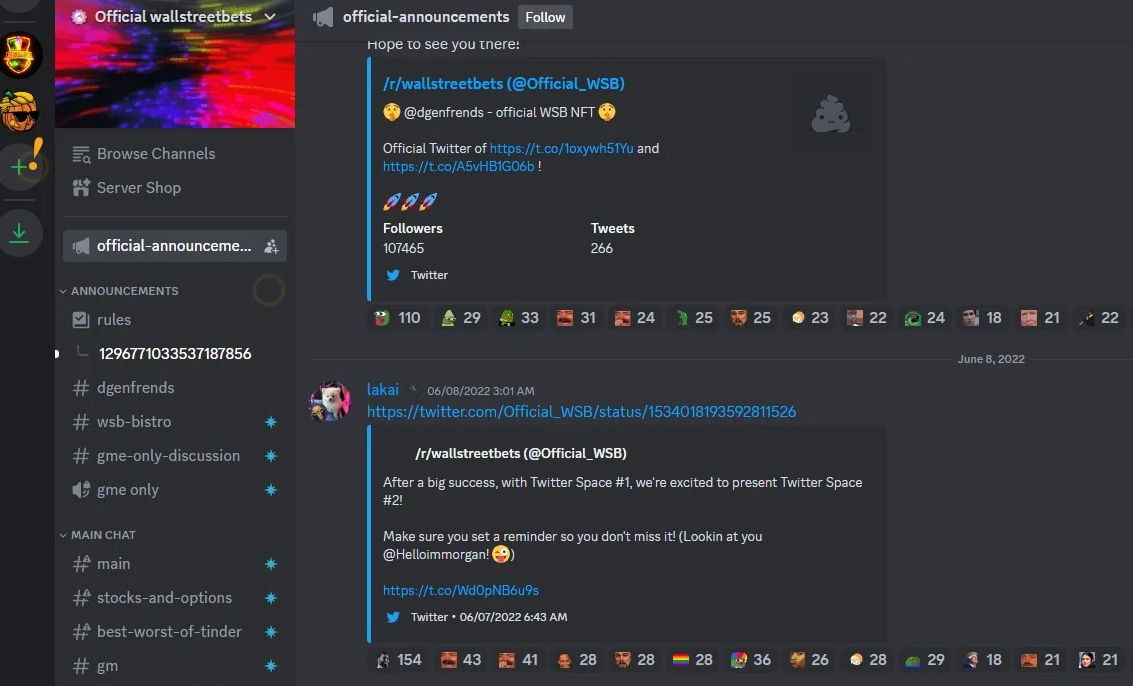
Discord is basically the same with a slightly different shape. Discord servers are the primary community infrastructure of major NFT projects, DeFi protocols, gaming projects and DAOs. Currently the phishing cases we see most commonly in crypto are happening over Discord, where attackers impersonate moderators or post fake announcements in hijacked channels. Users who would never click on a dubious link in an email inbox from a stranger will happily click the same link posted by someone wearing a moderator badge in the Discord of their favorite project. Although the platform alters the risk it does not change the underlying risk itself.
Deal in Your Pocket
The larger trend is obvious enough to name. Gone are the days of crypto users actively hunting down deals — needing to visit webpages, compare rates, and download user interfaces; welcome (or back again) to the even newer age of where deals arrive at them in whatever messaging tool happens to be open. Chat on updates to prices in the energy market. Trade alerts arrive as notifications. In a few taps, wallet operations are complete. No longer is the user expected to learn the interface, but instead the interface comes to where they are. In hindsight, this was the only way crypto ever breaks out of the early-adopters who are comfortable with technology and think of it merely as a more robust version of PayPal or Alipay, since everyone else literally never learnt to use new interfaces for an industry they were still figuring out whether they valued.
Convenient, but in exchange the user has to start creating a new set of habits — checking who really is behind that bot, reading what you are signing, keeping larger amounts in cold wallets and not trusting the chat window just because it looks like we have been here before. However, with the most common tasks such as moving stablecoins, topping up Energy, checking prices and executing small trades, the chat-window experience is the norm. Specifically, the TRON Energy bot category has evolved into something close to mandatory infrastructure for anyone conducting any frequency of USDT transfers on TRON — removing the single biggest friction point, which is constantly asking if this wallet has enough Energy for this transaction and replacing it with a tap.
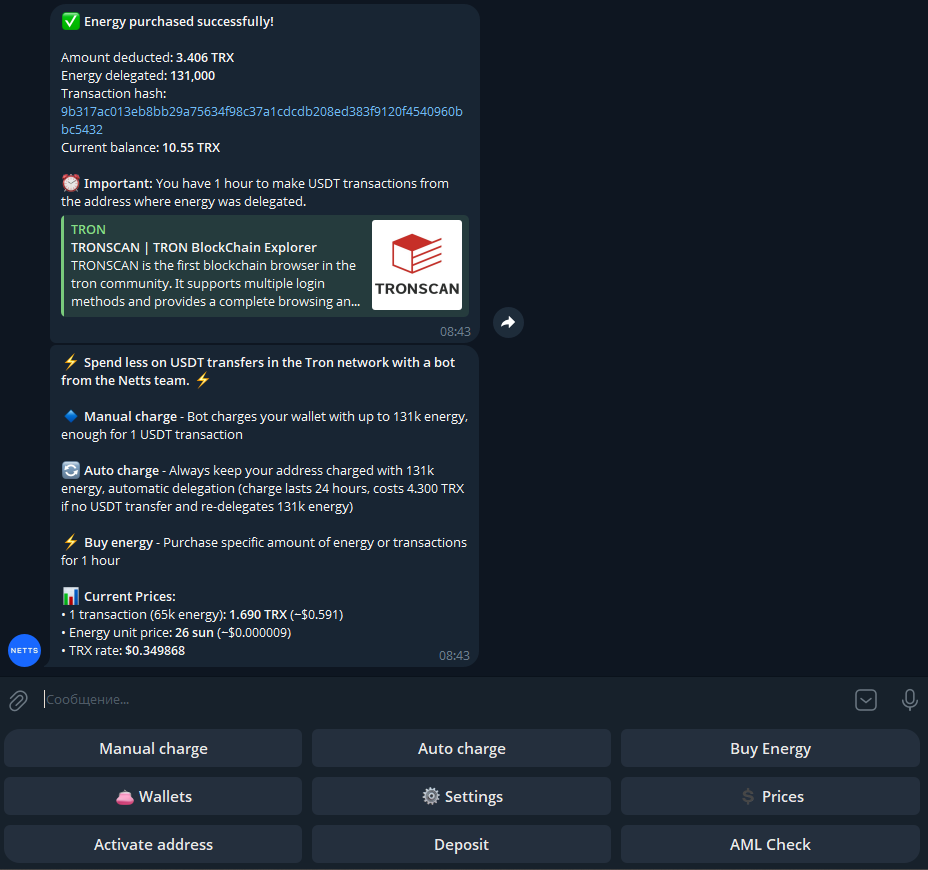
Netts Energy Charge Bot solves the everyday top-up problem within Telegram for all stablecoins movers on TRON. A manual charge gives up to 131k Energy on request, sufficient for a USDT exchange with more than adequate margin; an auto-charge setting continues how an address is stacked nonstop by re-appointing Energy at regular intervals, so no transfer is ever hindered for absence of assets. The entire process never takes you out from the chat window, which is the whole point of this format in the first place. Prices correspond to TRON Energy market rates, with off-peak hours offering the cheapest delegations at around 25 sun per Energy unit.