Bitcoin ETFs: Institutional Acceptance or Rebellion Gone Wrong?
Bitcoin was meant to bypass banks, but spot ETFs repackaged the rebellion for Wall Street portfolios, exchanging sovereignty for institutional flow.

January 11th, 2024, is a date forever etched in Bitcoin’s history, as spot Bitcoin exchange-traded funds (ETFs) began their journey on US exchanges. But at the dawn of its existence, Bitcoin’s value proposition was, quite literally, about exit options. The promise of a permission-free monetary system, capable of resisting censorship and capital control from nation-states and traditional financial institutions, was a defining characteristic of early crypto enthusiasm.
It was a way to opt out, to circumvent the established order and its slow-moving, regulator-approved innovations. Thus, it is only fair to say that the initial narratives focusing on Bitcoin as an economic alternative to fiat were resoundingly, if conditionally, fulfilled by the spot ETFs arrival on the scene. Nevertheless, the newly-formed instruments were, in their own way, another type of exit, one facing the opposite direction. Spot ETFs represented a way in for institutional investors that had no desire or ability to engage with crypto’s technical intricacies, from private key management to crypto-native custody solutions. They embodied the entry into the Bitcoin economy, one that would have little to no impact on the established institutional financial framework, at least on paper.
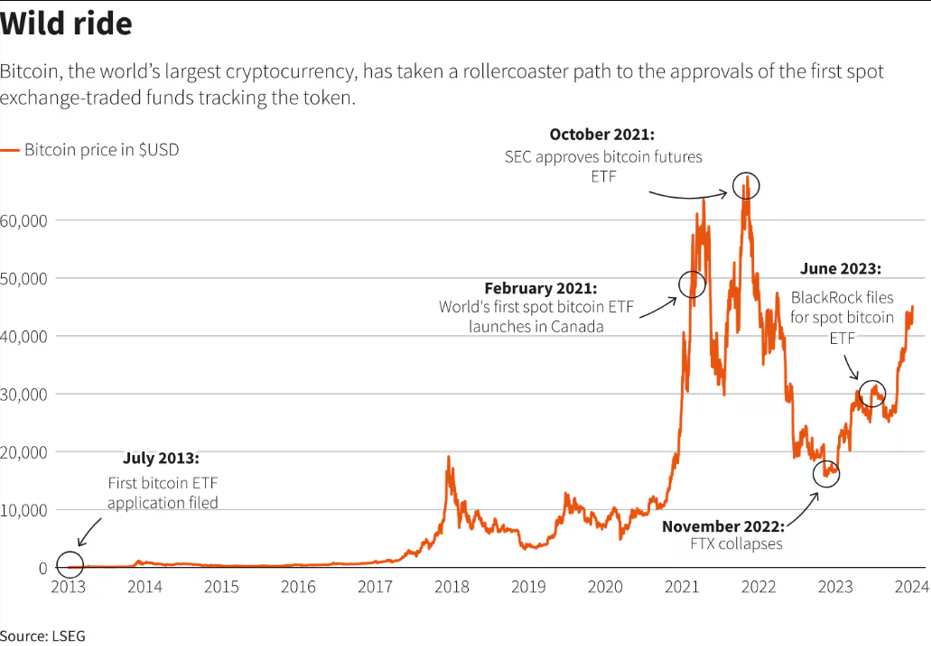
In essence, the introduction of spot ETFs really did not change much for the institutional investors that mattered most. A fiduciary tasked with managing a diversified portfolio consisting of sixty percent stocks and forty percent bonds is unlikely to have their risk management strategy profoundly impacted by a novel crypto allocation channel. As their twenty-first century counterpart, the BlackRock-juggernaut-hiring, SEC-suing, Grayscale-founding individual who purchased coins on a whim in 2011 is likely to feel right about their decision in retrospect. After all, the most enthusiastic segment of crypto’s early adopter base was built on an ideological opposition to the traditional financial system.
Nevertheless, the third category of market participants is the one that should be focusing on their priorities. Pension funds in need of yield, merchants in need of cross-border settlements, and average investors seeking to add a touch of gold to their portfolio without delving into the crypto rabbit hole are all stakeholders with legitimate interests in Bitcoin’s future. In this regard, ETFs are actually a rather pragmatic instrument, one that fulfills the basic requirements of any financial product designed at institutional adoption. They are easy to understand (no private key management), relatively trustworthy (regulated by the SEC), and convenient (bonds, stocks, and crypto in one portfolio). Despite being a custodied product with massive fees and built-in risks, an ETF represents the best available option for most investors seeking to acquire a Bitcoin exposure, at least until the dust settles and the regulatory environment changes.
Ticker Soup and Entry Fees
With the competition among the issuers shaping up to be as fierce as the one between the traditional Wall Street and crypto-native markets, the differences between the products are worth mentioning. With IBIT still dominating the board, FBTC holding the Fidelity loyalists, and Grayscale’s GBTC losing ground to cheaper wrappers and its own Mini Trust, the ticker soup now looks less like a launch party and more like a mature fee war. This is not, however, an analysis of prospectuses, but rather a description of the broader context and its most tangible implications for the market. The most remarkable characteristic of the spot ETF phenomenon really is the sheer absurdity of the situation. Here we go, having witnessed another financial system innovation that was supposed to disrupt the existing powers that be and instead got assimilated almost immediately. Bitcoin’s permanent, decentralized, untraceable exit option became, for all intents and purposes, one of the fastest-growing ETF categories of all time.
It is not the rebellion that has entered the halls of power, but the permissioned markets that have jumped onto the rebellion’s bandwagon. One can only wonder what the architects of the early crypto economy would say upon witnessing their brainchild getting tokenized and distributed as an exchange-traded product. Much like their counterparts in the gold market, Bitcoin maximalists must have mixed feelings about the sudden appearance of the paper versus coin debate in their niche. With the prospect of billions of dollars in inflows, the promise of massive asset management fees, and the opportunity to participate in what is sure to become history, institutional investors really did get what they wanted. However, it was not the rebellion they signed up for, and the early indications suggest that the unhappiness is rather widespread. The very same Wall Street entities that shorted crypto’s mainstream adoption potential in the early days of Bitcoin are now scrambling to capitalize on the market opportunity.
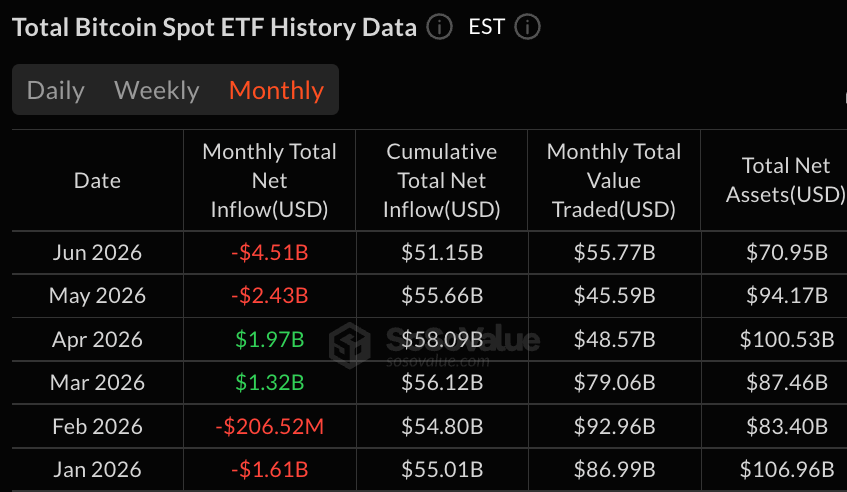
With ETFs no longer representing a novelty, the usual levers of macroeconomic regulation are being applied with more visible force. As institutional investors realized that the easiest way to enter the position was also the easiest way to leave it, the specter of a market reversal stopped being theoretical. June delivered the cleanest example. US spot Bitcoin ETFs recorded roughly $4.5 billion in net outflows, the worst monthly withdrawal since launch, and the pain was concentrated rather than evenly spread. IBIT absorbed the largest share of redemptions, while the July rebound was led mainly by FBTC and ARKB. The same wrapper that once made Bitcoin acceptable to committees also made it easy for those committees to cut exposure in a single rebalance.
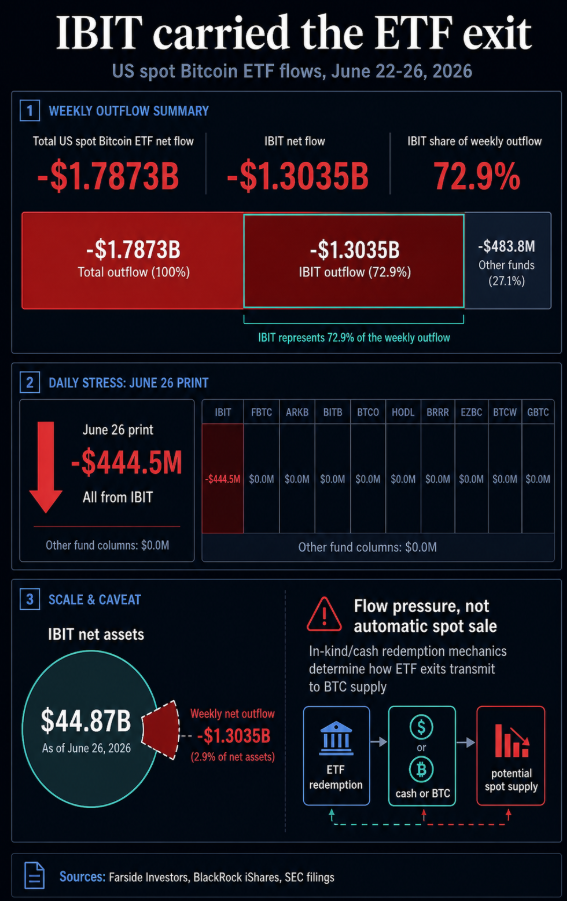
As the most obvious takeaway from this particular market inflection, one must return to the fundamentals of the spot ETF design and its underlying risks. With most of the liquidity concentrated among the top three issuers, the entire product category possesses frightening systemic risks. The institutional investors that purchase shares in a given ETF are in effect buying highly-regulated paper that represents trust in authorized participants, custodians, and the creation-redemption machinery around the actual coins. The SEC’s later approval of in-kind creations and redemptions improved the structure by allowing Bitcoin and Ether ETPs to work more like traditional commodity funds, but it did not remove the central irony. The self-custody asset is still being consumed through a chain of institutions.
This particular aspect of the spot ETF design was one of the many risks outlined in Satoshi’s original white paper, as few things are more insecure than the centralization of crypto custody. Grayscale’s GBTC serves as a permanent reminder of the dangers presented by concentrated third-party custody, as billions of dollars in investor capital were trapped for years in the closed-end fund’s premium-to-discount drama before the SEC lawsuit victory. The institutional capital was funneled through a concentrated mechanism and in effect, the investors became highly exposed to the risks of the custodian company defaulting or suffering an internal security breach. The market infrastructure around Bitcoin really does appear to be a masterclass in Wall Street’s ability to extract wealth from the volatility of the crypto economy. A select number of staggering volume figures do all the heavy lifting for the institutional adoption narrative, while the rest of the financial infrastructure serves to enrich the ecosystem’s gatekeepers and create the illusion of a traditional equity market around the volatile asset.
Inflows Obsession and the Capital Rotation
With institutional investors at the center of the spotlight, it is only logical to turn the discussion toward their interests. What motivated them to invest hundreds of millions, if not billions, into these novel financial instruments? What will be the impact on their operations and capital management strategies? Where do they stand in the grand scheme of things? While it is possible to attempt to answer any of these questions individually, it makes more sense to combine them and identify the overarching theme. In the simplest terms, one must understand that capital rotation drives everything in institutional finance, and a major product innovation such as spot ETFs rarely comes without significant rotation effects.
In the case of the spot ETF, the sheer scale of the flows really does define the entire discussion, as does the speed with which the mood can change. There is an entire industry dedicated to analyzing the movements and projecting potential outcomes, with market analysts such as Eric Balchunas speculating about the future dominance of spot funds or their ability to withstand the inevitable bear market that is sure to arrive eventually. However, there is the other side of the conversation, represented by the likes of Gary Gensler who approved the product launch not out of ideological belief in Bitcoin but rather regulatory obligation. Inside the SEC, there was also Hester Peirce who openly criticized the approach of her colleagues who ignored the market realities and the needs of the institutional investors.

It is evident that the entire industry is caught in a heated debate full of divergent viewpoints, with everyone pursuing rather self-serving objectives. The investors that seek to acquire Bitcoin exposure are in search of an entry point, and increasingly, an exit point that does not require explaining a seed phrase to the investment committee.
The issuers that launched the spot ETF products are in search of higher management fees and institutional adoption. The Wall Street asset managers eager to rotate capital into crypto are in search of yield, while the regulators tasked with overseeing the multi-billion dollar industry are in search of better oversight. Lastly, the everyday investors seeking to purchase a small amount of Bitcoin are in search of a convenient, low-cost entry. With most institutional investors possessing a fiduciary duty to their clients and limited ability to customize the investment vehicles, spot ETFs really do appear to represent the most reasonable choice in the context of the current environment.
Product Design Selfishness
It is crucial to understand the industry dynamics in the context of the selfish motivations that drive the decision-making process of the major stakeholders. The competition among the issuers is particularly notable in this regard, as they all strive to gain an advantage over their peers. At the moment, the war for institutional adoption is being waged on multiple fronts, with each party seeking to maximize revenue and minimize risks. For the fund providers, such as BlackRock, there is really only one way to do that, at least in the short term – keep the expense ratio low enough that allocators do not feel foolish. With tens of billions of dollars in assets under management, every basis point seems to matter. In turn, the custodians benefit from the long-dated institutional positions, as their security expenditures are significantly offset by the steady revenues from the APs purchasing and redeeming large batches of shares on a regular basis.
Meanwhile, the market-makers play their part in ensuring that the entire system works as intended. Their primary role is to provide liquidity at any given time, which allows the institutional investors to purchase shares in the ETF with relative ease. The traditional exchanges, for their part, are in a unique position to profit from the growing popularity of crypto, as they are the ones that list the ETF products and provide the infrastructure for trading. The Wall Street political apparatus benefits from the favorable publicity surrounding the Bitcoin adoption by institutional investors and the favorable optics generated by the entire affair. For most relevant stakeholders, the introduction of the spot ETF really is a win-win situation, although there are some critical risks that must be taken into account.
The first of these risks is the single point of failure represented by the custodians, as most of the volume is currently concentrated among the top three issuers. Secondly, the regulatory environment in many jurisdictions is rather hostile to crypto-native instruments, which means that any changes to the status quo could have devastating implications for the investors. Thirdly, even with in-kind mechanisms now approved, investors still hold fund shares rather than spendable coins, which means liquidity depends on market structure rather than personal custody. Lastly, the interaction between the massive institutional ownership and the miner economics is sure to have interesting implications for the future governance of the protocol, at least from a technical standpoint.
Combination of the fear of missing out and the industry-wide rush really took its toll on the institutional investors during the boom, causing them to behave in ways they would have never imagined. The sheer speed and scale of the early inflows suggest that they were driven by a mix of factors, ranging from genuine interest in the asset class to panic-driven capital rotation. The June 2026 outflow streak revealed the other half of the same behavior. Many institutional investors that purchased Bitcoin via spot ETF wanted to appear more progressive in the eyes of their clients until the macro tape told them to look disciplined instead.
Regulatory environment played an integral role in facilitating the transaction by legitimizing the product as a viable Bitcoin exposure vehicle. The situation itself serves as a reminder that the permissioned markets have far greater power and influence when it comes to capital allocation. It is no surprise that most regulators are focused on adopting the status quo approach of monitoring the industry from the shadows and intervening when appropriate. The institutional adoption of the spot ETF really was, ultimately, a political decision that has virtually nothing to do with Bitcoin’s disruptive potential. Speaking of profits, it is important to acknowledge that the winners of the current environment are rather obvious. First, the issuers that charge management fees on tens of billions in assets are in a fantastic position to earn durable recurring revenue.
The novelty factor ensured that the latecomers to the party enhanced their reputation among the investors while simultaneously selling their shares to the rotation-investing institutional counterparties. The investors that purchased the spot ETF in the early stages had the option to sell into the institutional bid before the drawdown started doing its work. Speculation on where the scam energy is currently concentrated is an interesting exercise, but there is no doubt that the wealth extraction from the long-suffering Bitcoin investors is far more widespread across the entire industry.
History Analogy and Rebellion Rejection
Parallels between the spot ETF adoption narrative and the history of gold are impossible to ignore, as both events encapsulate the same fundamental phenomenon. At the beginning of the 1970s, the US government permitted private gold ownership for the first time since the 1930s. Far from being an existential threat to the dominant fiat regime, the change ensured that gold would see its next phase of institutional adoption as a mainstream asset class. Much like crypto spot ETFs, gold funds and futures represented a novel way for institutional investors to access the asset, one that was conveniently permissioned and extremely difficult to short due to the market infrastructure.
The 19th-century railroad bonds are famous for being one of the first speculative bubbles of the modern era, representing a quintessential example of innovation followed by inevitable consolidation. After their initial rise in popularity, the bonds were sold to the public as reliable fixed-income instruments, ensuring steady payouts to investors that purchased them well before the market downturn arrived. Similarly, the modern index funds can be thought of as a type of institutional ETF for the traditional stock market.
Entire industry around the individual stock picking and trading has been transformed, at least on the surface, into a single homogeneous product with no apparent differences between the offerings of the major players. Much like the early Bitcoin believers, the proponents of the railroad bonds really did think that their innovation would reshape the financial system for the better. The similarities between the two movements are telling, with the crypto economy really being just another phase in the evolution of financial markets. It is up to the observer to determine whether the institutional adoption of Bitcoin is a corruption of its original vision or a natural evolution of the market infrastructure.
Convenience of Choice
The convenience of choice really is one of the most important factors when it comes to institutional adoption, and Bitcoin spot ETFs serve as an excellent illustration of the dynamic. Most investors that purchase the spot ETF are not interested in the intricate details of the product, as their primary objective is to gain exposure to Bitcoin without worrying about the associated risks. In the simplest terms, they are interested in the security and convenience of the custodial environment, and the rest is noise. The institutional investors that purchase shares in the spot ETF will never have to concern themselves with the possibility of a hardware wallet getting stolen or a malicious link tricking them into revealing their private key. With that said, the ease and comfort of the permissioned investing experience comes at the cost of flexibility, at least for now.
The rapid rise of spot ETFs as a viable institutional investment vehicle has essentially proven that monetizing the opportunity to participate in the financialization of society is always a winning strategy. In this particular case, the rebellion did not fail to disrupt the traditional finance establishment. It was embraced and assimilated with open arms, and the rebellion eventually turned itself into a new type of the establishment. The scale of the adoption and its speed are rather telling, as institutional investors can now purchase or redeem billions in Bitcoin exposure with the same procedural boredom they bring to any other allocation. The traditional financial system is permanently transformed as macroeconomic factors such as the interest rates set by the Federal Reserve become inexorably entangled with the volatile asset. The pure, anarcho-capitalist vision of decentralized electronic cash has, in reality, been split into two camps. The on-chain maximalists and the off-chain market makers continue to exist in their own right, with the former using the base layer for their transactions and the latter creating a deeply interconnected paper derivatives market around the digital gold. The institutional investors are largely satisfied with the convenience and reliability of the custodied exposure, despite the risks and additional taxation represented by the permissioned nature of their involvement.
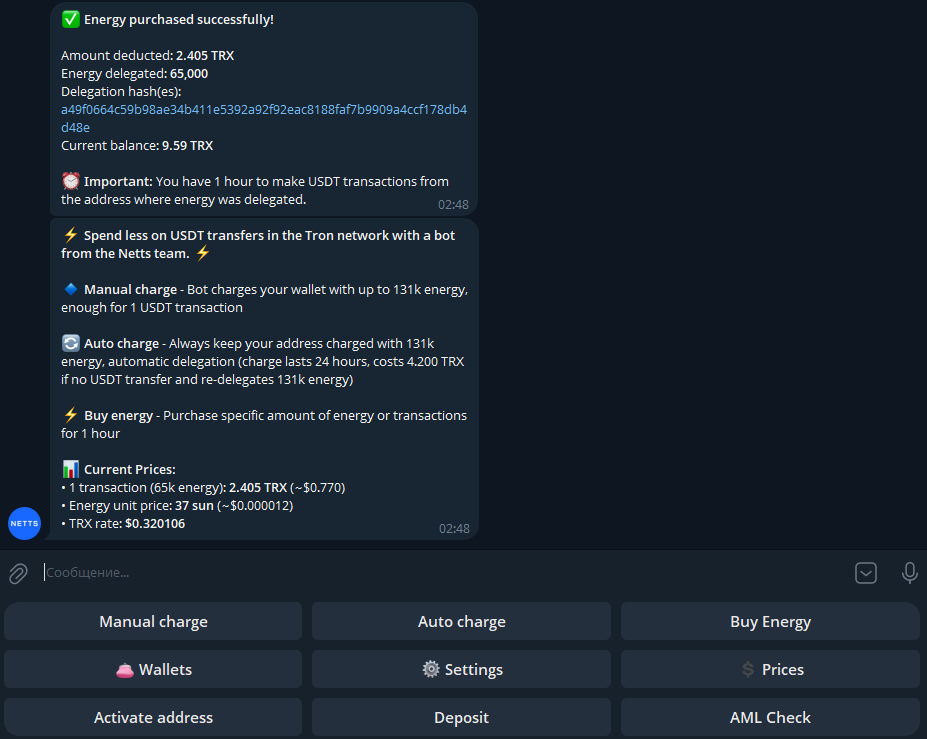
It’s always nice to discuss the ability to reach new levels of respectability within the ecosystem, but the reality is it’s the bottom layer of infrastructure which ultimately makes or breaks any practical adoption for the long-run. Netts Energy Charge Bot is yet another helpful on-chain utility for TRON users which seeks to simplify the tedious process of finding someone willing to charge you TRON Energy for conducting a USDT transfer. The bot allows for both manual and automatic charging as well as purchasing of 1-hour Energy packs. In the provided example, the user was charged 2.405 TRX for 65k Energy, which equals 37 sun per unit, while also having the option to set up an automatic recharge to maintain a 131k Energy buffer for a 24-hour cycle. For those uninterested in the narrative of financial freedom and only wanting to get their stablecoins moved cheaply and efficiently, TRON Energy refill, TRON fee reduction, and swift Energy delegation bots are what ultimately make the network’s infrastructure competitive beyond ideological chatter on the mempool level.