Bear Market in Crypto: Curse or Blessing?
Crypto bear markets punish hype, expose weak projects, scare retail, and sometimes create the entry points everyone wanted.

Everyone knows the perfect trade. Buy low, sell high. It’s such a simple sentence that it’s practically an insult. The problem is that no one rings a bell at “low” and no one throws a party at “high.” When it’s going up, high is just the beginning. When it’s going down, low looks suspiciously like a trapdoor.
That’s why bear markets are not really a price discovery mechanism. They’re a personality test with a side of money, on public display.
When the fear turns into panic, the bear awakens from his hibernation and begins to prowl the portfolio. Bitcoin, having enjoyed another round of institutional adoption and reached dizzying heights of absurdity, proved month after month that “digital gold” knows how to act like a risky asset. From the peak in 2025 to the recent low-$60,000 vicinity, the drop was nearly 50%, which is nothing to write home about in Bitcoin’s history but enough to remind everyone that volatility is still a core competency.
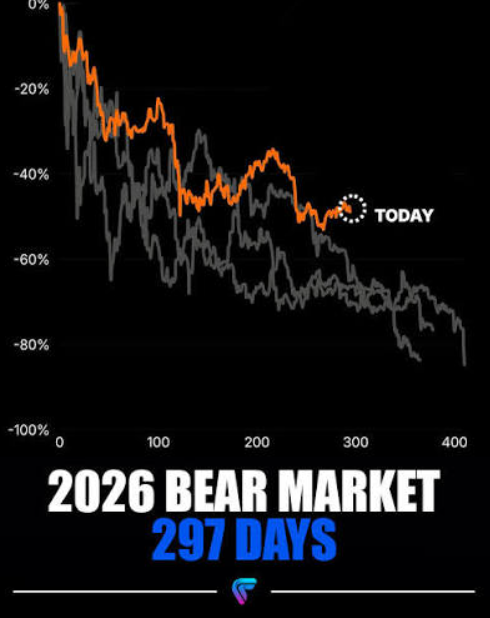
The scary thing about this particular bear market is that the panic seems to be coming from everywhere. Each cycle has its own particular narrative, but the script rarely changes: “healthy correction,” “buying opportunity,” “manipulation,” “macro pressures,” “crypto is dead,” and, eventually, “market is interesting again.” The latter often comes after enough people have given up and moved on.
Bear Does Not Knock
The recent selloff was not caused by a single factor, but rather a confluence of circumstances, each of which makes sense on its own.
Bitcoin ETF flows have been consistently negative in the US, with spot funds experiencing two consecutive days of outflows in August, and over $100M withdrawn in one session. Moves in bond yields and oil prices have also put pressure on risk assets in general, with traders rotating into AI and the broader equity market. Crypto’s self-importance aside, the sector has once again discovered that the global liquidity pool has a skeleton key.
Bitcoin’s proximity to $63,000 is not a problem in and of itself. It becomes one if one subscribed to the narrative that institutional adoption has made Bitcoin unidirectional. ETFs have made selling Bitcoin easier, more efficient, and less conspicuous. They have also made buying it easier, more efficient, and less conspicuous. A private individual may need to have his faith in crypto shaken before he can sell his coins. The portfolio manager only needs a model, a mandate, or a redemption request.
This is why the adoption of ETFs by institutional investors has been so confusing to everyone, including bulls. The latter desperately wanted the inflows because they represented institutional demand, but the outflows were equally difficult to rationalize. The reason was simple: institutional investors are large, but they are also systematic. They need to rebalance, take profits, and de-risk their positions. Their selling may be driven by nothing more sinister than a request from a money manager to reduce exposure by 2% because their risk model now considers Bitcoin a 25% asset. No one is wrong or malicious; money is just behaving like money.
Meanwhile, the crypto market’s corporate prophet has been selling Bitcoin. Strategy, Michael Saylor’s company, has been unloading Bitcoin in 2026 repeatedly, and with a degree of regularity that has not been characteristic of the firm’s treasury policy for years. The sales were relatively small, given the size of the company’s holdings, and were justified by Saylor as a response to treasury needs, preferred stock dividends, and the like. Still, every time the public face of Strategy sold some Bitcoin, it was as if the market had been expecting him to declare crypto dead.

It is not that Saylor has turned against his life’s work. It is that he has joined the long list of institutional investors who have discovered that in their quest for yield, they can become periodic sellers. Even the most enthusiastic proponents of on-chain value capture have to reckon with the realities of balance sheets, preferred dividends, and capital structure. As long as Strategy has committed to buying Bitcoin on any news, its selling has been a disappointment to some and a blessing to others.
Altcoin Graveyard
If Bitcoin is looking ugly, the rest of the market looks like a graveyard.
Solana is the most prominent example, as its ecosystem is reasonably deep, but the price is criminally low anyway. Trading around the mid-70s, the magic coin is both a barometer of risk appetite and a reminder of the things that could go wrong. Optimism prevails, so one reads about Solana’s throughput, consumer apps, DePIN, payments, memecoins, and an impending ETF listing. Pessimism prevails, so one remembers validator drama, memecoin liquidity, technical resistance, and the tendency of high-beta assets to distribute heavily when the liquidity tap is turned off.
The Altcoins Graveyard extends far beyond major protocols. There are long-tail projects that have been progressively discounting their on-chain narratives with each supply unlock. There are «infrastructure» protocols that provide little organic utility beyond their token mechanics. There are games with vaporized roadmaps, and there are AI «coins» that never actually built anything resembling artificial intelligence. The same could be said about every single industry vertical in the crypto economy: it is all filled with «Italian restaurants» that feature basil in their logo but have nothing to do with Italy.
The most heartbreaking aspect of the Altcoins Graveyard is the loss of social capital. Telegram channels that used to be read in real-time now resemble abandoned malls. Founders that used to share every partnership on-chain are increasingly tight-lipped. Community managers that used to hype every development update now discuss the same boring «building» and «long-term vision» as their counterparts in traditional venture capital. The chart looks bad, but the social metrics tell a more damning story since many altcoins have been partially or fully capitalized on the willingness of the community to continue believing in the project.
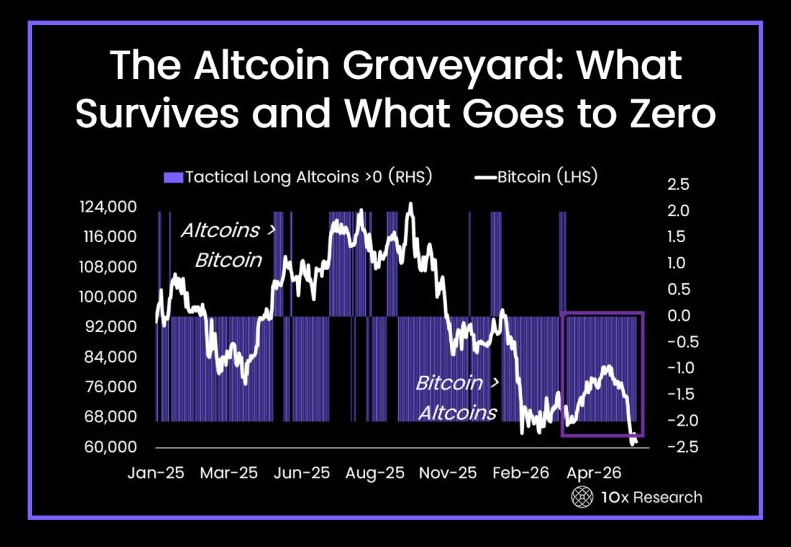
Bear markets are harsh judges of the crypto space because they take away the audience. In a bull market, everyone has a token; in a bear market, everyone has to defend their token’s narrative.
That brings us to the blessing aspect of the bear market. While no one is thrilled to see their tokens discounted by 80%, the brutal landscape does help separate the «projects» from the «ideas.» It cuts through the noise of the bull market season, punishing weak communities, governance theater, lazy tokenomics, and «founders» that only cared about the hype. A bear market strips away the «vision» and challenges everyone to actually build something valuable to the point where the product’s existence is questioned in the absence of financial incentives. It teaches users to care about costs and cashflows and makes them reevaluate the «utility» of every token purchased. In short, it removes fantasy and brings in reality, even if the price discovery process is far from accurate.
A bear market’s blessing comes with risks because it rarely differentiates between good and bad ideas. Liquidity is withdrawn from the entire system no matter what, which means the best teams suffer too. Product development grinds to a halt, protocol-owned liquidity burns tokens, and market makers trade against retail investors. Everyone is «disappointed,» but no one is willing to admit that the disappointment stems from losing control over the capital. A bear market exposes the «reality,» but that «reality» is rarely something everyone agrees upon.
BlackRock Smiles, Retail Sweats
The most fascinating contradiction of the current environment is that retail investors appear to be particularly crushed, while institutional investors seem to be surprisingly upbeat.
BlackRock has been one of the most consistent voices on the macro level, suggesting that Bitcoin has «merit as an asset class diversified away from traditional risk and return parameters,» while also noting that the «market has seen significant short-term volatility, but this is normal given the asset’s unique structure,» so «strategic allocations can be made with a long-term view.» Meanwhile, the everyday crypto Twitter is having an existential crisis, wondering if altcoins are already dead and if Bitcoin is something that can be owned by everyone.
Is there anyone sane enough to believe this is not manipulation? Of course, the practical application of the BlackRock wisdom may very well be to facilitate large-scale inflows in the Bitcoin «infrastructure» in the throes of the bear market. By publicly acknowledging that Bitcoin will eventually work as an asset class, BlackRock appears to be doing what all large asset managers do: generate «demand» for their products by convincing themselves and their clients that the said products are not garbage.
But there is a «dark side,» so to speak, of this particular brand of institutional commentary. BlackRock is one «large asset manager» out of many, and none of them talk to each other. Even if BlackRock’s true goal is to facilitate «strategic allocations» to crypto, such commentary could be interpreted by the paranoid retail investor as an attempt to create «demand» for the BlackRock crypto offerings specifically by generating «supply» of liquidity in the process. After all, there is no reason to believe that bullish commentary from a firm with billions of dollars in assets under management would not be used as a counterparty advantage over the unwitting retail investors seeking to buy Bitcoin futures.

The bear market makes everyone jaded, so it is challenging to discuss BlackRock’s intentions without resorting to outright conspiracy theories. The institutional investors are undoubtedly bullish on crypto, just like everyone else, but their «bullishness» is a euphemism for their willingness to buy crypto at any price with any reasonable expectation of returns in the medium-to-long term. Meanwhile, the retail investors perceive every bear market commentary as a «market manipulation attempt,» which it often is, if only on a psychological level. There is truth on both sides since BlackRock does not «secretly» want Bitcoin to succeed - it wants to be «relevant,» and the most obvious way to achieve «relevance» in crypto is to build products and infrastructure.
But the «relevance» is a self-indulgent delusion because BlackRock’s commentary rarely extends beyond the «fundamentals» of crypto assets. If BlackRock genuinely believed that Bitcoin was a «superior asset,» why would it comment on «fundamentals» at all? Why would it not be openly bullish the way private equity firms are openly bullish on the crypto market’s long-term prospects? Why would it dedicate an entire research note to the «bitcoin advantage» when Wall Street already knew that the «bitcoin advantage» existed long before anyone outside of crypto Twitter had ever heard of Bitcoin? The answer is that BlackRock is not wrong, per se, but it certainly has incentives to pretend it is. The «bitcoin advantage» is a way to differentiate itself in the competitive institutional finance space while simultaneously convincing investors that crypto is an asset class they can actually «understand.» In short, BlackRock’s «optimism» is a skillful combination of genuine insight and «fundamental analysis», but it hides the uncomfortable truth that institutional investors rarely care about anything crypto-related beyond the «risk-return parameters.»
That is the most «useful» aspect of the BlackRock commentary, I think, and the reason why this particular article is being written. BlackRock knows that institutional investors are not interested in crypto’s «vision» and «potential,» just like the «risk-return parameters» barely extend beyond their willingness to buy Bitcoin «funds.» But in the minds of ordinary investors, those fund «risks» are converted into «certainties» in direct proportion to how eager they are to «buy Bitcoin.» This is where the «institutional commentary» becomes weaponized against the retail investors. The institutional investors are not wrong to believe that crypto will eventually «work» as an asset class, but they rarely admit that their «belief» is nothing more than a convenient way to acquire funding in a competitive market. Meanwhile, the retail investors are not wrong to suspect that the institutional commentary is always designed to manipulate the market, but they rarely «realize» that it is a convenient way to justify their own actions during a bear market.
The ETF «rotation» is a perfect demonstration of the concept. Bitcoin «funds» have been seeing heavy redemption, while Ether and Solana «products» have been seeing inflows, suggesting that institutional investors are rotating their risk within the crypto space rather than «leaving it altogether.» This could be construed as «evidence» that institutions are bullish on Bitcoin, but the «evidence» ignores the inconvenient fact that institutional investors rarely hold Bitcoin in isolation in the first place. At the most basic level, ETF «rotation» is a «risk parity» move because Bitcoin represents less risk within the crypto ecosystem than Ether and Solana. At the deeper level, it is a recognition that Bitcoin has a «wider appeal,» but it has «limited supply,» and the «supply» is the reason why institutional investors prefer leveraged products in the first place.
Psychology of the Dip
The online discourse about the market «dip» is a curious spectacle in that it almost always features the same boring arguments. One group believes that crypto is «dead,» and they are absolutely convinced that it will never recover. They are tired of believing in «narratives,» they bought the «vision,» and they watched as AI stocks took all the momentum, leaving the crypto market with nothing to do. So, they are announcing their «death,» with a mix of existential dread and dark humor, stating that crypto is «dead, finished, over, etc.,» and all the social sentiment analysis tools are currently tracking this specific «language pattern.» Another group believes that crypto is «not dead» and is ready to «buy the dip.» They are calling it «DCA,» the «emotionless accumulation,» and they are discussing «buying the end of the bear market» as if it were a weather forecast. The third group is «waiting for a lower price» and talking about «$58k is way better than $70k,» etc. But the «lower price» is $50k to them, and then $40k and so on. They are hoping that at some point, the news will stop being negative, but they know that at some point, fear will turn into «buying the dip.» The bear market «opportunity» is always available, except that it rarely comes in the «convenient spot».
The fourth group is made up of those who are «arguing with ghosts.» They are telling everyone that they were «right» to panic sell because their «friend» insisted on «buying the top,» while their «investor» told them to «take profits.» The «dip» is not an opportunity to «collect the pieces» of the crypto market, it is a painful reminder that they believed their «friend» back then, and now their «investor» is asking for «advice» in crypto Twitter. The bear market is not only filled with financial regret but also the existential dread of realizing that one was not always right. There are no «crypto prophets» during a bear market, only regular people who are trying to buy something at a «reasonable price.» There are no «visionaries» during a bear market, only those who are «hoping» to have visionaries to buy from.
There is the fifth group of people who realize all of the above and are «done pretending.» They are admitting that they have «just been dumb» and «panicked sold their altcoins» and «used too much leverage» and «followed influencers.» This group is probably the healthiest one because it realizes that the «dumb individual behaviors» are what got them in this position, but it will not change anything right away since most «behaviors» are hard to stop even when «admitted.» A bear market «education» rarely comes fast and is usually painful, but it also lasts significantly shorter than the euphoria during bull markets.
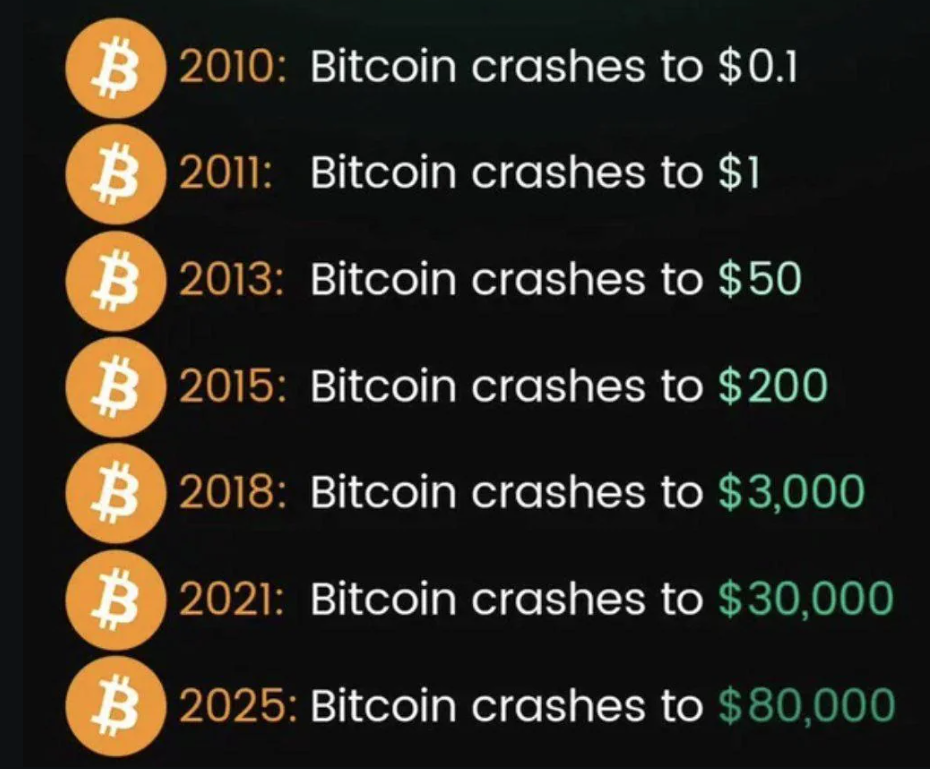
The fear has «side effects,» too. Product development slows down, exchange «advertising» budgets get cut, influencers get boring, venture capital «fund allocation» gets reviewed, and founders who raised money at «unbelievable valuations» reevaluate everything. Users get suspicious, regulators get «excited,» families get «sad,» and the «loud mouths» of the bull market get quiet, while the «quiet minds» of the bull market get louder. This is an «expected» outcome, really, of one of the «inevitable» bear markets, but the «inevitability» does not stop anyone from being disappointed. Everyone «had such high hopes» before the bear market, after all, and no one wanted to admit that they believed in «narratives,» just like the proponents of the «cryptocurrency bubble» claimed all along.
Crypto is far from «dead,» of course, for «almost every bear market in history» ended up being «the longest one ever.» It is difficult to believe that the cryptocurrency market «died» after every major «death cross» in the history of Bitcoin, but it «very much did» every time. Less than two decades ago, the cryptocurrency market «existed,» more or less, and now it has already been through several «crash cycles.» The «fear of the bear market» is always overblown, and the «hopes of the bull market» are always too high, but the «reality check» serves a critical function by separating the «visionaries» from the «speculators» and cutting through the noise. The market «education» is not as «fun» as it sounds, but it is an «essential» part of any investment journey, including crypto. The most important takeaway of the bear market is that one rarely knows what «low» really means before it becomes a «high.»
Curse or Blessing?
A bear market is a curse if one needed the liquidity to pay rent. It is a curse if one was long on leverage, late on buying, or had weak beliefs in the project’s fundamentals. It is a curse if one had to raise capital due to «unexpected circumstances» and a «change in the market environment.» It is a curse for everyone who thought that crypto was going to «normalize,» or normalize «enough.»
However, a bear market is a blessing in disguise for the market itself, as it filters out the «noise» and creates a «clear(er) picture» of what actually matters. It penalizes the «speculators,» rewarding the «visionaries,» and introducing healthy skepticism against every «revolutionary idea,» no matter how big the promised «vision» was. It lowers valuations, reduces hype, decreases the supply of «would-be influencers,» and, most importantly, reminds everyone that «volatility» is an «inherent characteristic» of the asset class and not some «disadvantage» that «markets» or «exchanges» somehow «added.» The hardest question to ask oneself during a bear market is the «lowest possible bottom» scenario, and if one could realistically «know», or at least «have enough information to be certain.» The answer, obviously, is «no.» The market will always surprise people in both directions, punishing those who acted «too soon» while rewarding those who acted «late enough.» But the «late enough» is rarely «late,» really, and most «speculators» only realize their folly when it is «already too late.» That is the «blessing» of the bear market - the «stupidity» of the «speculators» is rarely rewarded.
A bear market is always a «curse» for the «wrong» people, but it rarely lasts forever.
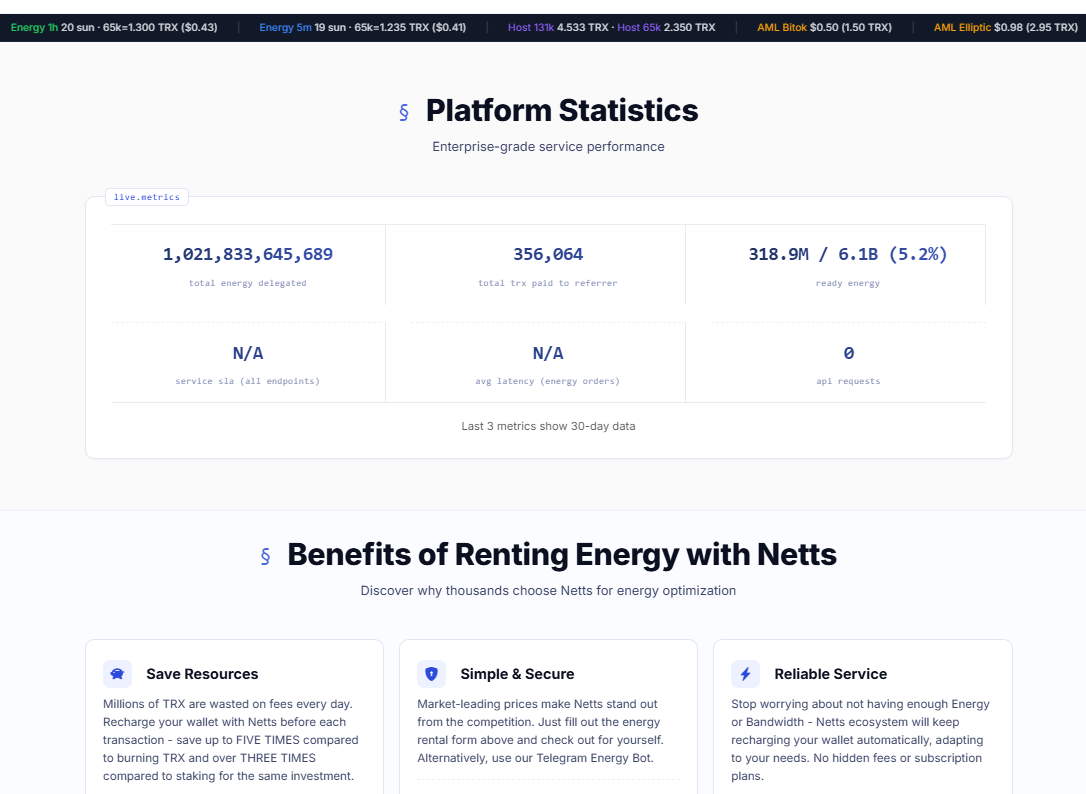
And for as long as users grapple with the bottom of the market and the market struggles to reach a bottom, it is always more practical to think about ways to save as opposed to empty proclamations. Netts.io allows users to rent Energy for USDT transfers on Tron as a TRON Energy aggregator, where users can purchase TRON Energy, find the cheapest TRON Energy, and make USDT transactions with reduced TRX consumption instead of wasting money on unnecessary gas fees. After all, nothing is as important as the smallest details during a bear market.